Günzel Karsten, Cash Hannes, Buckendahl John, Königbauer Maximilian, Asbach Patrick, Haas Matthias, Neymeyer Jörg, Hinz Stefan, Miller Kurt, Kempkensteffen Carsten
Department of Urology, Charité - University Medicine Berlin, Hindenburgdamm 30, 12203, Berlin, Germany.
Departement of Radiology, Charité - University Medicine Berlin, Hindenburgdamm 30, 12203, Berlin, Germany.
BMC Urol. 2017 Jan 13;17(1):7. doi: 10.1186/s12894-016-0196-9.
To explore the diagnostic benefit of an additional image fusion of the sagittal plane in addition to the standard axial image fusion, using a sensor-based MRI/US fusion platform.
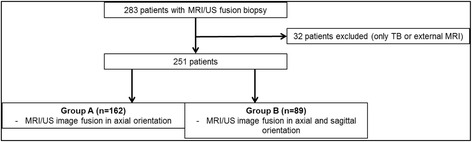
During July 2013 and September 2015, 251 patients with at least one suspicious lesion on mpMRI (rated by PI-RADS) were included into the analysis. All patients underwent MRI/US targeted biopsy (TB) in combination with a 10 core systematic prostate biopsy (SB). All biopsies were performed on a sensor-based fusion system. Group A included 162 men who received TB by an axial MRI/US image fusion. Group B comprised 89 men in whom the TB was performed with an additional sagittal image fusion.
The median age in group A was 67 years (IQR 61-72) and in group B 68 years (IQR 60-71). The median PSA level in group A was 8.10 ng/ml (IQR 6.05-14) and in group B 8.59 ng/ml (IQR 5.65-12.32). In group A the proportion of patients with a suspicious digital rectal examination (DRE) (14 vs. 29%, p = 0.007) and the proportion of primary biopsies (33 vs 46%, p = 0.046) were significantly lower. The rate of PI-RADS 3 lesions were overrepresented in group A compared to group B (19 vs. 9%; p = 0.044). Classified according to PI-RADS 3, 4 and 5, the detection rates of TB were 42, 48, 75% in group A and 25, 74, 90% in group B. The rate of PCa with a Gleason score ≥7 missed by TB was 33% (18 cases) in group A and 9% (5 cases) in group B; p-value 0.072. An explorative multivariate binary logistic regression analysis revealed that PI-RADS, a suspicious DRE and performing an additional sagittal image fusion were significant predictors for PCa detection in TB. 9 PCa were only detected by TB with sagittal fusion (sTB) and sTB identified 10 additional clinically significant PCa (Gleason ≥7).
Performing an additional sagittal image fusion besides the standard axial fusion appears to improve the accuracy of the sensor-based MRI/US fusion platform.
使用基于传感器的MRI/US融合平台,探讨除标准轴向图像融合外,增加矢状面图像融合的诊断益处。
在2013年7月至2015年9月期间,纳入251例在mpMRI上至少有一个可疑病变(根据PI-RADS评级)的患者进行分析。所有患者均接受了MRI/US靶向活检(TB)及10针系统前列腺活检(SB)。所有活检均在基于传感器 的融合系统上进行。A组包括162名通过轴向MRI/US图像融合接受TB的男性。B组包括89名在TB时进行了额外矢状面图像融合的男性。
A组的中位年龄为67岁(IQR 61-72),B组为68岁(IQR 60-71)。A组的中位PSA水平为8.10 ng/ml(IQR 6.05-14),B组为8.59 ng/ml(IQR 5.65-12.32)。A组中直肠指检(DRE)可疑的患者比例(14%对29%,p = 0.007)和初次活检比例(33%对46%,p = 0.046)显著较低。与B组相比,A组中PI-RADS 3类病变的比例过高(19%对9%;p = 0.044)。根据PI-RADS 3、4和5分类,A组TB的检出率分别为42%、48%、75%,B组分别为25%、74%、90%。A组TB漏诊的Gleason评分≥7的前列腺癌(PCa)比例为33%(18例),B组为9%(5例);p值0.072。一项探索性多变量二元逻辑回归分析显示,PI-RADS、DRE可疑以及进行额外的矢状面图像融合是TB中PCa检测的重要预测因素。9例PCa仅通过矢状面融合TB(sTB)检测到,sTB还发现了另外10例具有临床意义的PCa(Gleason≥7)。
除标准轴向融合外,增加矢状面图像融合似乎可提高基于传感器的MRI/US融合平台的准确性。