Quan Rong, Zhu Shanshan, Wei Li, Wang Jing, Yan Xu, Li Zixuan, Liu Jue
Beijing Key Laboratory for Prevention and Control of Infectious Diseases in Livestock and Poultry, Institute of Animal Husbandry and Veterinary Medicine, Beijing Academy of Agriculture and Forestry Sciences, No. 9 Shuguang Garden Middle Road, Haidian District, Beijing, 100097, People's Republic of China.
Virol J. 2017 Jan 13;14(1):7. doi: 10.1186/s12985-016-0668-2.
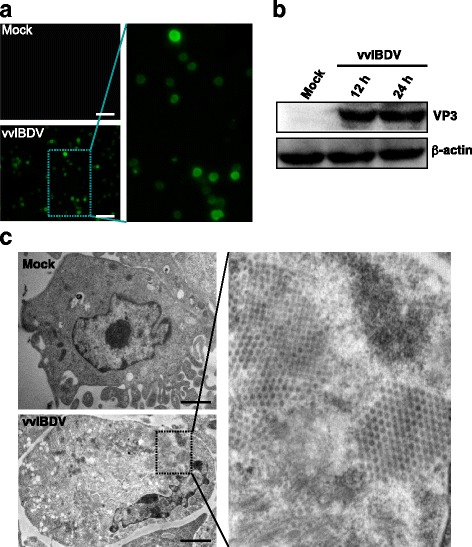
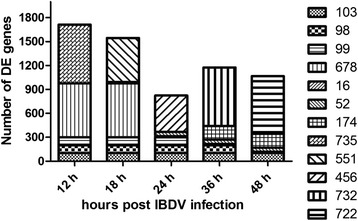
Infectious bursal disease virus (IBDV) causes a highly contagious, immunosuppressive disease in chickens. The virus mainly infects immature B lymphocytes in the bursa of Fabricius (BF). Chicken B cell line DT40, an avian leukosis virus-induced B cell line, supports very virulent IBDV (vvIBDV) infection in vitro and thereby serves as a good model for investigating the infection and pathogenesis of this virus. However, a transcriptome-wide understanding of the interaction between vvIBDV and B cells has not yet been achieved. This study aimed to employ time-course DNA microarrays to investigate gene expression patterns in DT40 cells after infection with vvIBDV strain LX.
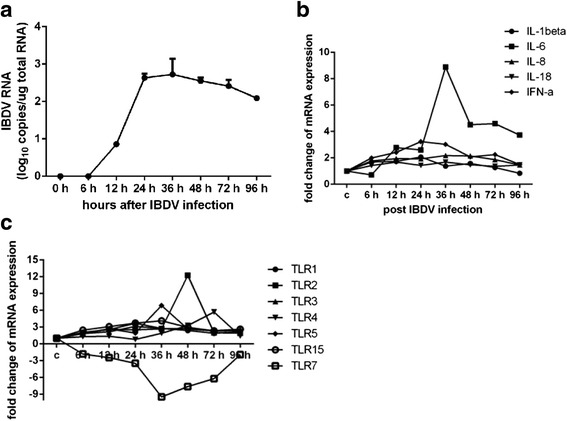
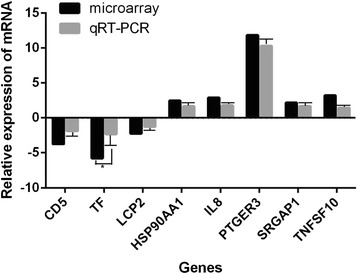
DT40 cells infected with vvIBDV exhibited alterations in the expression of many important host genes involved in signal transduction pathways, including MAPK signaling, PI3K/mTOR signaling, cell death and survival, BCR signaling, and antigen presentation. The changes in cellular mRNA levels identified by microarray analysis were confirmed for 8 selected genes using real-time reverse transcription-PCR. The upregulation of inflammatory cytokines and Toll-like receptors (TLRs) in the bursa of vvIBDV-infected chickens might involve excessive activation of the innate immune and inflammatory responses and contribute to tissue damage.
The present study is the first to provide a comprehensive differential transcriptional profile of cultured DT40 cells in response to vvIBDV infection and further extends our understanding of the molecular mechanisms underlying vvIBDV infection and pathogenesis.
传染性法氏囊病病毒(IBDV)可在鸡群中引发一种高度传染性的免疫抑制性疾病。该病毒主要感染法氏囊(BF)中未成熟的B淋巴细胞。鸡B细胞系DT40是一种禽白血病病毒诱导的B细胞系,能在体外支持超强毒IBDV(vvIBDV)感染,因此是研究该病毒感染和发病机制的良好模型。然而,尚未实现对vvIBDV与B细胞相互作用的全转录组理解。本研究旨在利用时间进程DNA微阵列研究DT40细胞在感染vvIBDV毒株LX后的基因表达模式。
感染vvIBDV的DT40细胞在参与信号转导途径的许多重要宿主基因表达上出现改变,这些途径包括丝裂原活化蛋白激酶(MAPK)信号传导、磷脂酰肌醇-3激酶/哺乳动物雷帕霉素靶蛋白(PI3K/mTOR)信号传导、细胞死亡与存活、B细胞受体(BCR)信号传导以及抗原呈递。通过微阵列分析确定的细胞mRNA水平变化,利用实时逆转录聚合酶链反应(real-time reverse transcription-PCR)对8个选定基因进行了验证。vvIBDV感染鸡的法氏囊中炎性细胞因子和Toll样受体(TLRs)的上调可能涉及固有免疫和炎性反应的过度激活,并导致组织损伤。
本研究首次提供了培养的DT40细胞对vvIBDV感染的全面差异转录谱,进一步拓展了我们对vvIBDV感染和发病机制潜在分子机制的理解。