Felippe Mariana Rhein, Zambon Joao Paulo, Girotti Marcia Eli, Burti Juliana Schulze, Hacad Claudia Rosenblatt, Cadamuro Lina, Almeida Fernando
Department of Urology, University of Sao Paulo, Sao Paulo, Brazil.
Institute of Regenerative Medicine, Wake Forest University, Winston-Salem, North Carolina.
Sex Med. 2017 Mar;5(1):e54-e60. doi: 10.1016/j.esxm.2016.09.001. Epub 2017 Jan 10.
Urinary incontinence (UI) has been associated with negative effects on women's sexuality. Women's sexuality and sexual function are a complex issue, and the role of UI is not completely clear.
To assess the impact of UI on female sexual function by comparing this population with a control group of continent women.
We performed a case-control study from August 2012 to September 2013. We evaluated continent and incontinent women (age range = 30-70 years) for their sexuality.
All patients were evaluated by anamnesis, physical examination, and self-report quality-of-life questionnaires. In addition, incontinent women underwent a 1-hour pad test. Patients without sexual activity were evaluated for the role of UI in their sexual abstinence. Sexual abstinence was defined as the absence of sexual activity for more than 6 months. All sexually active women completed the self-report Sexuality Quotient-Female Version (SQ-F) questionnaire.
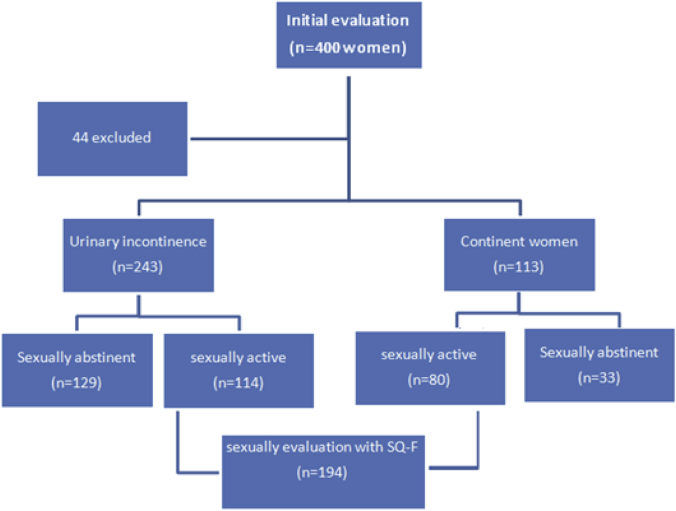
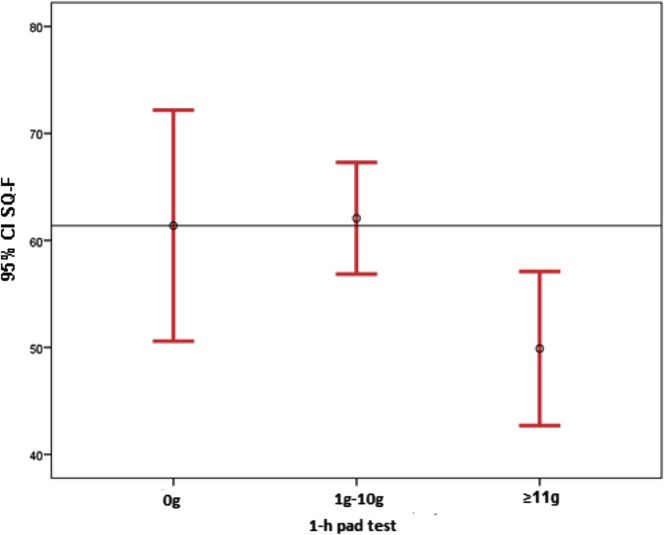
A total of 356 women were included in the study (incontinent, n = 243; continent, n = 113). Sexual abstinence was found in 162 women (45%). Incontinent women presented a higher prevalence (P < .001) of sexual abstinence than their counterparts (129 [53%] and 33 [29.2%], respectively). Age, marital status, and UI were found to be isolated predictive factors for more sexual abstinence in incontinent women. Sexually active women (incontinent, n = 114; continent, n = 80) presented similar demographic data. Despite a similar frequency of sexual activity, incontinent women had less sexual desire, foreplay, harmony with a partner, sexual comfort, and sexual satisfaction than their counterparts. Women with greater urinary leakage during the 1-hour pad test (weight > 11 g) had the worst sexual function (SQ-F) score.
Women with UI were more likely to be sexual abstinent than continent women. Furthermore, women with UI showed less sexual desire, sexual comfort, and sexual satisfaction than their counterparts despite having a similar frequency of sexual activity.
尿失禁(UI)已被证实会对女性性功能产生负面影响。女性的性与性功能是一个复杂的问题,尿失禁在其中所起的作用尚不完全明确。
通过将尿失禁女性群体与尿控正常的女性对照组进行比较,评估尿失禁对女性性功能的影响。
我们在2012年8月至2013年9月期间开展了一项病例对照研究。我们对尿控正常和尿失禁的女性(年龄范围 = 30 - 70岁)的性功能进行了评估。
所有患者均通过问诊、体格检查和自我报告的生活质量问卷进行评估。此外,尿失禁女性还进行了1小时的尿垫试验。对无性活动的患者评估尿失禁在其性禁欲中的作用。性禁欲定义为无性生活超过6个月。所有有性活动的女性均完成了自我报告的《性商 - 女性版》(SQ - F)问卷。
共有356名女性纳入研究(尿失禁组,n = 243;尿控正常组,n = 113)。162名女性(45%)存在性禁欲情况。尿失禁女性的性禁欲患病率高于对照组(分别为129例[53%]和33例[29.2%],P <.001)。年龄、婚姻状况和尿失禁被发现是尿失禁女性性禁欲增加的独立预测因素。有性活动的女性(尿失禁组,n = 114;尿控正常组,n = 80)呈现出相似的人口统计学数据。尽管性活动频率相似,但尿失禁女性的性欲、前戏、与伴侣的和谐度、性舒适度和性满意度均低于对照组。在1小时尿垫试验中漏尿量较大(重量 > 11 g)的女性性功能(SQ - F)得分最差。
与尿控正常的女性相比,尿失禁女性更易出现性禁欲。此外,尽管尿失禁女性与对照组的性活动频率相似,但其性欲、性舒适度和性满意度均较低。