Kulaylat Afif N, Qin Danni, Sun Susie X, Hollenbeak Christopher S, Schubart Jane R, Aboud Antone J, Flemming Donald J, Dillon Peter W, Bollard Edward R, Han David C
Department of Surgery, The Pennsylvania State University, College of Medicine, P.O. Box 850, 500 University Drive, H137, Hershey, PA, 17033-0850, USA.
School of Labor and Employment Relations, The Pennsylvania State University, University Park, PA, USA.
BMC Med Educ. 2017 Jan 14;17(1):14. doi: 10.1186/s12909-016-0853-4.
Mistreatment of trainees remains a frequently reported phenomenon in medical education. One barrier to creating an educational culture of respect and professionalism may be a lack of alignment in the perceptions of mistreatment among different learners. Through the use of clinical vignettes, our aim was to assess the perceptions of trainees toward themes of potential mistreatment at different stages of training.
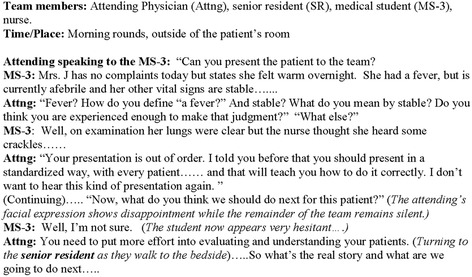
Based on observations from external experts embedded in the clinical learning environment, six thematic areas of potential mistreatment were identified: verbal abuse, specialty-choice discrimination, non-educational tasks, withholding/denying learning opportunities, neglect and gender/racial insensitivity. Corresponding clinical vignettes were created and distributed to 1) medical students, 2) incoming interns, 3) residents/fellows. Perceptions of the appropriateness of the interactions depicted in the vignettes were measured on a 5-point Likert scale. Scores were categorized into neutral or appropriate (≤3) or inappropriate (i.e. mistreatment) (>3) and compared using chi-squared tests.
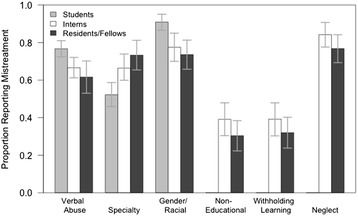
Four hundred twenty seven trainees participated (182 students, 120 interns, 125 residents/fellows). Proportions of students perceiving mistreatment differed significantly from those of interns and residents/fellows in domains of verbal abuse, specialty discrimination and gender/racial insensitivity (p < 0.05). In scenarios comparing interns to residents/fellows, no significant differences were noted in perceptions of mistreatment in the domains of non-educational tasks, withholding learning and neglect.
Perceptions of mistreatment differ at different developmental stages of medical training. After exposure to the clinical learning environment, perceptions of incoming interns did not differ from those of residents/fellows, implicating clinical rotations as a key period in indoctrinating students into the prevailing culture. More longitudinal studies are needed to confirm or better examine this phenomenon.
在医学教育中,学员遭受不当对待仍是一个经常被报道的现象。营造一种尊重和专业精神的教育文化的一个障碍可能是不同学习者对不当对待的认知缺乏一致性。通过使用临床案例,我们的目的是评估学员在培训不同阶段对潜在不当对待主题的认知。
基于融入临床学习环境的外部专家的观察,确定了潜在不当对待的六个主题领域:言语虐待、专业选择歧视、非教育性任务、扣留/拒绝学习机会、忽视以及性别/种族不敏感。创建了相应的临床案例并分发给:1)医学生,2)新入职实习生,3)住院医师/研究员。案例中所描述互动的适当性认知通过5点李克特量表进行测量。分数被分为中性或适当(≤3)或不适当(即不当对待)(>3),并使用卡方检验进行比较。
427名学员参与了研究(182名医学生,120名实习生,125名住院医师/研究员)。在言语虐待、专业歧视和性别/种族不敏感领域,认为存在不当对待的学生比例与实习生和住院医师/研究员的比例有显著差异(p < 0.05)。在比较实习生与住院医师/研究员的情景中,在非教育性任务、扣留学习机会和忽视领域的不当对待认知方面未发现显著差异。
在医学培训的不同发展阶段,对不当对待的认知存在差异。在接触临床学习环境后,新入职实习生的认知与住院医师/研究员的认知没有差异,这表明临床轮转是将学生灌输到主流文化中的关键时期。需要更多的纵向研究来证实或更好地研究这一现象。