Goldberg David, Ditah Ivo C, Saeian Kia, Lalehzari Mona, Aronsohn Andrew, Gorospe Emmanuel C, Charlton Michael
Division of Gastroenterology, Department of Medicine, University of Pennsylvania, Philadelphia, Pennsylvania; Department of Biostatistics and Epidemiology, Perelman School of Medicine at the University of Pennsylvania, Philadelphia, Pennsylvania; Leonard Davis Institute of Health Economics, University of Pennsylvania Philadelphia, Pennsylvania.
Division of Gastroenterology and Hepatology, Regions Hospital, St Paul, Minnesota.
Gastroenterology. 2017 Apr;152(5):1090-1099.e1. doi: 10.1053/j.gastro.2017.01.003. Epub 2017 Jan 11.
BACKGROUND & AIMS: Concurrent to development of more effective drugs for treatment of hepatitis C virus (HCV) infection, there has been an increase in the incidence of nonalcoholic fatty liver disease. Data indicate that liver transplantation prolongs survival times of patient with acute hepatitis associated with alcoholic liver disease (ALD). We compared data on disease prevalence in the population with data from liver transplantation waitlists to evaluate changes in the burden of liver disease in the United States.
We collected data on the prevalence of HCV from the 2010 and 2013-2014 cycles of the National Health and Nutrition Examination Survey. We also collected data from the HealthCore Integrated Research Database on patients with cirrhosis and chronic liver failure (CLF) from 2006 through 2014, and data on patients who received transplants from the United Network for Organ Sharing from 2003 through 2015. We determined percentages of new waitlist members and transplant recipients with HCV infection, stratified by indication for transplantation, modeling each calendar year as a continuous variable using the Spearman rank correlation, nonparametric test of trends, and linear regression models.
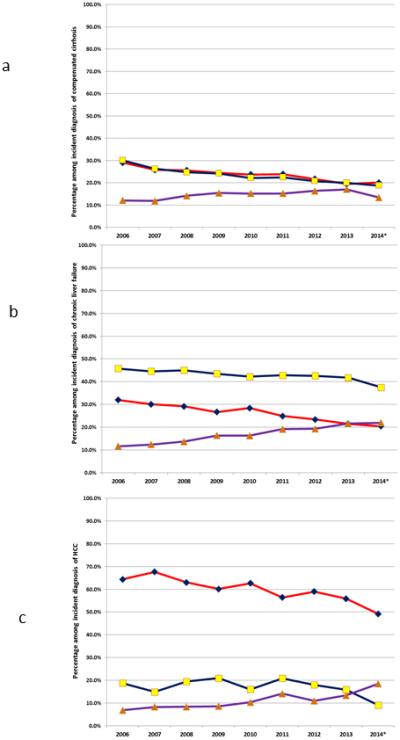
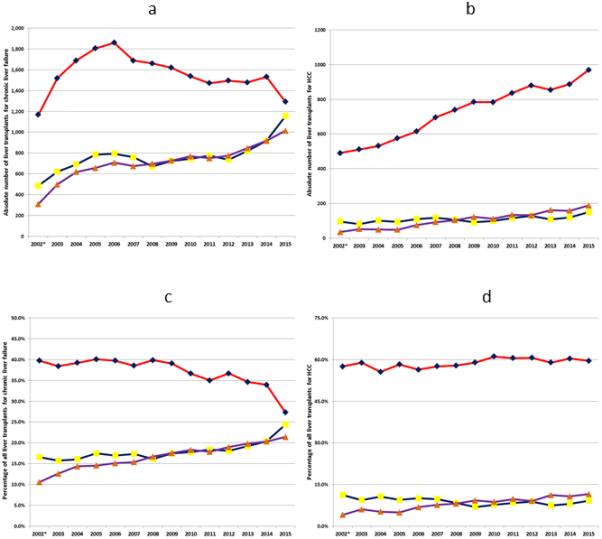
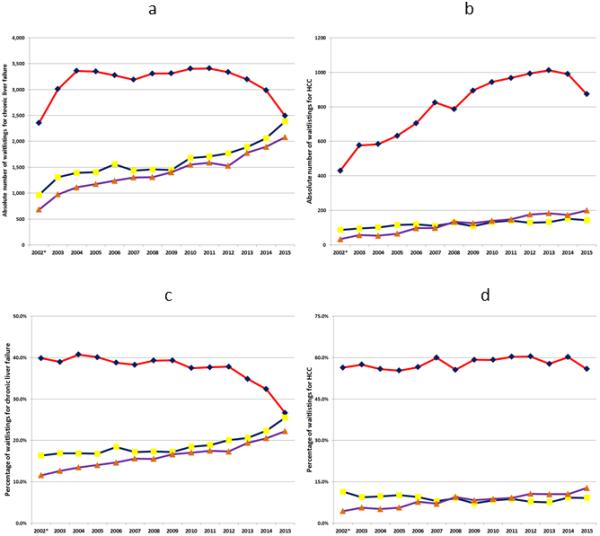
In an analysis of data from the National Health and Nutrition Examination Survey (2013-2014), we found that the proportion of patients with a positive HCV antibody who had a positive HCV RNA was 0.5 (95% confidence interval, 0.42-0.55); this value was significantly lower than in 2010 (0.64; 95% confidence interval, 0.59-0.73) (P = .03). Data from the HealthCore database revealed significant changes (P < .05 for all) over time in percentages of patients with compensated cirrhosis (decreases in percentages of patients with cirrhosis from HCV or ALD, but increase in percentages of patients with cirrhosis from nonalcoholic steatohepatitis [NASH]), CLF (decreases in percentages of patients with CLF from HCV or ALD, with an almost 3-fold increase in percentage of patients with CLF from NASH), and hepatocellular carcinoma (HCC) (decreases in percentages of patients with HCC from HCV or ALD and a small increase in HCC among persons with NASH). Data from the United Network for Organ Sharing revealed that among patients new to the liver transplant waitlist, or undergoing liver transplantation, for CLF, there was a significant decrease in the percentage with HCV infection and increases in percentages of patients with nonalcoholic fatty liver disease or ALD. Among patients new to the liver transplant waitlist or undergoing liver transplantation for HCC, proportions of those with HCV infection, nonalcoholic fatty liver disease, or ALD did not change between 2003 and 2015.
In an analysis of 3 different databases (National Health and Nutrition Examination Survey, HealthCore, and United Network for Organ Sharing), we found the proportion of patients on the liver transplant waitlist or undergoing liver transplantation for chronic HCV infection to be decreasing and fewer patients to have cirrhosis or CLF. However, the percentages of patients on the waitlist or receiving liver transplants for NASH or ALD are increasing, despite different relative burdens of disease among the entire population of patients with cirrhosis.
在研发更有效的丙型肝炎病毒(HCV)感染治疗药物的同时,非酒精性脂肪性肝病的发病率有所上升。数据表明,肝移植可延长酒精性肝病(ALD)相关急性肝炎患者的生存期。我们将人群中的疾病患病率数据与肝移植等待名单的数据进行比较,以评估美国肝病负担的变化。
我们收集了2010年以及2013 - 2014年周期的美国国家健康与营养检查调查中HCV患病率的数据。我们还从HealthCore综合研究数据库收集了2006年至2014年肝硬化和慢性肝衰竭(CLF)患者的数据,以及2003年至2015年器官共享联合网络中接受移植患者的数据。我们确定了新加入等待名单成员和HCV感染移植受者的百分比,按移植指征分层,将每个日历年作为连续变量,使用Spearman等级相关性、非参数趋势检验和线性回归模型进行分析。
在对美国国家健康与营养检查调查(2013 - 2014年)数据的分析中,我们发现HCV抗体阳性且HCV RNA阳性的患者比例为0.5(95%置信区间,0.42 - 0.55);该值显著低于2010年(0.64;95%置信区间,0.59 - 0.73)(P = 0.03)。HealthCore数据库的数据显示,随着时间推移,代偿期肝硬化患者百分比(HCV或ALD所致肝硬化患者百分比下降,但非酒精性脂肪性肝炎[NASH]所致肝硬化患者百分比增加)、CLF患者百分比(HCV或ALD所致CLF患者百分比下降,NASH所致CLF患者百分比几乎增加3倍)以及肝细胞癌(HCC)患者百分比(HCV或ALD所致HCC患者百分比下降,NASH患者中HCC略有增加)均有显著变化(所有P < 0.05)。器官共享联合网络的数据显示,在新加入肝移植等待名单或因CLF接受肝移植的患者中,HCV感染患者百分比显著下降,非酒精性脂肪性肝病或ALD患者百分比增加。在新加入肝移植等待名单或因HCC接受肝移植的患者中,2003年至2015年期间,HCV感染、非酒精性脂肪性肝病或ALD患者的比例没有变化。
通过对3个不同数据库(美国国家健康与营养检查调查、HealthCore和器官共享联合网络)的分析,我们发现肝移植等待名单上或因慢性HCV感染接受肝移植的患者比例在下降,肝硬化或CLF患者减少。然而,尽管在整个肝硬化患者群体中疾病的相对负担不同,但因NASH或ALD等待名单上或接受肝移植的患者百分比在增加。