Sluchanko Nikolai N, Beelen Steven, Kulikova Alexandra A, Weeks Stephen D, Antson Alfred A, Gusev Nikolai B, Strelkov Sergei V
Laboratory of Structural Biochemistry of Proteins, A.N. Bach Institute of Biochemistry, Federal Research Center "Fundamentals of Biotechnology", Russian Academy of Sciences, 119071 Moscow, Russia.
Laboratory for Biocrystallography, Department of Pharmaceutical and Pharmacological Sciences, KU Leuven, 3000 Leuven, Belgium.
Structure. 2017 Feb 7;25(2):305-316. doi: 10.1016/j.str.2016.12.005. Epub 2017 Jan 12.
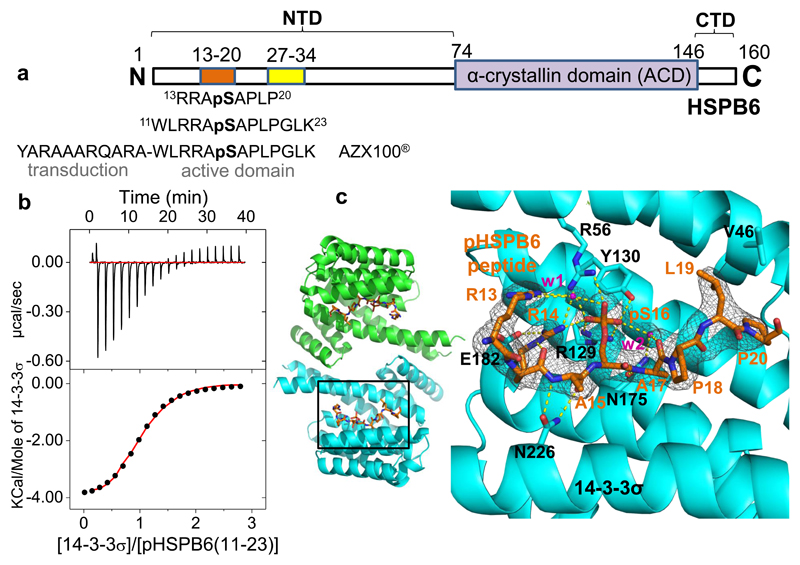
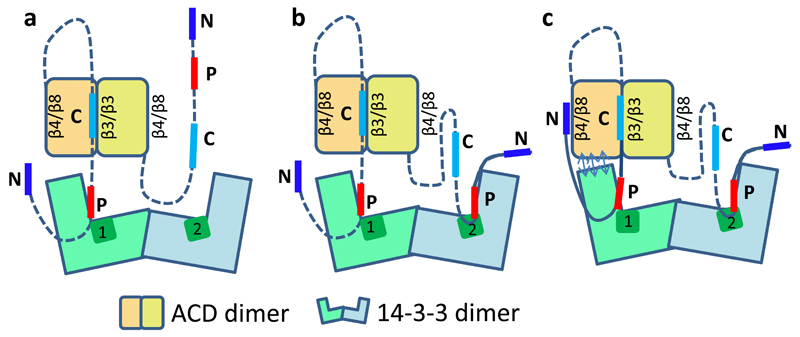
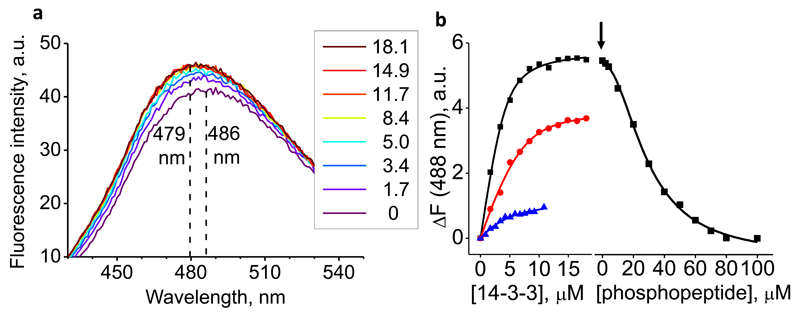
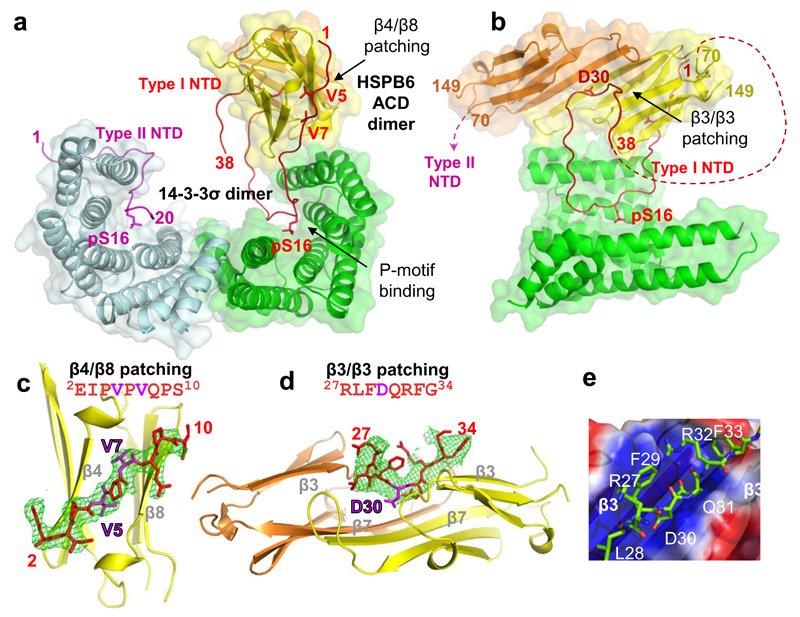
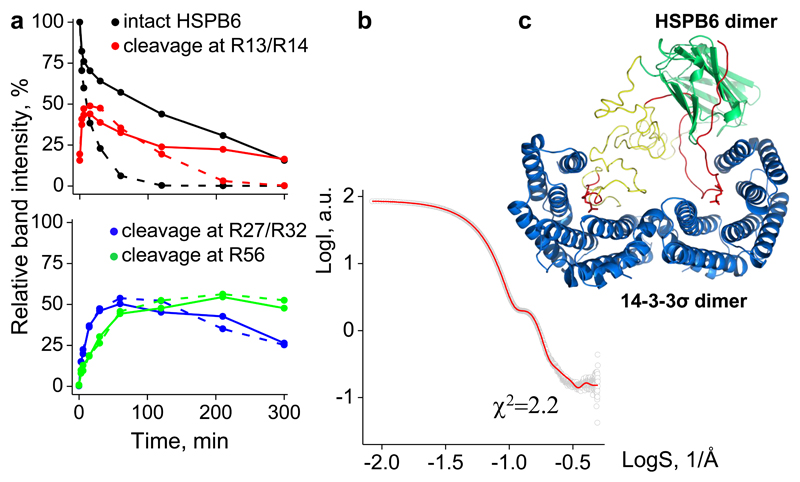
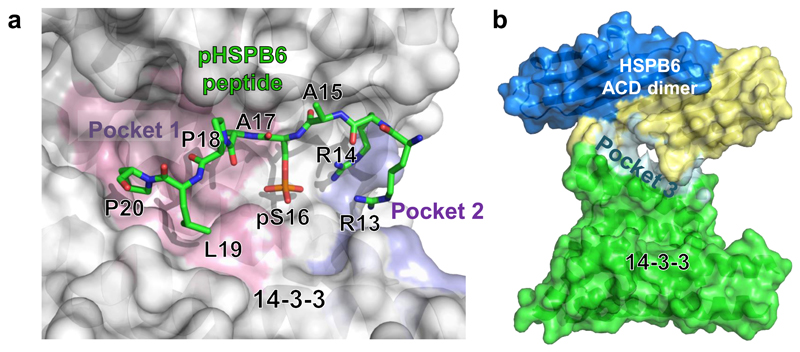
By interacting with hundreds of protein partners, 14-3-3 proteins coordinate vital cellular processes. Phosphorylation of the small heat shock protein, HSPB6, within its intrinsically disordered N-terminal domain activates its interaction with 14-3-3, ultimately triggering smooth muscle relaxation. After analyzing the binding of an HSPB6-derived phosphopeptide to 14-3-3 using isothermal calorimetry and X-ray crystallography, we have determined the crystal structure of the complete assembly consisting of the 14-3-3 dimer and full-length HSPB6 dimer and further characterized this complex in solution using fluorescence spectroscopy, small-angle X-ray scattering, and limited proteolysis. We show that selected intrinsically disordered regions of HSPB6 are transformed into well-defined conformations upon the interaction, whereby an unexpectedly asymmetric structure is formed. This structure provides the first atomic resolution snapshot of a human small HSP in functional state, explains how 14-3-3 proteins sequester their regulatory partners, and can inform the design of small-molecule interaction modifiers to be used as myorelaxants.
通过与数百种蛋白质伴侣相互作用,14-3-3蛋白协调重要的细胞过程。小热休克蛋白HSPB6在其固有无序的N端结构域内发生磷酸化,激活其与14-3-3的相互作用,最终引发平滑肌舒张。在使用等温滴定量热法和X射线晶体学分析了HSPB6衍生的磷酸肽与14-3-3的结合后,我们确定了由14-3-3二聚体和全长HSPB6二聚体组成的完整组装体的晶体结构,并使用荧光光谱、小角X射线散射和有限蛋白酶解在溶液中进一步表征了该复合物。我们表明,HSPB6的选定固有无序区域在相互作用后转变为明确的构象,从而形成了意想不到的不对称结构。该结构提供了处于功能状态的人类小热休克蛋白的首个原子分辨率快照,解释了14-3-3蛋白如何隔离其调节伴侣,并可为用作肌肉松弛剂的小分子相互作用调节剂的设计提供参考。