Chemical and Materials Engineering, New Mexico State University, Las Cruces, NM, 88003, USA.
Chemistry and Biochemistry, New Mexico State University, Las Cruces, NM, 88003, USA.
Sci Rep. 2017 Jan 16;7:40341. doi: 10.1038/srep40341.
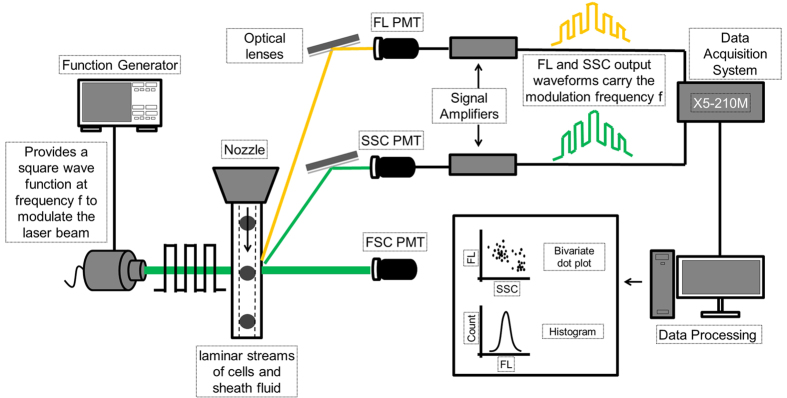
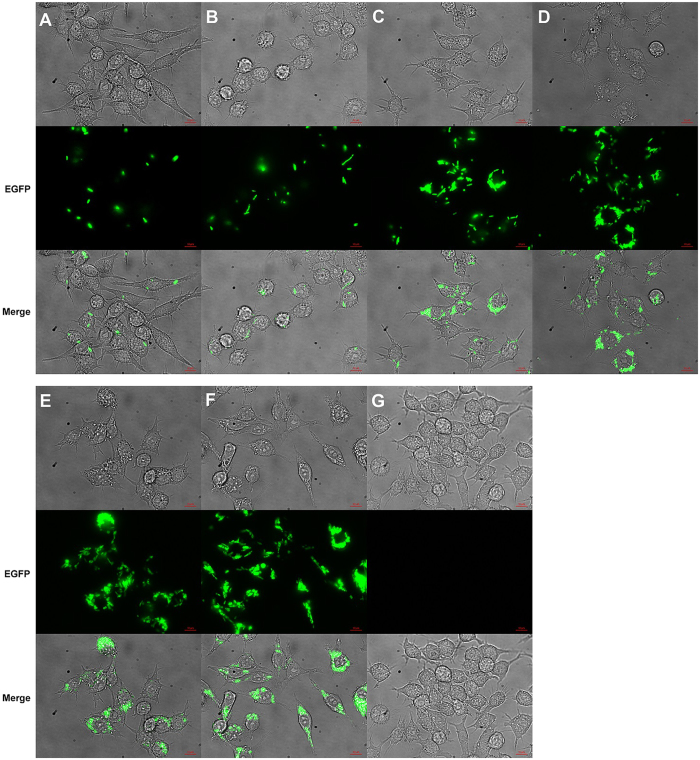
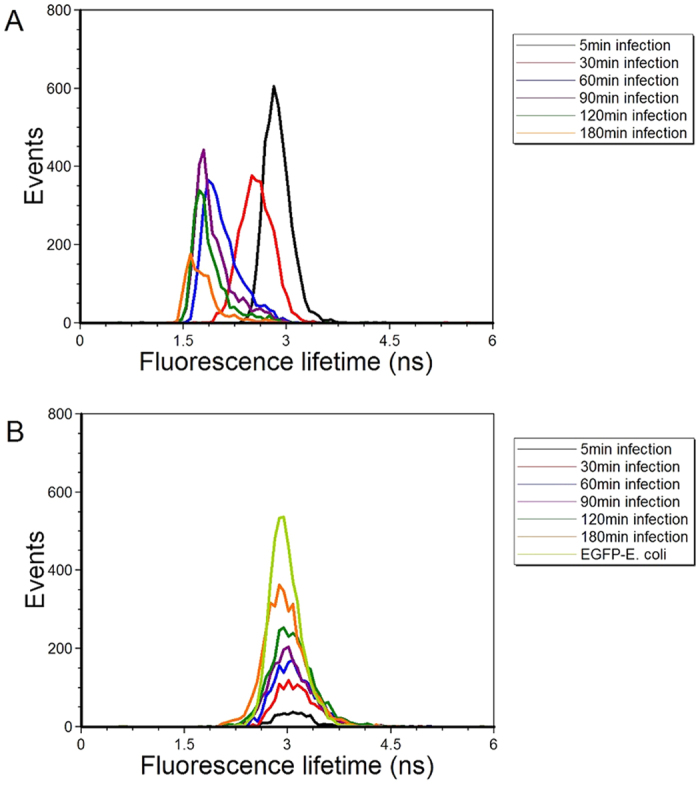
Phase-sensitive flow cytometry (PSFC) is a technique in which fluorescence excited state decay times are measured as fluorescently labeled cells rapidly transit a finely focused, frequency-modulated laser beam. With PSFC the fluorescence lifetime is taken as a cytometric parameter to differentiate intracellular events that are challenging to distinguish with standard flow cytometry. For example PSFC can report changes in protein conformation, expression, interactions, and movement, as well as differences in intracellular microenvironments. This contribution focuses on the latter case by taking PSFC measurements of macrophage cells when inoculated with enhanced green fluorescent protein (EGFP)-expressing E. coli. During progressive internalization of EGFP-E. coli, fluorescence lifetimes were acquired and compared to control groups. It was hypothesized that fluorescence lifetimes would correlate well with phagocytosis because phagosomes become acidified and the average fluorescence lifetime of EGFP is known to be affected by pH. We confirmed that average EGFP lifetimes consistently decreased (3 to 2 ns) with inoculation time. The broad significance of this work is the demonstration of how high-throughput fluorescence lifetime measurements correlate well to changes that are not easily tracked by intensity-only cytometry, which is affected by heterogeneous protein expression, cell-to-cell differences in phagosome formation, and number of bacterium engulfed.
相敏荧光寿命流式细胞术(PSFC)是一种技术,其中荧光激发态衰减时间被测量,因为荧光标记的细胞快速通过精细聚焦、频率调制的激光束。在 PSFC 中,荧光寿命被用作细胞计量参数,以区分用标准流式细胞术难以区分的细胞内事件。例如,PSFC 可以报告蛋白质构象、表达、相互作用和运动的变化,以及细胞内微环境的差异。本研究通过对接种增强型绿色荧光蛋白(EGFP)表达大肠杆菌的巨噬细胞进行 PSFC 测量,重点关注后一种情况。在 EGFP-大肠杆菌的逐渐内化过程中,获取荧光寿命并与对照组进行比较。假设荧光寿命与吞噬作用密切相关,因为吞噬体被酸化,并且 EGFP 的平均荧光寿命已知会受到 pH 值的影响。我们证实,随着接种时间的延长,平均 EGFP 寿命持续下降(3 到 2ns)。这项工作的广泛意义在于证明了高通量荧光寿命测量如何与仅通过强度无法跟踪的变化密切相关,这受到异质蛋白表达、吞噬体形成的细胞间差异以及吞噬的细菌数量的影响。