Center for RNA Biology, 484 West 12th Ave., Columbus, OH 43210 USA.
Department of Biological Chemistry and Pharmacology, The Ohio State University, 1060 Carmack Rd., Columbus, OH 43210 USA.
Biochim Biophys Acta Gene Regul Mech. 2017 Mar;1860(3):374-382. doi: 10.1016/j.bbagrm.2017.01.005. Epub 2017 Jan 14.
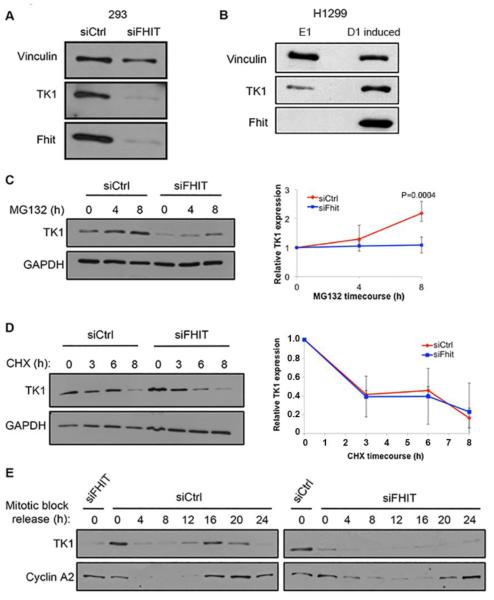
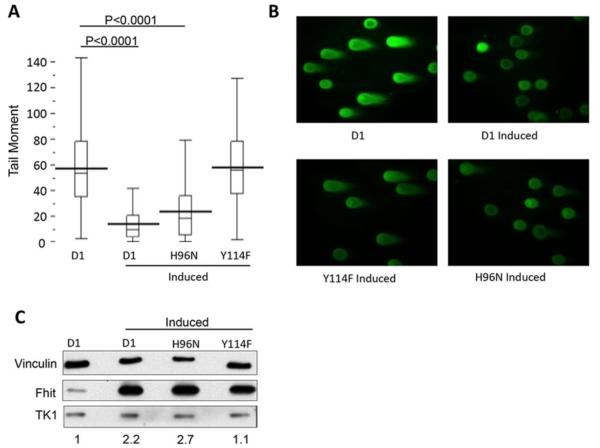
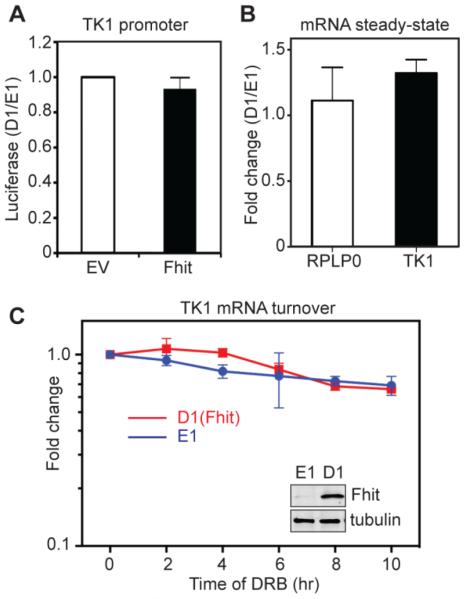
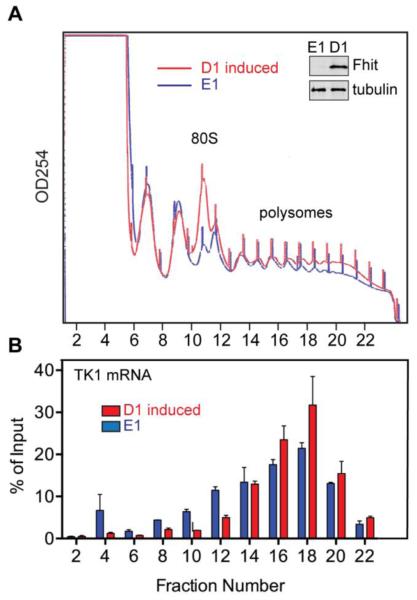
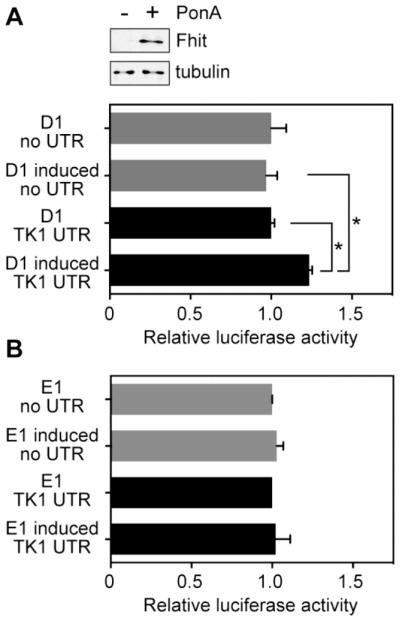
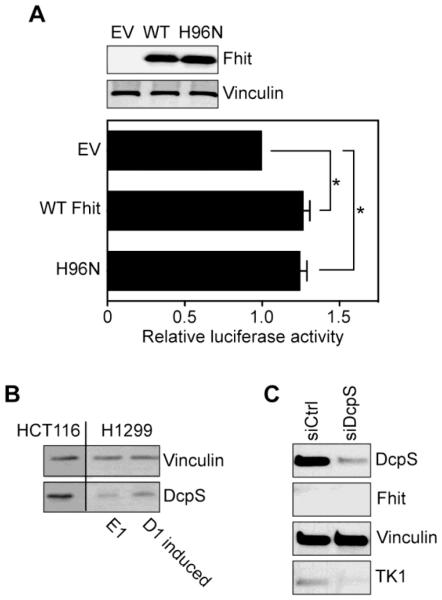
FHIT is a genome caretaker gene that is silenced in >50% of cancers. Loss of Fhit protein expression promotes accumulation of DNA damage, affects apoptosis and epithelial-mesenchymal transition, though molecular mechanisms underlying these alterations have not been fully elucidated. Initiation of genome instability directly follows Fhit loss and the associated reduced Thymidine Kinase 1 (TK1) protein expression. The effects on TK1 of Fhit knockdown and Fhit induction in the current study confirmed the role of Fhit in regulating TK1 expression. Changes in Fhit expression did not impact TK1 protein turnover or transcription from the TK1 promoter, nor steady-state levels of TK1 mRNA or turnover. Polysome profile analysis showed that up-regulated Fhit expression resulted in decreased TK1 RNA in non-translating messenger ribonucleoproteins and increased ribosome density on TK1 mRNA. Fhit does not bind RNA but its expression increased luciferase expression from a transgene bearing the TK1 5'-UTR. Fhit has been reported to act as a scavenger decapping enzyme, and a similar result with a mutant (H96) that binds but does not cleave nucleoside 5',5'-triphosphates suggests the impact on TK1 translation is due to its ability to modulate the intracellular level of cap-like molecules. Consistent with this, cells expressing Fhit mutants with reduced activity toward cap-like dinucleotides exhibit DNA damage resulting from TK1 deficiency, whereas cells expressing wild-type Fhit or the H96N mutant do not. The results have implications for the mechanism by which Fhit regulates TK1 mRNA, and more broadly, for its modulation of multiple functions as tumor suppressor/genome caretaker.
脆性组氨酸三联体(FHIT)是一种基因组守护者基因,在超过 50%的癌症中被沉默。Fhit 蛋白表达的缺失会促进 DNA 损伤的积累,影响细胞凋亡和上皮-间充质转化,尽管这些改变的分子机制尚未完全阐明。基因组不稳定性的发生直接紧随 Fhit 的缺失以及与之相关的胸苷激酶 1(TK1)蛋白表达降低。在本研究中,Fhit 敲低和诱导对 TK1 的影响证实了 Fhit 在调节 TK1 表达中的作用。Fhit 表达的变化不会影响 TK1 蛋白的周转或 TK1 启动子的转录,也不会影响 TK1 mRNA 的稳态水平或周转。多核糖体谱分析表明,上调的 Fhit 表达导致非翻译信使核糖核蛋白中 TK1 RNA 减少,TK1 mRNA 上的核糖体密度增加。Fhit 不结合 RNA,但它的表达增加了携带 TK1 5'-UTR 的转基因的荧光素酶表达。已经报道 Fhit 作为一种清除帽酶发挥作用,并且与结合但不切割核苷 5',5'-三磷酸的突变体(H96)的类似结果表明,对 TK1 翻译的影响是由于其调节细胞内帽样分子水平的能力。与此一致,表达对帽样二核苷酸活性降低的 Fhit 突变体的细胞表现出由于 TK1 缺乏导致的 DNA 损伤,而表达野生型 Fhit 或 H96N 突变体的细胞则不会。这些结果对 Fhit 调节 TK1 mRNA 的机制以及更广泛地对其作为肿瘤抑制因子/基因组守护者的多种功能的调节具有重要意义。