Sayuk Gregory S, Wolf Ray, Chang Lin
Washington University School of Medicine, St Louis, Missouri, USA.
St Louis Veterans Affairs Medical Center, St Louis, Missouri, USA.
Am J Gastroenterol. 2017 Jun;112(6):892-899. doi: 10.1038/ajg.2016.574. Epub 2017 Jan 17.
Irritable bowel syndrome (IBS) is a functional bowel disorder characterized by symptoms including abdominal pain and altered bowel function. Up to 75% of individuals with IBS may be undiagnosed. The aim of this study was to characterize symptoms, healthcare utilization, and treatments in populations with both diagnosed and undiagnosed IBS.
An online survey was conducted to compare gastrointestinal (GI) symptoms, healthcare visits, well-being, symptom management, and treatment satisfaction in individuals with and without medically diagnosed IBS (Rome III criteria). Symptom severity, disruptiveness, and treatment satisfaction were rated using a 7-point scale. Adjustments to daily life were determined by predefined survey responses.
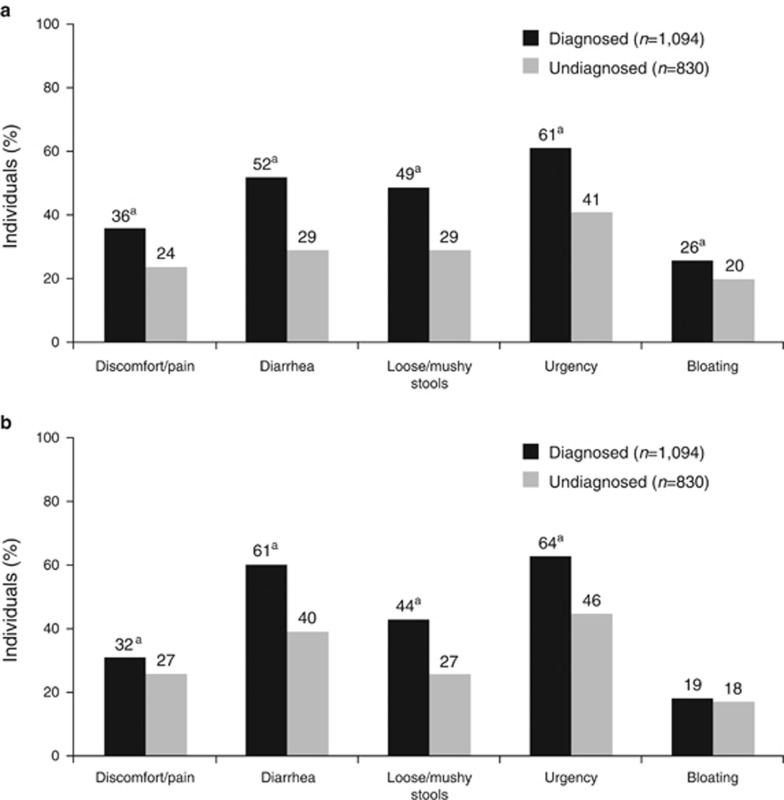
A total of 1,924 individuals with a history of GI symptoms were eligible and completed the survey. Of these, 1,094 individuals (56.9%) met the criteria for IBS; 830 individuals (43.1%) had no medical diagnosis of IBS despite meeting diagnostic criteria. Most participants received a diagnosis from either gastroenterologists (45%) or primary care physicians (42%). A greater percentage of diagnosed patients had severe GI symptoms (score ≥6) vs. undiagnosed individuals (16% vs. 8%, respectively; P<0.05); diagnosed patients were more likely to report that GI symptoms adversely affected their quality of life. Approximately 40% of participants received IBS-related treatment from primary care physicians; 26% and 43% of diagnosed and undiagnosed individuals, respectively, were not receiving treatment for GI symptoms.
Many individuals with IBS-related symptoms have not been medically diagnosed with IBS. IBS-related symptoms impact quality of life, yet more than one-third of individuals are not receiving treatment for IBS.
肠易激综合征(IBS)是一种功能性肠道疾病,其特征症状包括腹痛和肠道功能改变。高达75%的肠易激综合征患者可能未被诊断出来。本研究的目的是描述已诊断和未诊断肠易激综合征人群的症状、医疗保健利用情况和治疗方法。
进行了一项在线调查,以比较符合和不符合医学诊断肠易激综合征(罗马III标准)的个体的胃肠道(GI)症状、医疗就诊情况、健康状况、症状管理和治疗满意度。使用7分制对症状严重程度、干扰性和治疗满意度进行评分。通过预先定义的调查回复来确定对日常生活的调整。
共有1924名有胃肠道症状病史的个体符合条件并完成了调查。其中,1094名个体(56.9%)符合肠易激综合征标准;830名个体(43.1%)尽管符合诊断标准但未被医学诊断为肠易激综合征。大多数参与者由胃肠病学家(45%)或初级保健医生(42%)做出诊断。与未诊断个体相比,诊断患者中出现严重胃肠道症状(评分≥6)的比例更高(分别为16%和8%;P<0.05);诊断患者更有可能报告胃肠道症状对其生活质量产生不利影响。约40%的参与者接受了初级保健医生提供的与肠易激综合征相关的治疗;诊断和未诊断个体中分别有26%和43%未接受胃肠道症状治疗。
许多有肠易激综合征相关症状的个体尚未被医学诊断为肠易激综合征。肠易激综合征相关症状会影响生活质量,但超过三分之一的个体未接受肠易激综合征治疗。