Zhang Qingyin, Shao Ming'an, Jia Xiaoxu, Wei Xiaorong
College of Natural Resources and Environment, Northwest A&F University, Yangling, Shaanxi Province, China.
Key Laboratory of Ecosystem Network Observation and Modeling, Institute of Geographic Sciences and Natural Resources Research, Chinese Academy of Sciences, Beijing, China.
PLoS One. 2017 Jan 17;12(1):e0169770. doi: 10.1371/journal.pone.0169770. eCollection 2017.
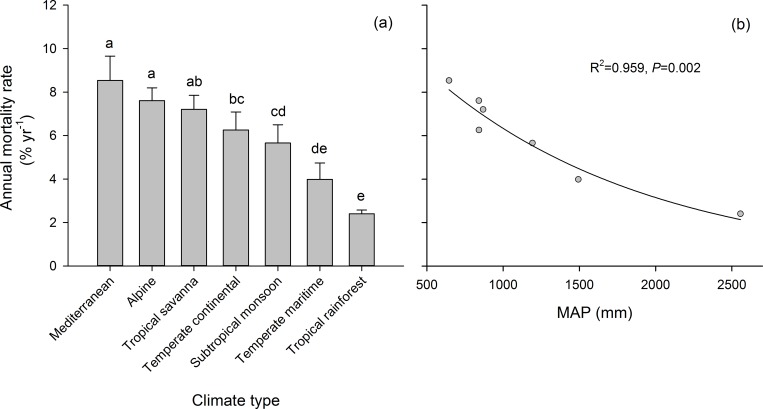
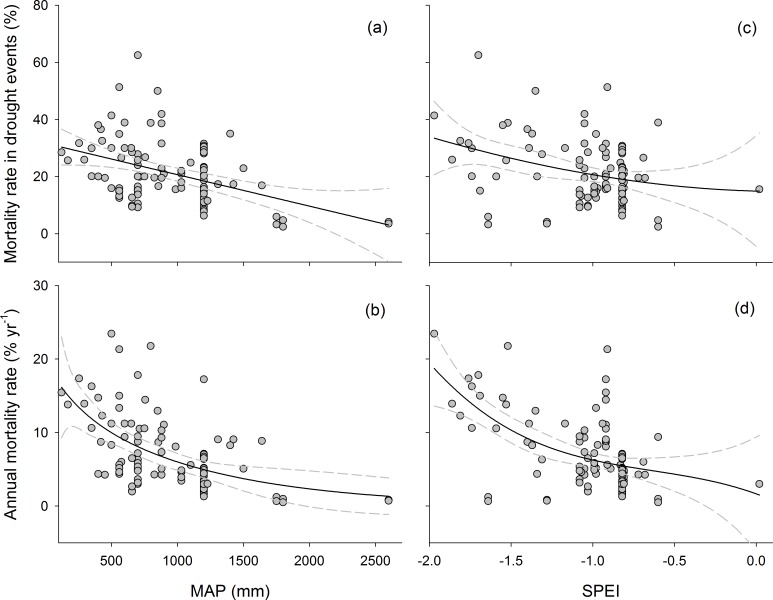
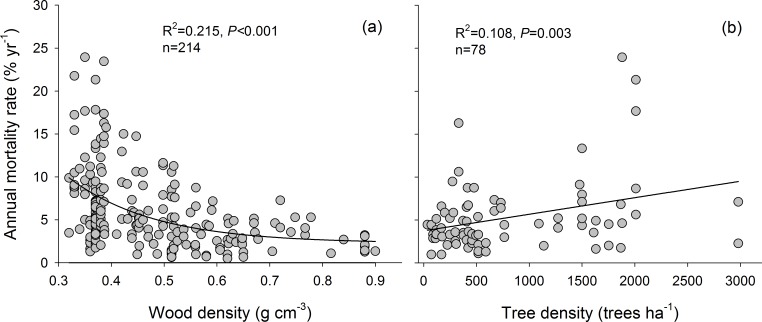
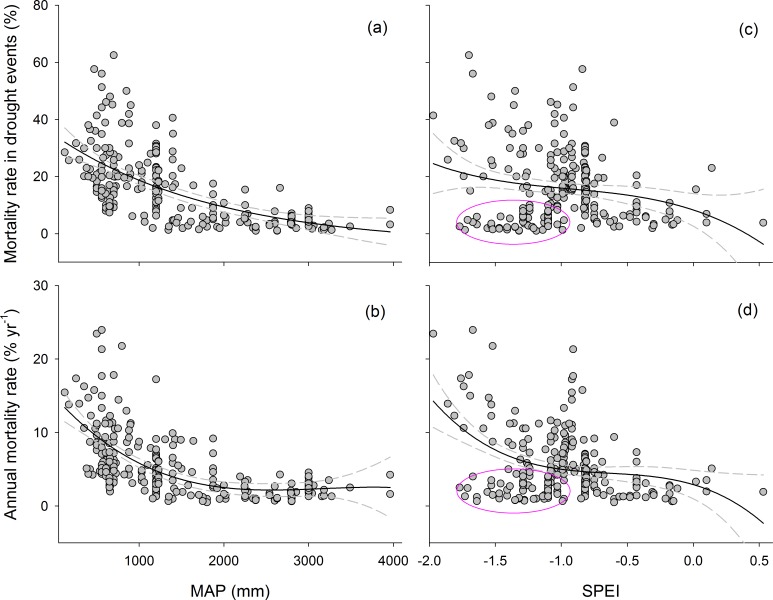
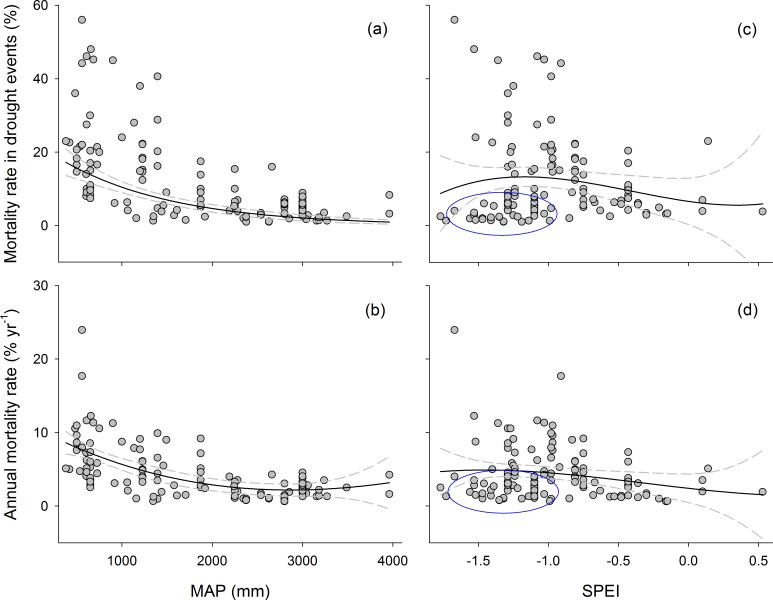
Tree mortality due to warming and drought is a critical aspect of forest ecosystem in responding to climate change. Spatial patterns of tree mortality induced by drought and its influencing factors, however, have yet to be documented at the global scale. We collected observations from 248 sites globally where trees have died due to drought and then assessed the effects of climatic and forest factors on the rate of tree mortality. The global mean annual mortality rate was 5.5%. The rate of tree mortality was significantly and negatively correlated with mean annual precipitation (P < 0.01). Tree mortality was lowest in tropical rainforests with mean annual precipitation >2000 mm and was severe in regions with mean annual precipitation <1000 mm. Mortality rates varied amongst species. The global annual rate of mortality was much higher for gymnosperms (7.1%) than angiosperms (4.8%) but did not differ significantly between evergreen (6.2%) and deciduous (6.1%) species. Stand age and wood density affected the mortality rate. Saplings (4.6%) had a higher mortality rate than mature trees (3.2%), and mortality rates significantly decreased with increasing wood density for all species (P < 0.01). We therefore concluded that the tree mortality around the globe varied with climatic and forest factors. The differences between tree species, wood density, stand density, and stand age should be considered when evaluating tree mortality at a large spatial scale during future climatic extremes.
因气候变暖和干旱导致的树木死亡是森林生态系统应对气候变化的一个关键方面。然而,干旱引发的树木死亡的空间格局及其影响因素在全球范围内尚未得到记录。我们收集了全球248个树木因干旱死亡的地点的观测数据,然后评估了气候和森林因素对树木死亡率的影响。全球年均死亡率为5.5%。树木死亡率与年均降水量显著负相关(P < 0.01)。年均降水量>2000毫米的热带雨林中树木死亡率最低,而年均降水量<1000毫米的地区树木死亡率则很高。不同物种的死亡率各不相同。裸子植物的全球年死亡率(7.1%)远高于被子植物(4.8%),但常绿树种(6.2%)和落叶树种(6.1%)之间的死亡率没有显著差异。林分年龄和木材密度影响死亡率。幼树(4.6%)的死亡率高于成熟树木(3.2%),所有物种的死亡率均随木材密度的增加而显著降低(P < 0.01)。因此,我们得出结论,全球树木死亡率随气候和森林因素而变化。在未来气候极端事件期间,在大空间尺度上评估树木死亡率时,应考虑树种、木材密度、林分密度和林分年龄之间的差异。