Hu Lihua, Huang Xiao, You Chunjiao, Li Juxiang, Hong Kui, Li Ping, Wu Yanqing, Wu Qinhua, Bao Huihui, Cheng Xiaoshu
Department of Cardiovascular Medicine, the Second Affiliated Hospital of Nanchang University, Nanchang of Jiangxi, China.
PLoS One. 2017 Jan 17;12(1):e0170238. doi: 10.1371/journal.pone.0170238. eCollection 2017.
This study aimed to describe the prevalence and risk factors of prehypertension and hypertension in Jiangxi Province, China. Individuals with prehypertension frequently progress into hypertension and are at high risk of developing cardiovascular disease and stroke.
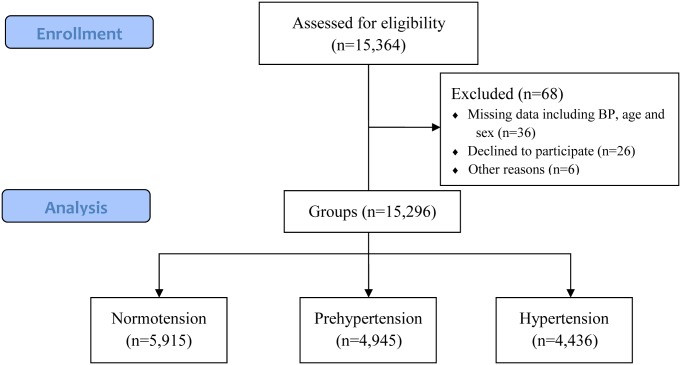
A cross-sectional survey of 15,296 participants (15 years or older) was conducted in Jiangxi Province, China, in 2013, using questionnaire forms and physical measurements.
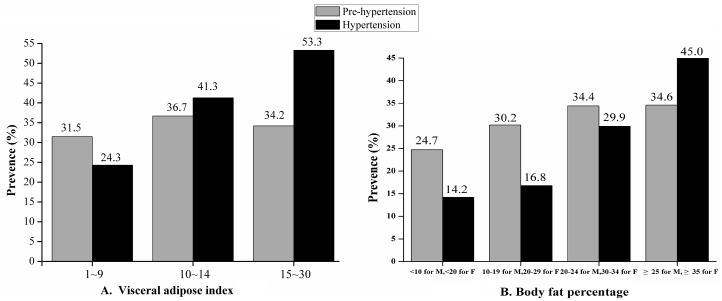
The prevalence of prehypertension and hypertension was 32.3% (39.2% in men and 27.6% in women) and 29.0% (30.1% in men and 28.2% in women), respectively. The awareness, treatment, and control rates among all hypertensive participants were 64.8%, 27.1%, and 12.6%, respectively. The prevalence of prehypertension in males declined with age, but the prevalence of hypertension increased in different genders. The prevalence of prehypertension and hypertension increased with increasing body mass index (BMI). The prevalence of prehypertension decreased, in parallel to an increase in the prevalence of hypertension, with increasing waist circumference (WC). A combination of WC and BMI was superior to individual indices in identifying hypertension. A multivariate logistic regression analysis indicated that increasing age, high BMI, high visceral adipose index, and high heart rate were risk factors for prehypertension and hypertension. The high body fat percentage was significantly associated with prehypertension. Living in an urban area, male sex, abdominal obesity, and menopause were correlated with hypertension.
Prehypertension and hypertension are epidemic in southern China. Further studies are needed to explore an indicator that can represent the visceral fat accurately and has a close relationship with cardiovascular disease.
本研究旨在描述中国江西省高血压前期及高血压的患病率和危险因素。高血压前期个体常进展为高血压,且患心血管疾病和中风的风险较高。
2013年在中国江西省对15296名15岁及以上参与者进行了横断面调查,采用问卷调查表和体格测量。
高血压前期和高血压的患病率分别为32.3%(男性为39.2%,女性为27.6%)和29.0%(男性为30.1%,女性为28.2%)。所有高血压参与者的知晓率、治疗率和控制率分别为64.8%、27.1%和12.6%。男性高血压前期患病率随年龄增长而下降,但不同性别高血压患病率均上升。高血压前期和高血压的患病率随体重指数(BMI)增加而升高。随着腰围(WC)增加,高血压前期患病率下降,而高血压患病率上升。腰围和体重指数相结合在识别高血压方面优于单一指标。多因素logistic回归分析表明,年龄增长、高BMI、高内脏脂肪指数和高心率是高血压前期和高血压的危险因素。高体脂百分比与高血压前期显著相关。居住在城市地区、男性性别、腹型肥胖和绝经与高血压相关。
高血压前期和高血压在中国南方呈流行态势。需要进一步研究探索一种能准确代表内脏脂肪且与心血管疾病密切相关的指标。