Barreto-Curiel Fernando, Focken Ulfert, D'Abramo Louis R, Viana María Teresa
Facultad de Ciencias Marinas, Universidad Autónoma de Baja California (UABC), Ensenada, México.
Thuenen Institute of Fisheries Ecology, Ahrensburg, Germany.
PLoS One. 2017 Jan 17;12(1):e0170124. doi: 10.1371/journal.pone.0170124. eCollection 2017.
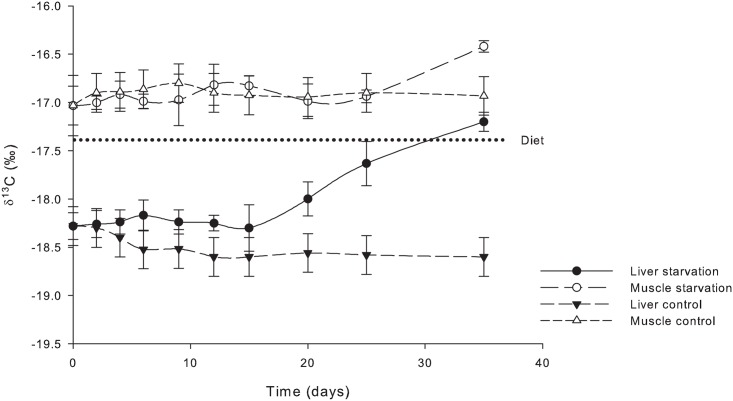
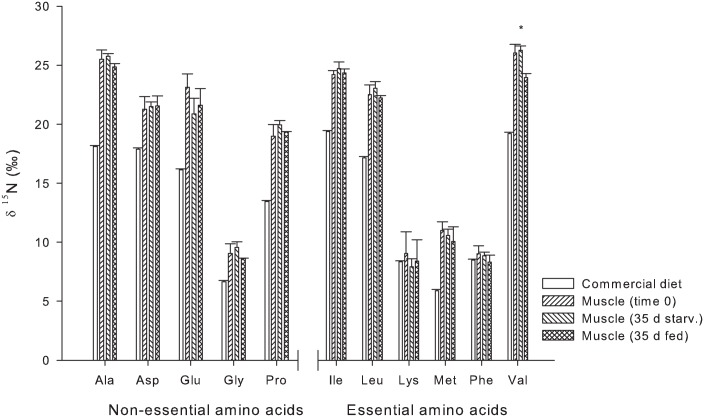
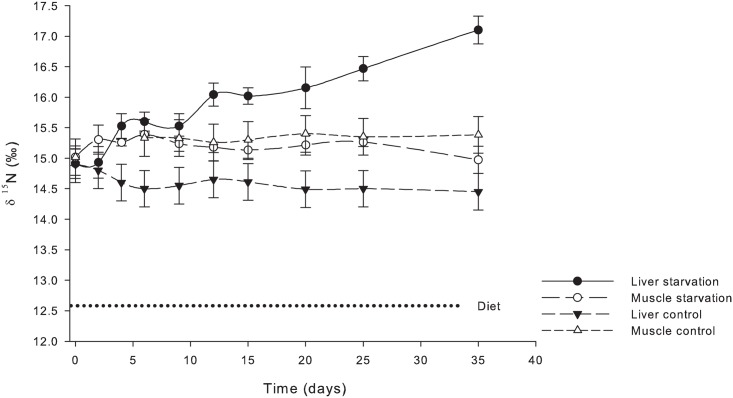
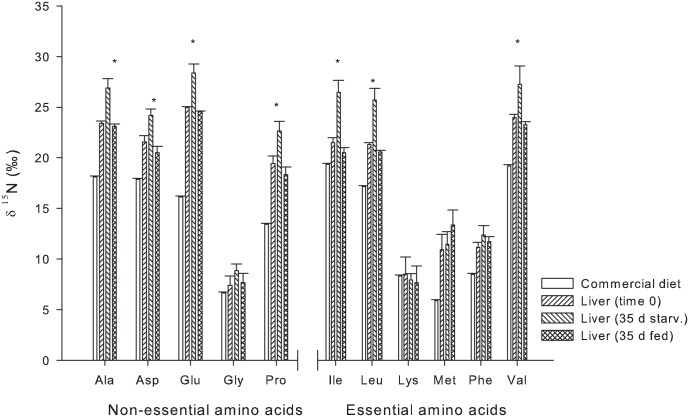
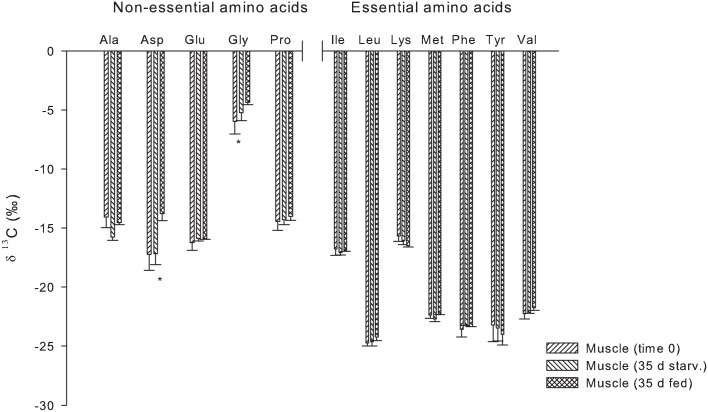
Fish starvation is defined as food deprivation for a long period of time, such that physiological processes become confined to basal metabolism. Starvation provides insights in physiological processes without interference from unknown factors in digestion and nutrient absorption occurring in fed state. Juveniles of amberjack Seriola lalandi were isotopically equilibrated to a formulated diet for 60 days. One treatment consisted of fish that continued to be fed and fish in the other treatment were not fed for 35 days. The isotopic signatures prior to the beginning of and after the starvation period, for fish in the starvation and control treatments, were analysed for lipid content, fatty acid composition and isotopic analysis of bulk (EA-IRMS) and of amino acids (compound specific isotope analysis, CSIA). There were three replicates for the starvation group. Fatty acid content in muscle and liver tissue before and after starvation was determined to calculate percent change. Results showed that crude lipid was the most used source of energy in most cases; the PUFAs and LC-PUFAs were highly conserved. According to the protein signature in bulk (δ15N) and per amino acid (δ13C and δ15N), in muscle tissue, protein synthesis did not appear to occur substantially during starvation, whereas in liver, increases in δ13C and δ15N indicate that protein turnover occurred, probably for metabolic routing to energy-yielding processes. As a result, isotopic values of δ15N in muscle tissue do not change, whereas CSIA net change occurred in the liver tissue. During the study period of 35 days, muscle protein was largely conserved, being neither replenished from amino acid pools in the plasma and liver nor catabolized.
鱼类饥饿被定义为长时间的食物剥夺,以至于生理过程局限于基础代谢。饥饿为研究生理过程提供了见解,而不受进食状态下消化和营养吸收中未知因素的干扰。黄尾鰤(Seriola lalandi)幼鱼在60天内通过同位素平衡适应一种配方饲料。一种处理方式是让鱼继续进食,另一种处理方式中的鱼则35天不喂食。对饥饿处理组和对照组的鱼在饥饿期开始前和饥饿期后的同位素特征进行了分析,包括脂质含量、脂肪酸组成以及对整体(元素分析仪-同位素比率质谱仪,EA-IRMS)和氨基酸(化合物特异性同位素分析,CSIA)的同位素分析。饥饿组有三个重复样本。测定饥饿前后肌肉和肝脏组织中的脂肪酸含量,以计算变化百分比。结果表明,在大多数情况下,粗脂质是最常用的能量来源;多不饱和脂肪酸(PUFAs)和长链多不饱和脂肪酸(LC-PUFAs)高度保守。根据整体(δ15N)和每个氨基酸(δ13C和δ15N)的蛋白质特征,在肌肉组织中,饥饿期间蛋白质合成似乎没有大量发生,而在肝脏中,δ13C和δ15N的增加表明发生了蛋白质周转,可能是为了将代谢导向产生能量的过程。因此,肌肉组织中δ15N的同位素值没有变化,而肝脏组织中发生了CSIA净变化。在35天的研究期间,肌肉蛋白质在很大程度上得到了保留,既没有从血浆和肝脏中的氨基酸库中补充,也没有被分解代谢。