Early Angela M, Shanmugarajah Niroshan, Buchon Nicolas, Clark Andrew G
Department of Ecology and Evolutionary Biology, Cornell University, Ithaca, New York, United States of America.
Department of Molecular Biology and Genetics, Cornell University, Ithaca, New York, United States of America.
PLoS One. 2017 Jan 17;12(1):e0170332. doi: 10.1371/journal.pone.0170332. eCollection 2017.
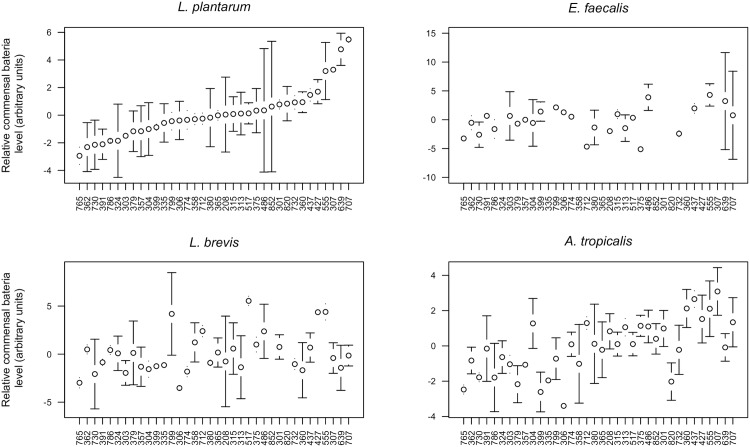
Host genotype can influence the composition of the commensal bacterial community in some organisms. Composition, however, is only one parameter describing a microbial community. Here, we test whether a second parameter-abundance of bacteria-is a heritable trait by quantifying the presence of four commensal bacterial strains within 36 gnotobiotic inbred lines of Drosophila melanogaster. We find that D. melanogaster genotype exerts a significant effect on microbial levels within the fly. When introduced as monocultures into axenic flies, three of the four bacterial strains were reliably detected within the fly. The amounts of these different strains are strongly correlated, suggesting that the host regulates commensal bacteria through general, not bacteria-specific, means. While the correlation does not appear to be driven by simple variation in overall gut dimensions, a genetic association study suggests that variation in commensal bacterial load may largely be attributed to physical aspects of host cell growth and development.
宿主基因型可影响某些生物体中共生细菌群落的组成。然而,组成只是描述微生物群落的一个参数。在这里,我们通过量化黑腹果蝇36个无菌近交系中四种共生细菌菌株的存在情况,来测试第二个参数——细菌丰度——是否为一种可遗传的性状。我们发现,黑腹果蝇的基因型对果蝇体内的微生物水平有显著影响。当作为单一培养物引入无菌果蝇时,四种细菌菌株中的三种在果蝇体内被可靠地检测到。这些不同菌株的数量高度相关,这表明宿主通过一般而非细菌特异性的方式调节共生细菌。虽然这种相关性似乎不是由肠道总体尺寸的简单变化驱动的,但一项基因关联研究表明,共生细菌载量的变化可能很大程度上归因于宿主细胞生长和发育的物理方面。