Riisgaard Helle, Søndergaard Jens, Munch Maria, Le Jette V, Ledderer Loni, Pedersen Line B, Nexøe Jørgen
Research Unit of General Practice, Department of Public Health, University of Southern Denmark, J.B. Winsløws Vej 9A, Odense C, 5000, Denmark.
Section of Health Promotion and Health Services, Department of Public Health, Aarhus University, Bartholins Allé 2, Aarhus C, 8000, Denmark.
BMC Health Serv Res. 2017 Jan 17;17(1):44. doi: 10.1186/s12913-017-1984-y.
In recent years, the healthcare system in the western world has undergone a structural development caused by changes in demography and pattern of disease. In order to maintain the healthcare system cost-effective, new tasks are placed in general practice urging the general practitioners to rethink the working structure without compromising the quality of care. However, there is a substantial variation in the degree to which general practitioners delegate tasks to their staff, and it is not known how these various degrees of task delegation influence the job satisfaction of general practitioners and their staff.
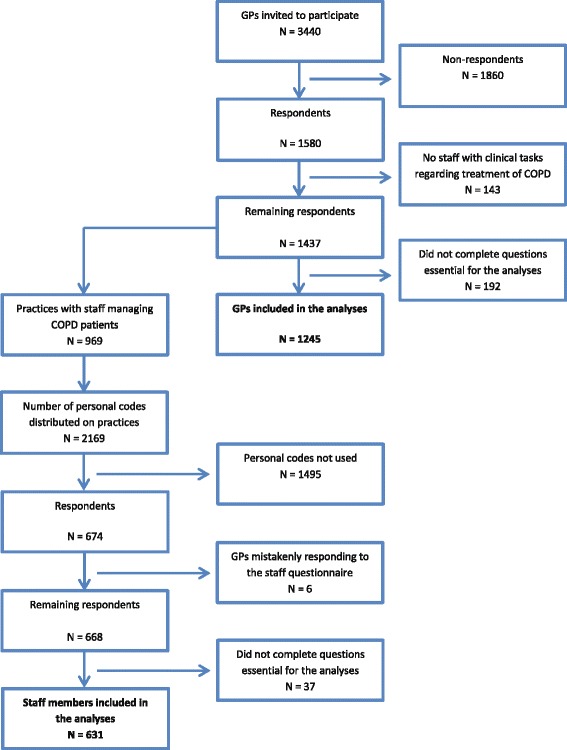
We performed a cross-sectional study based on two electronic questionnaires, one for general practitioners and one for their staff. Both questionnaires were divided into two parts, a part exploring the degree of task delegation regarding management of patients with chronic obstructive pulmonary disease in general practice and a part concerning the general job satisfaction and motivation to work.
We found a significant association between perceived "maximal degree" of task delegation in management of patients with chronic obstructive pulmonary disease and the staff's overall job satisfaction. The odds ratio of the staff's satisfaction with the working environment displayed a tendency that there is also an association with "maximal degree" of task delegation. In the analysis of the general practitioners, the odds ratios of the results indicate that there is a tendency that "maximal degree" of task delegation is associated with overall job satisfaction, satisfaction with the challenges in work, and satisfaction with the working environment.
We conclude that a high degree of task delegation is significantly associated with overall job satisfaction of the staff, and that there is a tendency that a high degree of task delegation is associated with the general practitioners' and the staff's satisfaction with the working environment as well as with general practitioners' overall job satisfaction and satisfaction with challenges in work. To qualify future delegation processes within general practice, further research could explore the reasons for our findings.
近年来,西方世界的医疗保健系统因人口结构和疾病模式的变化而经历了结构性发展。为了保持医疗保健系统的成本效益,新的任务被分配到全科医疗中,促使全科医生在不降低护理质量的前提下重新思考工作结构。然而,全科医生将任务委托给其工作人员的程度存在很大差异,而且尚不清楚这些不同程度的任务委托如何影响全科医生及其工作人员的工作满意度。
我们基于两份电子问卷进行了一项横断面研究,一份针对全科医生,另一份针对他们的工作人员。两份问卷均分为两部分,一部分探讨在全科医疗中对慢性阻塞性肺疾病患者管理的任务委托程度,另一部分涉及总体工作满意度和工作积极性。
我们发现,在慢性阻塞性肺疾病患者管理中感知到的任务委托“最大程度”与工作人员的总体工作满意度之间存在显著关联。工作人员对工作环境的满意度的优势比显示出一种趋势,即也与任务委托的“最大程度”有关联。在对全科医生的分析中,结果的优势比表明存在一种趋势,即任务委托的“最大程度”与总体工作满意度、对工作挑战的满意度以及对工作环境的满意度相关。
我们得出结论,高度的任务委托与工作人员的总体工作满意度显著相关,并且存在一种趋势,即高度的任务委托与全科医生和工作人员对工作环境的满意度以及全科医生的总体工作满意度和对工作挑战的满意度相关。为了使未来全科医疗中的委托流程更加完善,进一步的研究可以探索我们研究结果的原因。