Asiimwe Nicholas, Yeo Seung Geun, Kim Min-Sik, Jung Junyang, Jeong Na Young
Department of Biomedical Science, Graduate School, Kyung Hee University, 26 Kyungheedae-ro, Dongdaemun-gu, Seoul 02447, Republic of Korea.
Department of Otorhinolaryngology, H & N Surgery, College of Medicine, Kyung Hee University, 26 Kyungheedae-ro, Dongdaemun-gu, Seoul 02447, Republic of Korea; East-West Medical Research Institute, Kyung Hee University, 26 Kyungheedae-ro, Dongdaemun-gu, Seoul 02447, Republic of Korea.
Oxid Med Cell Longev. 2016;2016:7205747. doi: 10.1155/2016/7205747. Epub 2016 Dec 21.
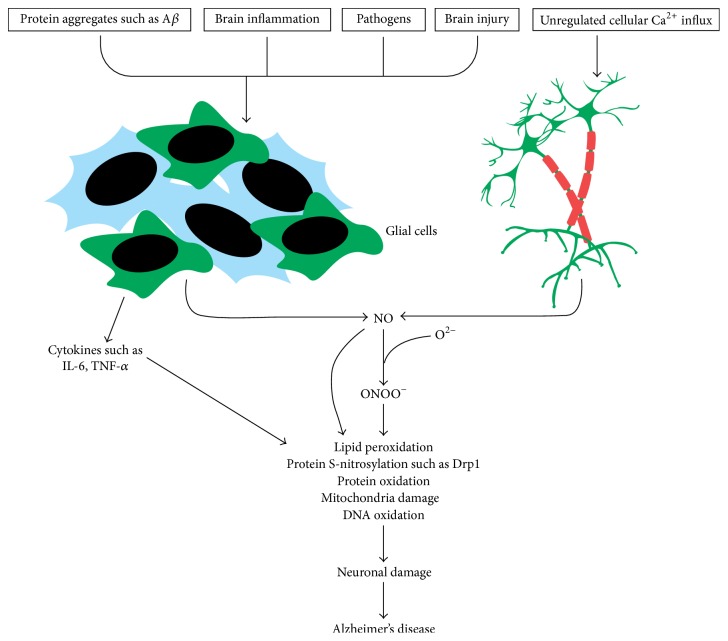
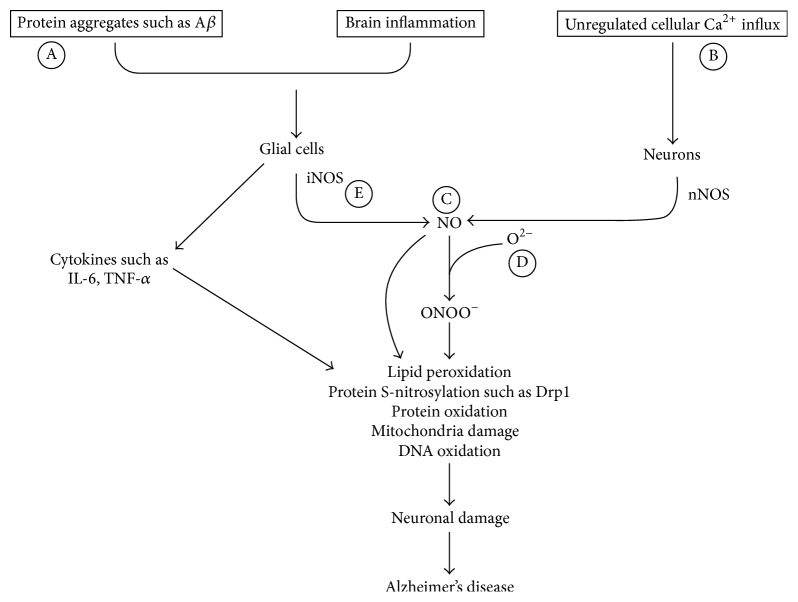
Neuronal inflammation is a systematically organized physiological step often triggered to counteract an invading pathogen or to rid the body of damaged and/or dead cellular debris. At the crux of this inflammatory response is the deployment of nonneuronal cells: microglia, astrocytes, and blood-derived macrophages. Glial cells secrete a host of bioactive molecules, which include proinflammatory factors and nitric oxide (NO). From immunomodulation to neuromodulation, NO is a renowned modulator of vast physiological systems. It essentially mediates these physiological effects by interacting with cyclic GMP (cGMP) leading to the regulation of intracellular calcium ions. NO regulates the release of proinflammatory molecules, interacts with ROS leading to the formation of reactive nitrogen species (RNS), and targets vital organelles such as mitochondria, ultimately causing cellular death, a hallmark of many neurodegenerative diseases. AD is an enervating neurodegenerative disorder with an obscure etiology. Because of accumulating experimental data continually highlighting the role of NO in neuroinflammation and AD progression, we explore the most recent data to highlight in detail newly investigated molecular mechanisms in which NO becomes relevant in neuronal inflammation and oxidative stress-associated neurodegeneration in the CNS as well as lay down up-to-date knowledge regarding therapeutic approaches targeting NO.
神经元炎症是一个系统组织的生理过程,通常在遇到入侵病原体或清除体内受损和/或死亡的细胞碎片时被触发。这种炎症反应的关键在于非神经元细胞的作用:小胶质细胞、星形胶质细胞和血液来源的巨噬细胞。胶质细胞会分泌大量生物活性分子,其中包括促炎因子和一氧化氮(NO)。从免疫调节到神经调节,NO是一种对众多生理系统都有显著作用的调节剂。它主要通过与环磷酸鸟苷(cGMP)相互作用来介导这些生理效应,从而调节细胞内钙离子。NO调节促炎分子的释放,与活性氧(ROS)相互作用导致活性氮物质(RNS)的形成,并作用于线粒体等重要细胞器,最终导致细胞死亡,这是许多神经退行性疾病的一个标志。阿尔茨海默病(AD)是一种令人衰弱的神经退行性疾病,其病因不明。由于越来越多的实验数据不断突出NO在神经炎症和AD进展中的作用,我们探讨了最新的数据,详细阐述了NO在中枢神经系统神经元炎症和氧化应激相关神经退行性变中发挥作用的新研究分子机制,并梳理了有关针对NO的治疗方法的最新知识。