Madurasinghe V W, Sohanpal Ratna, James Wai, Steed Liz, Eldridge Sandra, Taylor Sjc, Griffiths C, Walton Robert
Centre for Primary Care and Public Health, Barts and The London School of Medicine and Dentistry, Yvonne Carter Building, 58 Turner Street, London, E1 2AB UK ; Pragmatic Clinical Trials Unit (PCTU), Centre for Primary Care and Public Health, Blizard Institute, Yvonne Carter Building, 58 Turner Street, London, E1 2AB UK.
Centre for Primary Care and Public Health, Barts and The London School of Medicine and Dentistry, Yvonne Carter Building, 58 Turner Street, London, E1 2AB UK.
Pilot Feasibility Stud. 2017 Jan 10;3:1. doi: 10.1186/s40814-016-0120-9. eCollection 2017.
UK government policy aims to strengthen the role of community pharmacies in health promotion. Thus, we conducted feasibility studies for an intervention to enhance delivery of the NHS Smoking Cessation Service.
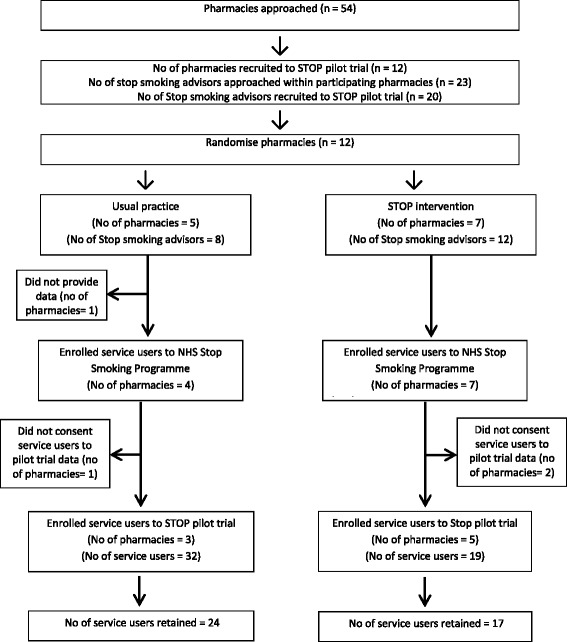
The overall aims were to assess acceptability and feasibility of conducting the intervention in community pharmacies and piloting this with a cluster randomised trial. Specific objectives were (1) to estimate likely participation rates of pharmacies and stop smoking advisors, (2) to establish the potential impact of the training intervention on throughput and retention of smokers in smoking services, (3) to establish potential impact on smoking cessation outcomes, (4) to optimise logistics for conducting a cluster randomised trial in the next phase of the research programme and (5) to consider the feasibility of collecting pharmacy and service user data. In this cluster randomised parallel group pilot trial, 12 community pharmacies in East London were allocated to intervention or usual practice using simple randomisation (allocation ratio 2:1). Data were analysed descriptively.
Twelve of 54 (22.2%, 95% CI 12.0% to 35.6%) pharmacies and 20 of 23 (87.0%, 95% CI 66.4% to 97.2%) advisors invited, agreed to participate. Over 5 months, 302 smokers in intervention pharmacies (mean per pharmacy 43.1, 95% CI: -4.3 to 90.5) and 319 in usual practice pharmacies (mean per pharmacy 79.8, 95% CI: 19.0 to 140.5) joined the service. 51 of 621 smokers (6.3% in intervention vs 10.0% in usual practice) consented to provide additional data on smoking cessation. 17 of 19 smokers that consented were retained at 4 weeks in intervention arm (89.5%, 95% CI: 66.9% to 98.7%) and 24 of 32 in usual practice (75.0%, 95% CI: 56.6% to 88.5%). 10 of 19 in the intervention arm (52.6%, 95% CI: 28.9% to 75.6%) stopped smoking compared to 7 of 32 in usual practice arm (21.9%, 95% CI: 9.3% to 40.0%). The pilot was useful in providing insights on how best to conduct the definitive trial and shortcomings of our present logistical arrangements, including feasibility of collecting pharmacy and service user data.
Recruitment rates show that the main trial is feasible, and the results suggest that the intervention may improve retention and quit rates in smoking cessation services. We gained insights on how best to conduct the definitive trial which will proceed as planned.
英国政府政策旨在加强社区药房在健康促进方面的作用。因此,我们针对一项旨在加强国民保健制度戒烟服务提供的干预措施开展了可行性研究。
总体目标是评估在社区药房实施该干预措施并通过整群随机试验进行试点的可接受性和可行性。具体目标包括:(1)估计药房和戒烟顾问的可能参与率;(2)确定培训干预对戒烟服务中吸烟者的接待量和留存率的潜在影响;(3)确定对戒烟结果的潜在影响;(4)优化在研究项目下一阶段进行整群随机试验的后勤安排;(5)考虑收集药房和服务使用者数据的可行性。在这项整群随机平行组试点试验中,东伦敦的12家社区药房通过简单随机化被分配到干预组或常规组(分配比例为2:1)。对数据进行描述性分析。
在受邀的54家药房中有12家(22.2%,95%置信区间为12.0%至35.6%)、23名顾问中有20名(87.0%,95%置信区间为66.4%至97.2%)同意参与。在5个月的时间里,干预组药房有302名吸烟者(平均每家药房43.1名,95%置信区间:-4.3至90.5),常规组药房有319名吸烟者(平均每家药房79.8名,95%置信区间:19.0至140.5)加入该服务。621名吸烟者中有51名(干预组为6.3%,常规组为10.0%)同意提供关于戒烟的额外数据。在干预组同意的19名吸烟者中,有17名在4周时仍留存(89.5%,95%置信区间:66.9%至98.7%),常规组32名中有24名(75.0%,95%置信区间:56.6%至88.5%)。干预组19名中有10名(52.6%,95%置信区间:28.9%至75.6%)戒烟,而常规组32名中有7名(21.9%,95%置信区间:9.3%至40.0%)戒烟。该试点有助于深入了解如何最好地进行确定性试验以及我们目前后勤安排的不足之处,包括收集药房和服务使用者数据的可行性。
招募率表明主要试验是可行的,结果表明该干预措施可能提高戒烟服务中的留存率和戒烟率。我们深入了解了如何最好地进行确定性试验,该试验将按计划进行。