Medina-Polo José, Sopeña-Sutil Raquel, Benítez-Sala Raúl, Lara-Isla Alba, Alonso-Isa Manuel, Gil-Moradillo Javier, Justo-Quintas Juan, García-Rojo Esther, González-Padilla Daniel Antonio, Passas-Martínez Juan Bautista, Tejido-Sánchez Ángel
Department of Urology, Hospital Universitario 12 de Octubre, Madrid, Spain.
Investig Clin Urol. 2017 Jan;58(1):61-69. doi: 10.4111/icu.2017.58.1.61. Epub 2017 Jan 4.
Healthcare-associated infections (HAIs) in urological patients have special features due to specific risk factors. Our objective was to evaluate the characteristics and risk factors for HAIs in patients hospitalized in a Urology ward.
We evaluated prospectively, from 2012 to 2015, the incidence, types and risk factor for HAIs, microbiological and resistance patterns.
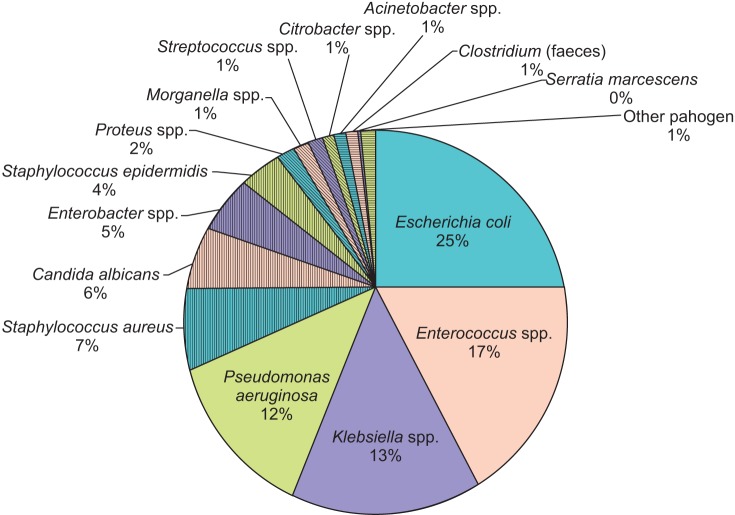
The incidence of HAIs was 6.3%. The most common types were urinary infections (70.5%) and surgical site infections (22.1%). Univariate analysis showed an increased risk of HAIs among patients with American Society of Anesthesiologists physical status classification system III-IV (odds ratio [OR], 1.39; p<0.001), immunosuppression (OR, 1.80; p=0.013), previous urinary infection (OR, 4.46; p<0,001), and urinary catheter before admission (OR, 1.74; p<0.001). The surgical procedures with the highest incidence of HAIs were radical cystectomy (54.2%) and renal surgery (8.7%). The most frequently isolated microorganisms were (25.1%), spp. (17.5%), spp. (13.5%) and (12.3%). was the most common microorganism after radical cystectomy and in surgical site infections, showed resistance rates of 53.5% for fluoroquinolones, 9.3% for amikacin. The percentage of extended-spectrum betalactamase producing was 24.7%. spp. showed resistance rates of 47.8% for fluoroquinolones, 7.1% for amikacin and 4.3% for carbapenems. spp showed resistance rates of 1.7% for vancomycin and; of 33.3% for carbapenems and 26.2% for amikacin.
Comorbidities, previous urinary infections, and urinary catheter are risk factors for HAIs. The microorganisms most commonly isolated were , and . Prospective monitoring may decrease the incidence of infections.
由于特定的风险因素,泌尿外科患者的医疗保健相关感染(HAIs)具有特殊特征。我们的目标是评估泌尿外科病房住院患者HAIs的特征和风险因素。
我们前瞻性地评估了2012年至2015年期间HAIs的发病率、类型和风险因素、微生物学及耐药模式。
HAIs的发病率为6.3%。最常见的类型是泌尿系统感染(70.5%)和手术部位感染(22.1%)。单因素分析显示,美国麻醉医师协会身体状况分类系统III-IV级患者发生HAIs的风险增加(比值比[OR],1.39;p<0.001),免疫抑制患者(OR,1.80;p=0.013)、既往泌尿系统感染患者(OR,4.46;p<0.001)以及入院前留置导尿管的患者(OR,1.74;p<0.001)。HAIs发病率最高的手术是根治性膀胱切除术(54.2%)和肾脏手术(8.7%)。最常分离出的微生物是……(25.1%)、……属(17.5%)、……属(13.5%)和……(12.3%)。……是根治性膀胱切除术后及手术部位感染中最常见的微生物,对氟喹诺酮类药物的耐药率为53.5%,对阿米卡星的耐药率为9.3%。产超广谱β-内酰胺酶的……百分比为24.7%。……属对氟喹诺酮类药物的耐药率为47.8%,对阿米卡星的耐药率为7.1%,对碳青霉烯类药物的耐药率为4.3%。……属对万古霉素的耐药率为1.7%;……对碳青霉烯类药物的耐药率为33.3%,对阿米卡星的耐药率为26.2%。
合并症、既往泌尿系统感染和留置导尿管是HAIs的风险因素。最常分离出的微生物是……、……和……。前瞻性监测可能会降低感染发生率。