Medina-Polo José, Gil-Moradillo Javier, González-Díaz Alejandro, Abad-López Pablo, Santos-Pérez de la Blanca Rocío, Hernández-Arroyo Mario, Peña-Vallejo Helena, Téigell-Tobar Julio, Calzas-Montalvo Cristina, Caro-González Prado, Miranda-Utrera Natalia, Tejido-Sánchez Ángel
Department of Urology, Health Research Institute i+12, Hospital Universitario 12 de Octubre, Madrid, Spain.
GMS Infect Dis. 2021 Aug 30;9:Doc04. doi: 10.3205/id000073. eCollection 2021.
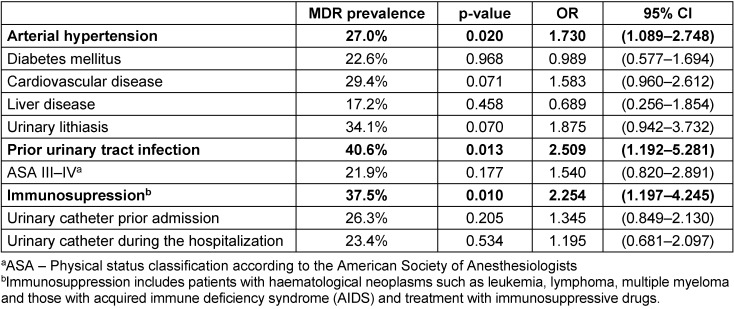
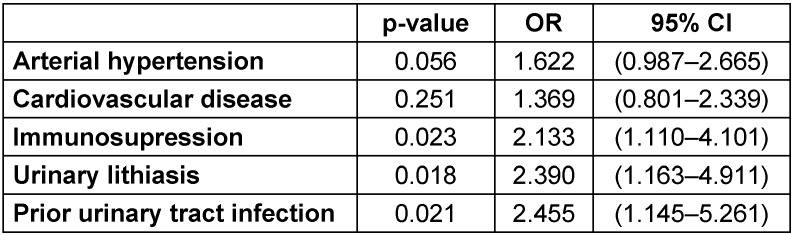
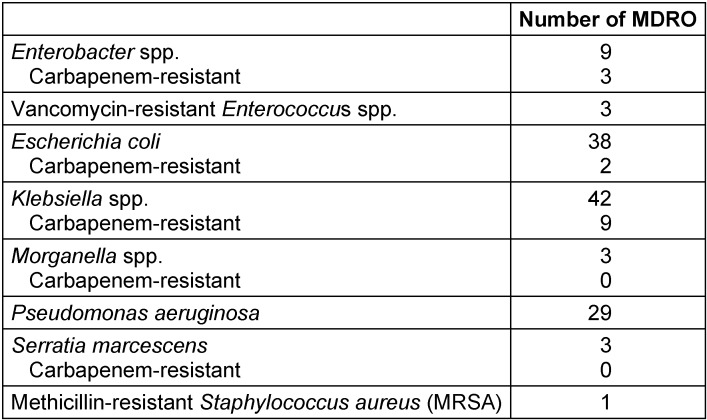
To analyze, in a urology ward, the prevalence and characteristics of healthcare-associated infections (HAIs) due to multidrug-resistant organisms (MDRO). We carried out an observational study from 2012 to 2019, evaluating MDRO among patients with HAIs, who were hospitalized in the urology ward. MDRO include spp., resistant to at least three antibiotic groups, extended-spectrum beta-lactamase (ESBL) producing or those resistant to carbapenems, and spp. resistant to vancomycin. Among patients with HAIs, MDRO were isolated in 100 out of 438 (22.8%) positive cultures. Univariate and multivariate analyses reported that prior urinary tract infection (UTI) [OR 2.45; 95% CI 1.14-5.36; p=0.021] and immunosuppression [OR 2.13; 95% CI 1.11-4.10; p=0.023] were risk factors for MDRO. A high prevalence of MRDO was found in patients with a catheter in the upper urinary tract; 27.6% for double J stent, 29.6% in those with a nephrostomy tube, and 50% in those with a percutaneous internal/external nephroureteral (PCNU) stent. MDRO were isolated in 28.4% of cultures with (23.8% and 44.7% in those with and spp.); 7% of showed resistance to carbapenems (1.3% and 10% for and spp., respectively). Three out of 80 spp. were vancomycin-resistant. The rate of resistant to at least three antibiotic groups was 36.3%. The isolation of MDRO, in up to 25% of positive cultures in a urology ward, constitutes a challenge for the selection of antibiotics. MDRO are more common in immunosuppressed patients, those with previous UTIs, and those with a catheter in the upper urinary tract.
为分析泌尿外科病房中耐多药微生物(MDRO)所致医疗保健相关感染(HAI)的患病率及特征。我们于2012年至2019年开展了一项观察性研究,评估在泌尿外科病房住院的HAI患者中的MDRO情况。MDRO包括对至少三类抗生素耐药的 菌属、产超广谱β-内酰胺酶(ESBL)的 菌或对碳青霉烯类耐药的 菌,以及对万古霉素耐药的 菌。在HAI患者中,438份阳性培养物中有100份(22.8%)分离出MDRO。单因素和多因素分析显示,既往尿路感染(UTI)[比值比(OR)2.45;95%置信区间(CI)1.14 - 5.36;p = 0.021]和免疫抑制[OR 2.13;95% CI 1.11 - 4.10;p = 0.023]是MDRO的危险因素。在上尿路置管患者中发现MDRO的患病率较高;双J支架患者为27.6%,肾造瘘管患者为29.6%,经皮肾内外输尿管(PCNU)支架患者为50%。在 菌培养物中,28.4%分离出MDRO( 菌和 菌培养物中分别为23.8%和44.7%);7%的 菌对碳青霉烯类耐药( 菌和 菌分别为1.3%和10%)。80株 菌中有3株对万古霉素耐药。对至少三类抗生素耐药的 菌比例为36.3%。在泌尿外科病房,高达25%的阳性培养物中分离出MDRO,这对抗生素的选择构成了挑战。MDRO在免疫抑制患者、既往有UTI的患者以及上尿路置管患者中更为常见。