Liu Minna, Ning Xiaoxuan, Li Rong, Yang Zhen, Yang Xiaoxia, Sun Shiren, Qian Qi
Department of Nephrology, Xijing Hospital, Fourth Military Medical University, Xi'an, Shaanxi, China.
State Key Laboratory of Cancer Biology, Fourth Military Medical University, Xi'an, Shaanxi, China.
J Cell Mol Med. 2017 Jul;21(7):1248-1259. doi: 10.1111/jcmm.13060. Epub 2017 Jan 18.
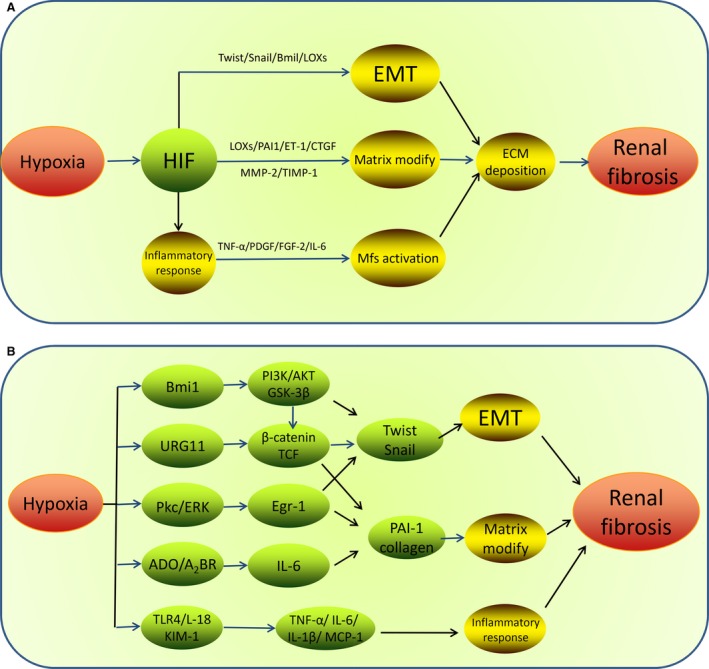
Renal fibrosis is the common pathological hallmark of progressive chronic kidney disease (CKD) with diverse aetiologies. Recent researches have highlighted the critical role of hypoxia during the development of renal fibrosis as a final common pathway in end-stage kidney disease (ESKD), which joints the scientist's attention recently to exploit the molecular mechanism underlying hypoxia-induced renal fibrogenesis. The scaring formation is a multilayered cellular response and involves the regulation of multiple hypoxia-inducible signalling pathways and complex interactive networks. Therefore, this review will focus on the signalling pathways involved in hypoxia-induced pathogenesis of interstitial fibrosis, including pathways mediated by HIF, TGF-β, Notch, PKC/ERK, PI3K/Akt, NF-κB, Ang II/ROS and microRNAs. Roles of molecules such as IL-6, IL-18, KIM-1 and ADO are also reviewed. A comprehensive understanding of the roles that these hypoxia-responsive signalling pathways and molecules play in the context of renal fibrosis will provide a foundation towards revealing the underlying mechanisms of progression of CKD and identifying novel therapeutic targets. In the future, promising new effective therapy against hypoxic effects may be successfully translated into the clinic to alleviate renal fibrosis and inhibit the progression of CKD.
肾纤维化是各种病因所致慢性肾脏病(CKD)进展的常见病理标志。近期研究强调了缺氧在肾纤维化发展过程中的关键作用,它是终末期肾病(ESKD)的最终共同通路,这使得科学家们最近将注意力集中于探索缺氧诱导肾纤维化的分子机制。瘢痕形成是一种多层次的细胞反应,涉及多种缺氧诱导信号通路和复杂的交互网络的调控。因此,本综述将聚焦于参与缺氧诱导的间质纤维化发病机制的信号通路,包括由缺氧诱导因子(HIF)、转化生长因子-β(TGF-β)、Notch、蛋白激酶C/细胞外信号调节激酶(PKC/ERK)、磷脂酰肌醇-3激酶/蛋白激酶B(PI3K/Akt)、核因子-κB(NF-κB)、血管紧张素II/活性氧(Ang II/ROS)和微小RNA介导的信号通路。还将综述白细胞介素-6(IL-6)、白细胞介素-18(IL-18)、肾损伤分子-1(KIM-1)和腺苷(ADO)等分子的作用。全面了解这些缺氧反应性信号通路和分子在肾纤维化中的作用,将为揭示CKD进展的潜在机制和确定新的治疗靶点奠定基础。未来,有望针对缺氧效应的新型有效疗法可能会成功转化至临床,以减轻肾纤维化并抑制CKD的进展。