Vesterby Martin Svoldgaard, Pedersen Preben Ulrich, Laursen Malene, Mikkelsen Søren, Larsen Jens, Søballe Kjeld, Jørgensen Lene Bastrup
a INNO-X Healthcare, Aarhus University.
e Department of Clinical Medicine , Aarhus University , Denmark .
Acta Orthop. 2017 Feb;88(1):41-47. doi: 10.1080/17453674.2016.1256939. Epub 2016 Nov 16.
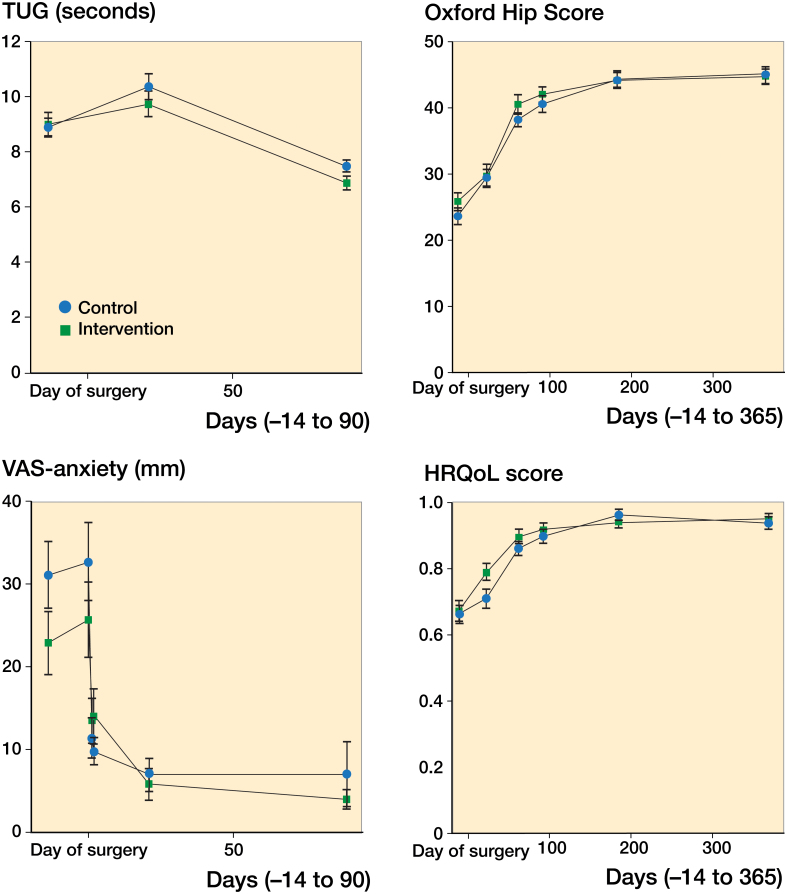
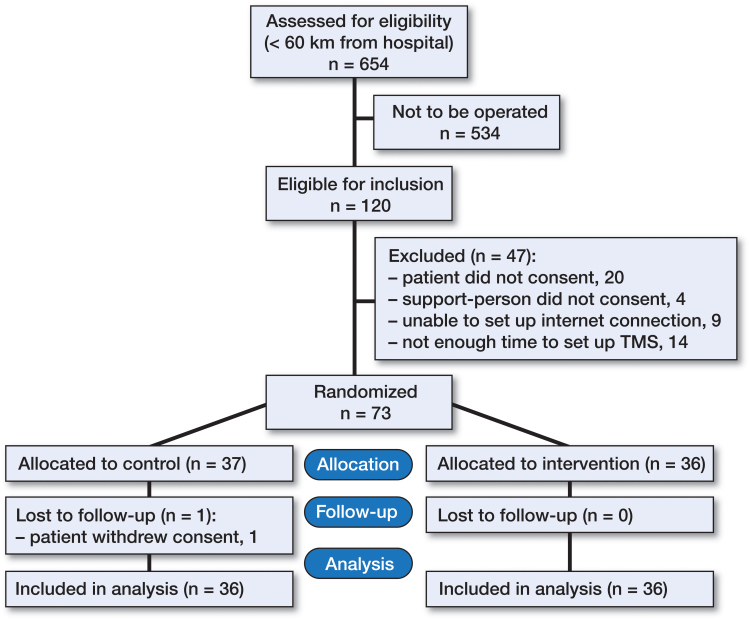
Background and purpose - Telemedicine could allow patients to be discharged more quickly after surgery and contribute to improve fast-track procedures without compromising quality, patient safety, functionality, anxiety, or other patient-perceived parameters. We investigated whether using telemedicine support (TMS) would permit hospital discharge after 1 day without loss of self-assessed quality of life, loss of functionality, increased anxiety, increased rates of re-admission, or increased rates of complications after hip replacement. Patients and methods - We performed a randomized controlled trial involving 72 Danish patients in 1 region who were referred for elective fast-track total hip replacement between August 2009 and March 2011 (654 were screened for eligibility). Half of the patients received a telemedicine solution connected to their TV. The patients were followed until 1 year after surgery. Results - Length of stay was reduced from 2.1 days (95% CI: 2.0-2.3) to 1.1 day (CI: 0.9-1.4; p < 0.001) with the TMS intervention. Health-related quality of life increased in both groups, but there were no statistically significant differences between groups. There were also no statistically significant differences between groups regarding timed up-and-go test and Oxford hip score at 3-month follow-up. At 12-month follow-up, the rates of complications and re-admissions were similar between the groups, but the number of postoperative hospital contacts was lower in the TMS group. Interpretation - Length of postoperative stay was shortened in patients with the TMS solution, without compromising patient-perceived or clinical parameters in patients undergoing elective fast-track surgery. These results indicate that telemedicine can be of value in fast-track treatment of patients undergoing total hip replacement.
背景与目的——远程医疗可使患者术后更快出院,并有助于改进快速康复流程,同时不影响医疗质量、患者安全、功能、焦虑程度或患者其他可感知参数。我们调查了使用远程医疗支持(TMS)是否能让患者在术后1天出院,且不会导致自我评估的生活质量下降、功能丧失、焦虑增加、再入院率升高或髋关节置换术后并发症发生率增加。患者与方法——我们在1个地区对72名丹麦患者进行了一项随机对照试验,这些患者在2009年8月至2011年3月期间被转诊接受择期快速康复全髋关节置换术(共筛查了654名患者的 eligibility)。一半患者收到了连接到其电视的远程医疗解决方案。对患者进行随访直至术后1年。结果——通过TMS干预,住院时间从2.1天(95%CI:2.0 - 2.3)缩短至1.1天(CI:0.9 - 1.4;p < 0.001)。两组患者与健康相关的生活质量均有所提高,但组间无统计学显著差异。在3个月随访时,两组在计时起立行走测试和牛津髋关节评分方面也无统计学显著差异。在12个月随访时,两组并发症和再入院率相似,但TMS组术后医院联系次数较少。解读——采用TMS解决方案的患者术后住院时间缩短了,且未影响接受择期快速康复手术患者的可感知参数或临床参数。这些结果表明,远程医疗在全髋关节置换术患者的快速康复治疗中具有价值。