Pavan Sonia, Rommel Kathrin, Mateo Marquina María Elena, Höhn Sophie, Lanneau Valérie, Rath Ana
Inserm, US14 - Orphanet, Paris, France.
Orphanet Germany, Centre for Rare Diseases, Hannover Medical School, Hannover, Germany.
PLoS One. 2017 Jan 18;12(1):e0170365. doi: 10.1371/journal.pone.0170365. eCollection 2017.
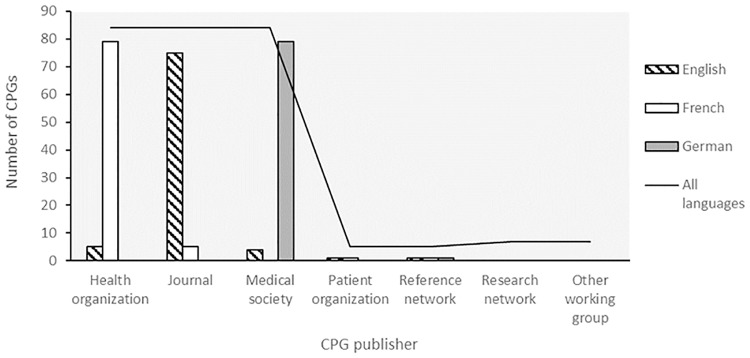
Clinical practice guidelines (CPGs) for rare diseases (RDs) are scarce, may be difficult to identify through Internet searches and may vary in quality depending on the source and methodology used. In order to contribute to the improvement of the diagnosis, treatment and care of patients, Orphanet (www.orpha.net) has set up a procedure for the selection, quality evaluation and dissemination of CPGs, with the aim to provide easy access to relevant, accurate and specific recommendations for the management of RDs. This article provides an analysis of selected CPGs by medical domain coverage, prevalence of diseases, languages and type of producer, and addresses the variability in CPG quality and availability. CPGs are identified via bibliographic databases, websites of research networks, expert centres or medical societies. They are assessed according to quality criteria derived from the Appraisal of Guidelines, REsearch and Evaluation (AGREE II) Instrument. Only open access CPGs and documents for which permission from the copyright holders has been obtained are disseminated on the Orphanet website. From January 2012 to July 2015, 277 CPGs were disseminated, representing coverage of 1,122 groups of diseases, diseases or subtypes in the Orphanet database. No language restriction is applied, and so far 10 languages are represented, with a predominance of CPGs in English, French and German (92% of all CPGs). A large proportion of diseases with identified CPGs belong to rare oncologic, neurologic, hematologic diseases or developmental anomalies. The Orphanet project on CPG collection, evaluation and dissemination is a continuous process, with regular addition of new guidelines, and updates. CPGs meeting the quality criteria are integrated to the Orphanet database of rare diseases, together with other types of textual information and the appropriate services for patients, researchers and healthcare professionals in 40 countries.
罕见病的临床实践指南(CPG)数量稀少,可能难以通过互联网搜索找到,并且质量可能因来源和所采用的方法而异。为了有助于改善患者的诊断、治疗和护理,Orphanet(www.orpha.net)建立了一套CPG的筛选、质量评估和传播程序,旨在为罕见病的管理提供方便获取的相关、准确和具体的建议。本文按医学领域覆盖范围、疾病患病率、语言和制定者类型对选定的CPG进行了分析,并探讨了CPG质量和可获取性的差异。CPG通过书目数据库、研究网络网站、专家中心或医学协会来识别。根据源自《指南评估、研究与评价(AGREE II)工具》的质量标准对其进行评估。只有开放获取的CPG以及已获得版权所有者许可的文件才会在Orphanet网站上传播。从2012年1月至2015年7月,共传播了277份CPG,涵盖了Orphanet数据库中的1122组疾病、病症或亚型。没有语言限制,到目前为止有10种语言的CPG,其中英语、法语和德语的CPG占主导(占所有CPG的92%)。已确定CPG的疾病中很大一部分属于罕见肿瘤、神经、血液疾病或发育异常。Orphanet关于CPG收集、评估和传播的项目是一个持续的过程,会定期添加新指南并进行更新。符合质量标准的CPG与其他类型的文本信息以及为40个国家的患者、研究人员和医疗保健专业人员提供的适当服务一起被整合到Orphanet罕见病数据库中。