Li Ling-Jun, Kramer Michael, Tapp Robyn J, Man Ryan E K, Lek Ngee, Cai Shirong, Yap Fabian, Gluckman Peter, Tan Kok Hian, Chong Yap Seng, Koh Jia Yu, Saw Seang Mei, Cheung Yin Bun, Wong Tien Yin
Singapore Eye Research Institute, Singapore National Eye Centre, 11 Third Hospital Ave, Singapore, 168751, Singapore.
Centre for Quantitative Medicine, Duke-NUS Graduate Medical School, 8 College Road, Singapore, 169857, Singapore.
BMC Ophthalmol. 2017 Jan 18;17(1):4. doi: 10.1186/s12886-016-0398-7.
Small-vessel dysfunction may be an important consequence of chronic hyperglycemia. We examined the association between gestational diabetes mellitus (GDM), a state of transient hyperglycemia during pregnancy, and retinal microvascular changes in pregnant women at 26-28 weeks of pregnancy.
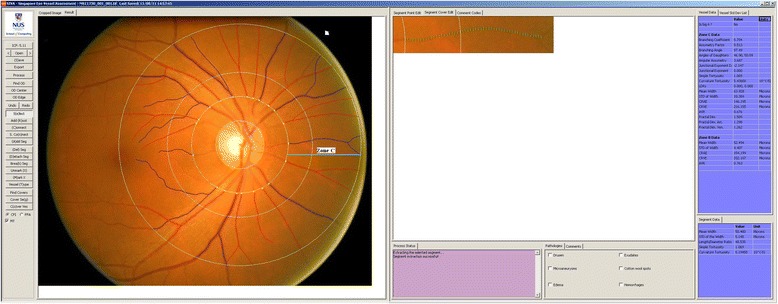
A total of 1136 pregnant women with singleton pregnancies were recruited during their first trimester at two major Singapore maternity hospitals in an on-going birth cohort study. Participants underwent an oral glucose tolerance test and retinal imaging at 26-28 weeks gestation (n = 542). We used the 1999 World Health Organization (WHO) criteria to define GDM: ≥7.0 mmol/L for fasting glucose and/or ≥7.8 mmol/L for 2-h post-glucose. Retinal microvasculature was measured using computer software (Singapore I Vessel Analyzer, SIVA version 3.0, Singapore Eye Research Institute, Singapore) from the retinal photographs.
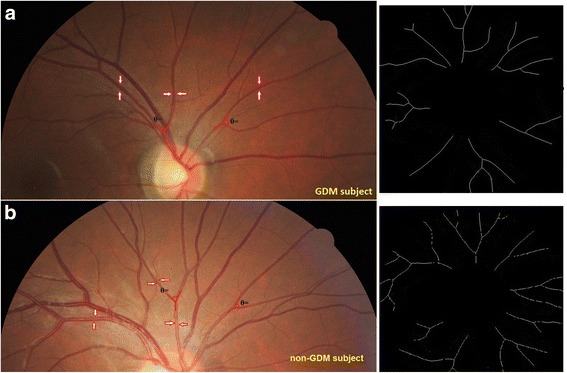
In a multiple linear regression model adjusting for age, ethnicity and maternal education, mothers with GDM had narrower arteriolar caliber (-1.6 μm; 95% Confidence Interval [CI]: -3.1 μm, -0.2 μm), reduced arteriolar fractal dimension (-0.01 Df; 95% CI: -0.02 Df, -0.001 Df;), and larger arteriolar branching angle (1.8°; 95% CI: 0.3°, 3.3°) than mothers without GDM. After further adjusting for traditional risks of GDM, arteriolar branching angle remained significantly larger in mothers with GDM than those without GDM (2.0°; 95% CI: 0.5°, 3.6°).
GDM was associated with a series of retinal arteriolar abnormalities, including narrower caliber, reduced fractal dimension and larger branching angle, suggesting that transient hyperglycemia during pregnancy may cause small-vessel dysfunction.
小血管功能障碍可能是慢性高血糖的一个重要后果。我们研究了妊娠糖尿病(GDM),即孕期短暂高血糖状态,与妊娠26 - 28周孕妇视网膜微血管变化之间的关联。
在新加坡两家主要妇产医院进行的一项正在进行的出生队列研究中,共招募了1136名单胎妊娠孕妇,她们在孕早期入组。参与者在妊娠26 - 28周时接受了口服葡萄糖耐量试验和视网膜成像(n = 542)。我们采用1999年世界卫生组织(WHO)标准定义GDM:空腹血糖≥7.0 mmol/L和/或葡萄糖后2小时血糖≥7.8 mmol/L。使用计算机软件(新加坡IVessel Analyzer,SIVA版本3.0,新加坡眼科研究所,新加坡)从视网膜照片测量视网膜微血管。
在调整了年龄、种族和母亲教育程度的多元线性回归模型中,患有GDM的母亲比未患GDM的母亲有更窄的小动脉管径(-1.6μm;95%置信区间[CI]:-3.1μm,-0.2μm),更小的小动脉分形维数(-0.01 Df;95% CI:-0.02 Df,-0.001 Df),以及更大的小动脉分支角度(1.8°;95% CI:0.3°,3.3°)。在进一步调整GDM的传统风险因素后,患有GDM的母亲的小动脉分支角度仍显著大于未患GDM的母亲(2.0°;95% CI:0.5°,3.6°)。
GDM与一系列视网膜小动脉异常有关,包括管径变窄、分形维数降低和分支角度增大,提示孕期短暂高血糖可能导致小血管功能障碍。