Limmroth Volker, Ziemssen Tjalf, Lang Michael, Richter Stephan, Wagner Bert, Haas Judith, Schmidt Stephan, Gerbershagen Kathrin, Lassek Christoph, Klotz Luisa, Hoffmann Olaf, Albert Christian, Schuh Katrin, Baier-Ebert Monika, Wendt Guillaume, Schieb Heinke, Hoyer Susanne, Dechend Ralf, Haverkamp Wilhelm
Department of Neurology, Cologne General Hospitals, University of Cologne, Cologne, Germany.
Center of Clinical Neuroscience, University Clinic Carl Gustav Carus Dresden, Dresden, Germany.
BMC Neurol. 2017 Jan 18;17(1):11. doi: 10.1186/s12883-016-0789-7.
First dose observation for cardiac effects is required for fingolimod, but recommendations on the extent vary. This study aims to assess cardiac safety of fingolimod first dose. Individual bradyarrhythmic episodes were evaluated to assess the relevance of continuous electrocardiogram (ECG) monitoring.
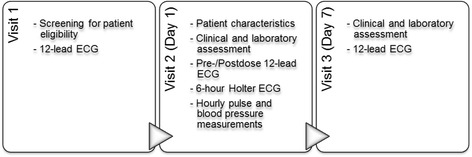
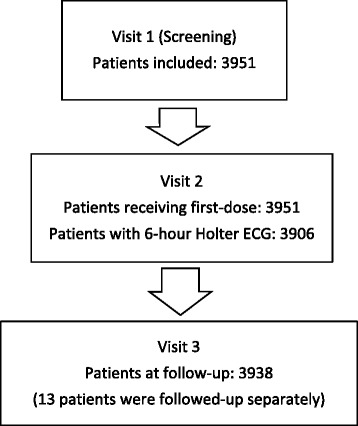
START is an ongoing open-label, multi-center study. At the time of analysis 3951 patients were enrolled. The primary endpoints are the incidence of bradycardia (heart rate < 45 bpm) and second-/third-degree AV blocks during treatment initiation. The relevance of Holter was assessed by matching ECG findings with the occurrence of clinical symptoms as well as by rigorous analysis of AV blocks with regard to the duration of pauses and the minimal heart rate recorded during AV block.
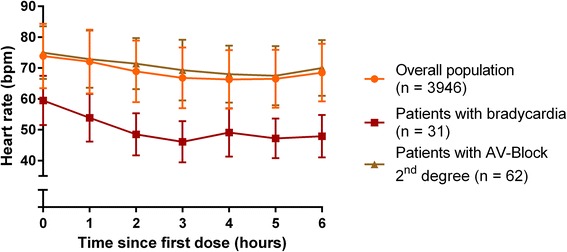
Thirty-one patients (0.8%) developed bradycardia (<45 bpm), 62 patients (1.6%) had second-degree Mobitz I and/or 2:1 AV blocks with a lowest reading (i.e. mean of ten consecutive beats) of 35 bpm and the longest pause lasting for 2.6 s. No Mobitz II or third-degree AV blocks were observed. Only one patient complained about mild chest discomfort and fatigue. After 1 week, there was no second-/third-degree AV block.
Continuous Holter ECG monitoring in this large real-life cohort revealed that bradycardia and AV conduction abnormalities were rare, transient and benign. No further unexpected abnormalities were detected. The data presented here give an indication that continuous Holter ECG monitoring does not add clinically relevant value to patients' safety.
NCT01585298 ; registered April 23, 2012.
芬戈莫德需要进行首剂心脏效应观察,但关于观察程度的建议各不相同。本研究旨在评估芬戈莫德首剂的心脏安全性。对个体缓慢性心律失常发作进行评估,以评估连续心电图(ECG)监测的相关性。
START是一项正在进行的开放标签、多中心研究。在分析时,共纳入3951例患者。主要终点是治疗开始时心动过缓(心率<45次/分钟)和二度/三度房室传导阻滞的发生率。通过将心电图结果与临床症状的发生情况相匹配,以及对房室传导阻滞的暂停持续时间和房室传导阻滞期间记录的最低心率进行严格分析,来评估动态心电图的相关性。
31例患者(0.8%)出现心动过缓(<45次/分钟),62例患者(1.6%)出现二度莫氏I型和/或2:1房室传导阻滞,最低读数(即连续十次心跳的平均值)为35次/分钟,最长停顿持续2.6秒。未观察到莫氏II型或三度房室传导阻滞。只有1例患者抱怨有轻度胸部不适和疲劳。1周后,无二度/三度房室传导阻滞。
在这个大型现实生活队列中进行的连续动态心电图监测显示,心动过缓和房室传导异常罕见、短暂且为良性。未检测到其他意外异常。此处呈现的数据表明,连续动态心电图监测对患者安全没有增加临床相关价值。
NCT01585298;2012年4月23日注册。