Sacco James, Ruplin Andrew, Skonieczny Paul, Ohman Michael
Ellis Pharmacogenomics Laboratory, College of Pharmacy and Health Sciences, Drake University, Des Moines, IA 50311 USA.
Canine Genet Epidemiol. 2017 Jan 13;4:1. doi: 10.1186/s40575-016-0040-2. eCollection 2017.
In humans, reduced activity of the enzyme monoamine oxidase type A (MAOA) due to genetic polymorphisms within the gene leads to increased brain neurotransmitter levels associated with aggression. In order to study MAOA genetic diversity in dogs, we designed a preliminary study whose objectives were to identify novel alleles in functionally important regions of the canine gene, and to investigate whether the frequencies of these polymorphisms varied between five broad breed groups (ancient, herding, mastiff, modern European, and mountain). Fifty dogs representing these five breed groups were sequenced.
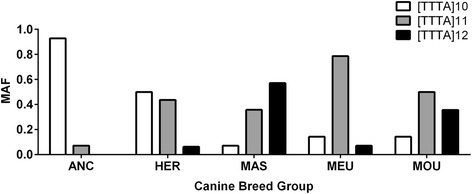
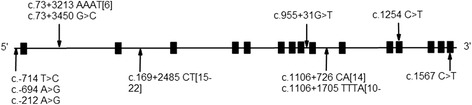
A total of eleven polymorphisms were found. Seven were single nucleotide polymorphisms (SNPs; two exonic, two intronic and three in the promoter), while four were repeat intronic variations. The most polymorphic loci were repeat regions in introns 1, 2 (7 alleles) and 10 (3 alleles), while the exonic and the promoter regions were highly conserved. Comparison of the allele frequencies of certain microsatellite polymorphisms among the breed groups indicated a decreasing or increasing trend in the number of repeats at different microsatellite loci, as well as the highest genetic diversity for the ancient breeds and the lowest for the most recent mountain breeds, perhaps attributable to canine domestication and recent breed formation. While a specific promoter SNP (-212A > G) is rare in the dog, it is the major allele in wolves. Replacement of this ancestral allele in domestic dogs may lead to the deletion of heat shock factor binding sites on the promoter.
Dogs exhibit significant variation in certain intronic regions of the gene, while the coding and promoter regions are well-conserved. Distinct genetic differences were observed between breed groups. Further studies are now required to establish whether such polymorphisms are associated in any way with MAOA level and canine behaviour including aggression.
在人类中,由于该基因内的遗传多态性导致单胺氧化酶A(MAOA)活性降低,会使与攻击行为相关的大脑神经递质水平升高。为了研究犬类MAOA基因的多样性,我们设计了一项初步研究,其目的是在犬类该基因功能重要区域鉴定新的等位基因,并调查这些多态性的频率在五个广泛的品种组(古老品种、畜牧品种、獒犬品种、现代欧洲品种和山地品种)之间是否存在差异。对代表这五个品种组的50只狗进行了测序。
共发现11个多态性位点。其中7个是单核苷酸多态性(SNP;2个在外显子中,2个在内含子中,3个在启动子中),而4个是内含子重复变异。多态性最高的位点是内含子1、2(7个等位基因)和10(3个等位基因)中的重复区域,而外显子和启动子区域高度保守。品种组间某些微卫星多态性的等位基因频率比较表明,不同微卫星位点的重复次数有减少或增加的趋势,古老品种的遗传多样性最高,而最近的山地品种最低,这可能归因于犬类的驯化和近期品种的形成。虽然一个特定的启动子SNP(-212A>G)在狗中很少见,但它是狼中的主要等位基因。家犬中这种祖先等位基因的替换可能导致该启动子上热休克因子结合位点的缺失。
狗在该基因的某些内含子区域表现出显著变异,而编码区和启动子区域则高度保守。在品种组之间观察到明显的遗传差异。现在需要进一步研究来确定这些多态性是否以任何方式与MAOA水平以及包括攻击行为在内的犬类行为相关。