Zhu Yu-Jun, Huang De-Run, Fan Ye-Yang, Zhang Zhen-Hua, Ying Jie-Zheng, Zhuang Jie-Yun
State Key Laboratory of Rice Biology and Chinese National Center for Rice Improvement, China National Rice Research Institute, Hangzhou 310006, China.
Int J Genomics. 2016;2016:2587823. doi: 10.1155/2016/2587823. Epub 2016 Dec 22.
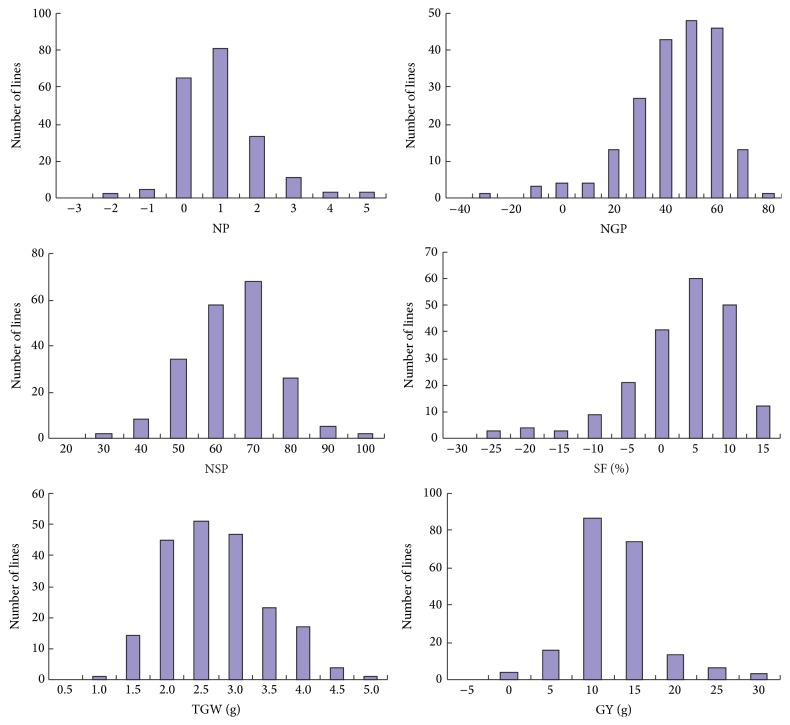
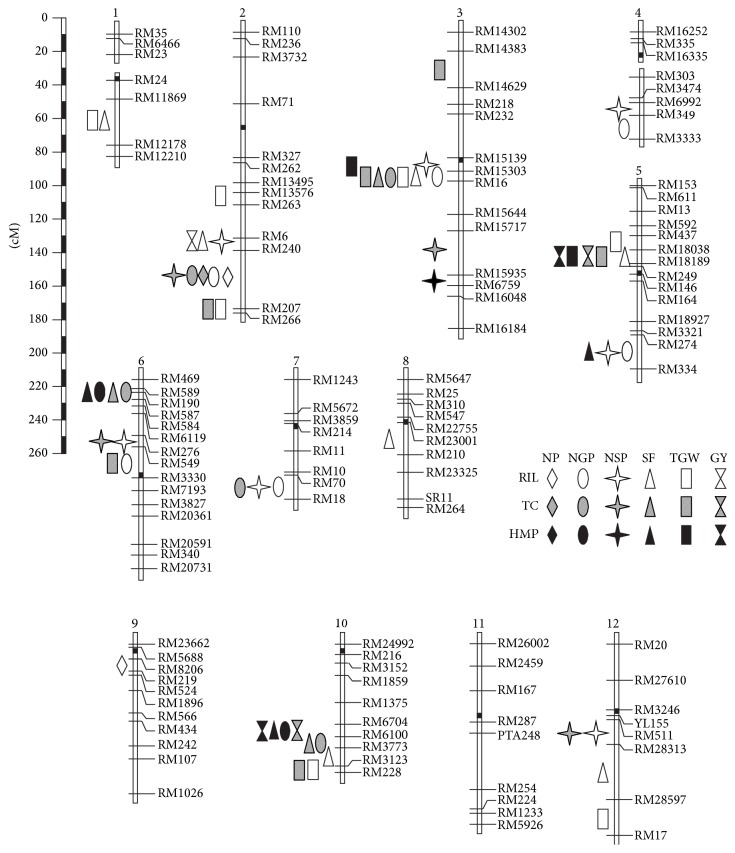
Analysis of the genetic basis of yield heterosis in rice was conducted by quantitative trait locus mapping using a set of 204 recombinant inbred lines (RILs), its testcross population, and mid-parent heterosis dataset (H). A total of 39 QTLs for six yield traits were detected, of which three were detected in all the datasets, ten were common to the RIL and testcross populations, six were common to the testcross and H, and 17, 2, and 1 were detected for RILs, testcrosses, and H, respectively. When a QTL was detected in both the RIL and testcross populations, the difference between TQ and IR24 and that between Zh9A/TQ and Zh9A/IR24 were always in the same direction, providing the potential to increase the yield of hybrids by increasing the yield of parental lines. Genetic action mode of the 39 QTLs was inferred by comparing their performances in RILs, testcrosses, and H. The genetic modes were additive for 17 QTLs, dominance for 12 QTLs, and overdominance for 10 QTLs. These results suggest that dominance and overdominance are the most important contributor to yield heterosis in rice, in which the accumulative effects of yield components play an important role.
利用一套204个重组自交系(RIL)、其测交群体和中亲杂种优势数据集(H),通过数量性状基因座定位对水稻产量杂种优势的遗传基础进行了分析。共检测到6个产量性状的39个QTL,其中3个在所有数据集中均被检测到,10个在RIL和测交群体中共同存在,6个在测交群体和H中共同存在,分别在RIL、测交群体和H中检测到17个、2个和1个。当在RIL和测交群体中均检测到一个QTL时,TQ与IR24之间的差异以及Zh9A/TQ与Zh9A/IR24之间的差异始终方向相同,这为通过提高亲本系产量来增加杂交种产量提供了潜力。通过比较39个QTL在RIL、测交群体和H中的表现来推断其遗传作用模式。遗传模式为加性的有17个QTL,显性的有12个QTL,超显性的有10个QTL。这些结果表明,显性和超显性是水稻产量杂种优势的最重要贡献因素,其中产量构成因素的累加效应起着重要作用。