Feldman William B, Kim Anthony S, Chiong Winston
From the Department of Medicine, Brigham and Women's Hospital, Boston, MA (W.B.F.); Department of Neurology, Weill Institute for Neurosciences, University of California, San Francisco (A.S.K, W.C.); and the University of California, San Francisco Memory and Aging Center (W.C.).
Stroke. 2017 Mar;48(3):799-801. doi: 10.1161/STROKEAHA.116.014458. Epub 2017 Jan 19.
Slow recruitment in acute stroke trials hampers the evaluation of new therapies and delays the adoption of effective therapies into clinical practice. This systematic review evaluates whether recruitment efficiency and rates have increased in acute stroke trials from 1990 to 2014.
Acute stroke trials from 2010 to 2014 were identified by a search of PubMed, Medline, the Cochrane Database of Research in Stroke, and the Stroke Trials Registry. These trials were compared to a previously published data set of trials conducted from 1990 to 2004.
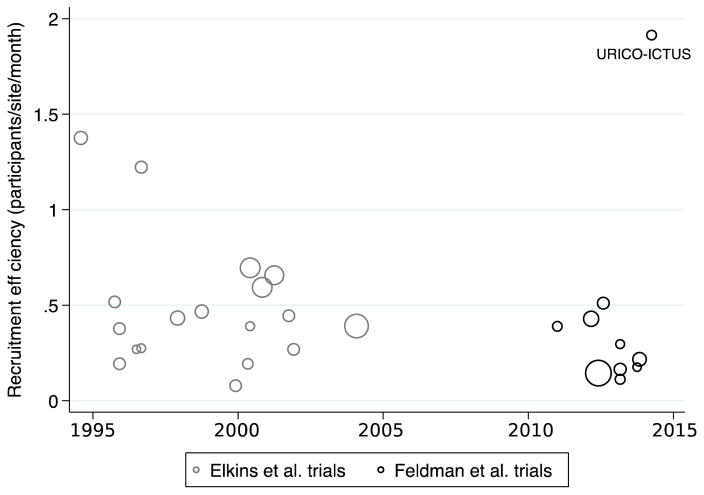
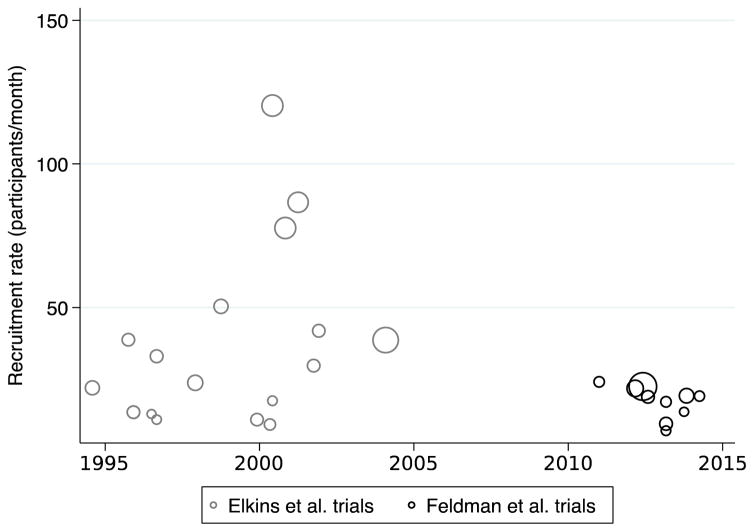
The median recruitment efficiency of trials from 1990 to 2004 was 0.41 participants/site/month compared with 0.26 participants/site/month from 2010 to 2014 (=0.14). The median recruitment rate of trials from 1990 to 2004 was 26.8 participants/month compared with 19.0 participants/month from 2010 to 2014 (=0.13).
For acute stroke trials, neither recruitment efficiency nor recruitment rates have increased over the past 25 years and, if anything, have declined.
急性中风试验中招募速度缓慢阻碍了新疗法的评估,并延迟了有效疗法在临床实践中的应用。本系统评价评估了1990年至2014年急性中风试验中招募效率和招募率是否有所提高。
通过检索PubMed、Medline、中风研究Cochrane数据库和中风试验注册库,确定2010年至2014年的急性中风试验。将这些试验与之前发表的1990年至2004年进行的试验数据集进行比较。
1990年至2004年试验的招募效率中位数为0.41名受试者/站点/月,而2010年至2014年为0.26名受试者/站点/月(=0.14)。1990年至2004年试验的招募率中位数为26.8名受试者/月,而2010年至2014年为19.0名受试者/月(=0.13)。
对于急性中风试验,在过去25年中,招募效率和招募率均未提高,而且如果有变化的话,反而是下降了。