Suda Toshikuni, Okawa Osamu, Masaoka Rion, Gyotoku Yoshinori, Tokutomi Naohiko, Katayama Yasumi, Tamano Masaya
Toshikuni Suda, Osamu Okawa, Rion Masaoka, Yoshinori Gyotoku, Naohiko Tokutomi, Yasumi Katayama, Masaya Tamano, Department of Gastroenterology, Dokkyo Medical University Koshigaya Hospital, Saitama 343-8555, Japan.
World J Hepatol. 2017 Jan 8;9(1):64-68. doi: 10.4254/wjh.v9.i1.64.
To investigate shear wave (SW) propagation velocity in patients with untreated hepatitis C and patients with sustained virological response (SVR).
A total of 136 hepatitis C patients [85 patients who had not received antiviral therapy (naïve group) and 51 patients who had received antiviral therapy and subsequently achieved SVR of at least 24 wk (SVR group)] and 58 healthy volunteers and outpatients without liver disease (control group) underwent evaluation of liver stiffness by SW elastography (SWE). Various parameters were evaluated in the chronic hepatitis C patients at the time of SWE.
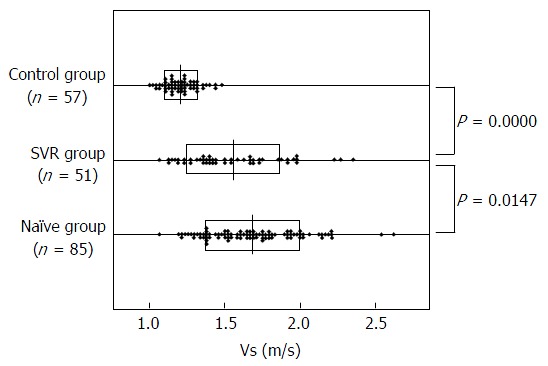
SW propagation velocity (Vs) was 1.23 ± 0.14 m/s in the control group, 1.56 ± 0.32 m/s in the SVR group, and 1.69 ± 0.31 m/s in the naïve group. Significant differences were seen between the control group and the SVR group ( = 0.0000) and between the SVR group and the naïve group ( = 0.01417). All four fibrosis markers were higher in the naïve group than in the SVR group. In the naïve group, Vs was positively correlated with alanine aminotransferase (ALT) ( = 0.5372), α feto protein (AFP) ( = 0.4389), type IV collagen ( = 0.5883), procollagen III peptide (P-III-P) ( = 0.4140), hyaluronic acid ( = 0.4551), and Mac-2 binding protein glycosylation isomer (M2BPGi) ( = 0.6092) and negatively correlated with albumin ( = -0.4289), platelets ( = -0.5372), and prothrombin activity ( = -0.5235). On multiple regression analysis, Vs was the most strongly correlated with ALT (standard partial regression std β = 0.4039, = 0.00000). In the SVR group, Vs was positively correlated with AFP ( = 0.6977), type IV collagen ( = 0.5228), P-III-P ( = 0.5812), hyaluronic acid ( = 0.5189), and M2BPGi ( = 0.6251) and negatively correlated with albumin ( = -0.4283), platelets ( = -0.4842), and prothrombin activity ( = -0.4771). On multiple regression analysis, Vs was strongly correlated with AFP (standard partial regression std β = 0.5953, = 0.00000) and M2BPGi (standard partial regression std β= 0.2969, = 0.03363).
In hepatitis C patients, liver stiffness is higher in treatment-naïve patients than in those showing SVR. SWE may be a predictor of hepatocarcinogenesis in SVR patients.
研究未经治疗的丙型肝炎患者和获得持续病毒学应答(SVR)的患者的剪切波(SW)传播速度。
136例丙型肝炎患者[85例未接受抗病毒治疗的患者(初治组)和51例接受抗病毒治疗并随后实现至少24周SVR的患者(SVR组)]以及58名无肝病的健康志愿者和门诊患者(对照组)接受了剪切波弹性成像(SWE)评估肝脏硬度。在SWE检查时对慢性丙型肝炎患者的各种参数进行评估。
对照组的SW传播速度(Vs)为1.23±0.14米/秒,SVR组为1.56±0.32米/秒,初治组为1.69±0.31米/秒。对照组与SVR组之间(P = 0.0000)以及SVR组与初治组之间(P = 0.01417)存在显著差异。初治组的所有四项纤维化标志物均高于SVR组。在初治组中,Vs与丙氨酸氨基转移酶(ALT)(P = 0.5372)、甲胎蛋白(AFP)(P = 0.4389)、IV型胶原(P = 0.5883)、III型前胶原肽(P-III-P)(P = 0.4140)、透明质酸(P = 0.4551)和Mac-2结合蛋白糖基化异构体(M2BPGi)(P = 0.6092)呈正相关,与白蛋白(P = -0.4289)、血小板(P = -0.5372)和凝血酶原活性(P = -0.5235)呈负相关。多元回归分析显示,Vs与ALT相关性最强(标准偏回归系数std β = 0.4039,P = 0.00000)。在SVR组中,Vs与AFP(P = 0.6977)、IV型胶原(P = 0.5228)、P-III-P(P = 0.5812)、透明质酸(P = 0.5189)和M2BPGi(P = 0.6251)呈正相关,与白蛋白(P = -0.4283)、血小板(P = -0.4842)和凝血酶原活性(P = -0.4771)呈负相关。多元回归分析显示,Vs与AFP(标准偏回归系数std β = 0.5953,P = 0.00000)和M2BPGi(标准偏回归系数std β = 0.2969,P = 0.03363)相关性较强。
在丙型肝炎患者中,初治患者的肝脏硬度高于实现SVR的患者。SWE可能是SVR患者肝癌发生的预测指标。