Ata Rehman, Antonescu Costin N
Department of Chemistry and Biology, Ryerson University, 350 Victoria Street, Toronto, ON M5B 2K3, Canada.
Graduate Program in Molecular Science, Ryerson University, 350 Victoria Street, Toronto, ON M5B 2K3, Canada.
Int J Mol Sci. 2017 Jan 18;18(1):189. doi: 10.3390/ijms18010189.
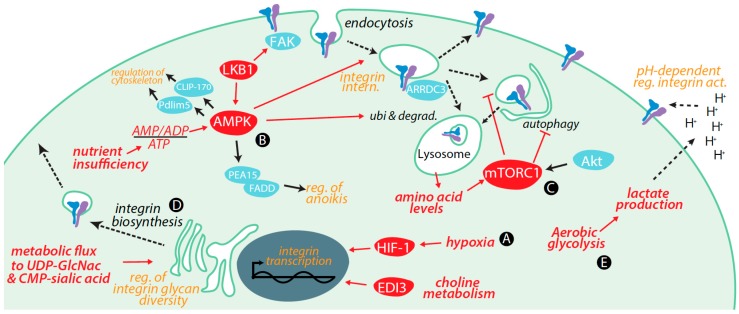
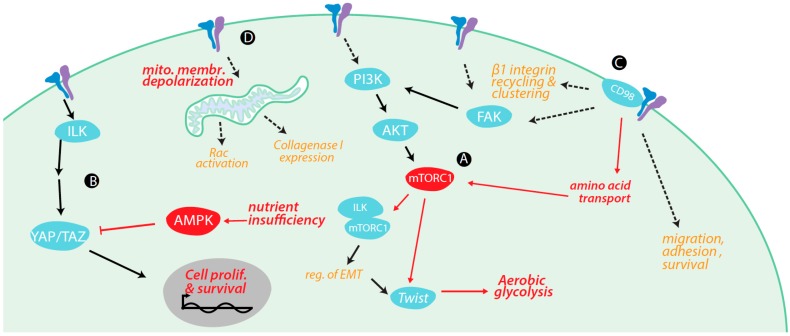
Integrins are important regulators of cell survival, proliferation, adhesion and migration. Once activated, integrins establish a regulated link between the extracellular matrix and the cytoskeleton. Integrins have well-established functions in cancer, such as in controlling cell survival by engagement of many specific intracellular signaling pathways and in facilitating metastasis. Integrins and associated proteins are regulated by control of transcription, membrane traffic, and degradation, as well as by a number of post-translational modifications including glycosylation, allowing integrin function to be modulated to conform to various cellular needs and environmental conditions. In this review, we examine the control of integrin function by cell metabolism, and the impact of this regulation in cancer. Within this context, nutrient sufficiency or deprivation is sensed by a number of metabolic signaling pathways such as AMP-activated protein kinase (AMPK), mammalian target of rapamycin (mTOR) and hypoxia-inducible factor (HIF) 1, which collectively control integrin function by a number of mechanisms. Moreover, metabolic flux through specific pathways also controls integrins, such as by control of integrin glycosylation, thus impacting integrin-dependent cell adhesion and migration. Integrins also control various metabolic signals and pathways, establishing the reciprocity of this regulation. As cancer cells exhibit substantial changes in metabolism, such as a shift to aerobic glycolysis, enhanced glucose utilization and a heightened dependence on specific amino acids, the reciprocal regulation of integrins and metabolism may provide important clues for more effective treatment of various cancers.
整合素是细胞存活、增殖、黏附和迁移的重要调节因子。一旦被激活,整合素就在细胞外基质和细胞骨架之间建立起一种受调控的联系。整合素在癌症中具有已明确的功能,例如通过许多特定的细胞内信号通路的参与来控制细胞存活以及促进转移。整合素及相关蛋白受到转录、膜运输和降解的调控,以及包括糖基化在内的多种翻译后修饰的调控,从而使整合素的功能能够被调节以适应各种细胞需求和环境条件。在本综述中,我们研究了细胞代谢对整合素功能的调控以及这种调控在癌症中的影响。在此背景下,多种代谢信号通路如AMP激活的蛋白激酶(AMPK)、雷帕霉素靶蛋白(mTOR)和缺氧诱导因子(HIF)1能够感知营养物质的充足或缺乏,它们通过多种机制共同控制整合素的功能。此外,特定途径的代谢通量也控制整合素,例如通过控制整合素的糖基化,从而影响整合素依赖的细胞黏附和迁移。整合素还控制各种代谢信号和途径,建立了这种调控的相互性。由于癌细胞在代谢方面表现出显著变化,如向有氧糖酵解转变、葡萄糖利用增强以及对特定氨基酸的依赖性增加,整合素与代谢的相互调控可能为更有效地治疗各种癌症提供重要线索。