Yi Gang-Shun, Wang Wei-Wei, Cao Wei-Guo, Wang Feng-Ping, Liu Xi-Peng
State Key Laboratory of Microbial Metabolism, School of Life Sciences & Biotechnology, Shanghai Jiao Tong University, Shanghai 200240, China.
Department of Genetics and Biochemistry, Clemson University, Clemson, SC 29634, USA.
Genes (Basel). 2017 Jan 18;8(1):38. doi: 10.3390/genes8010038.
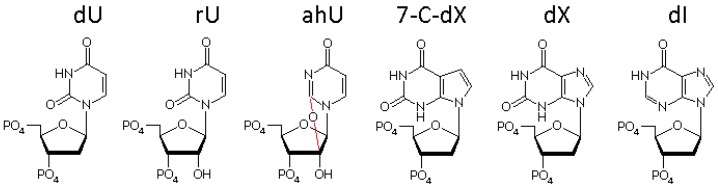
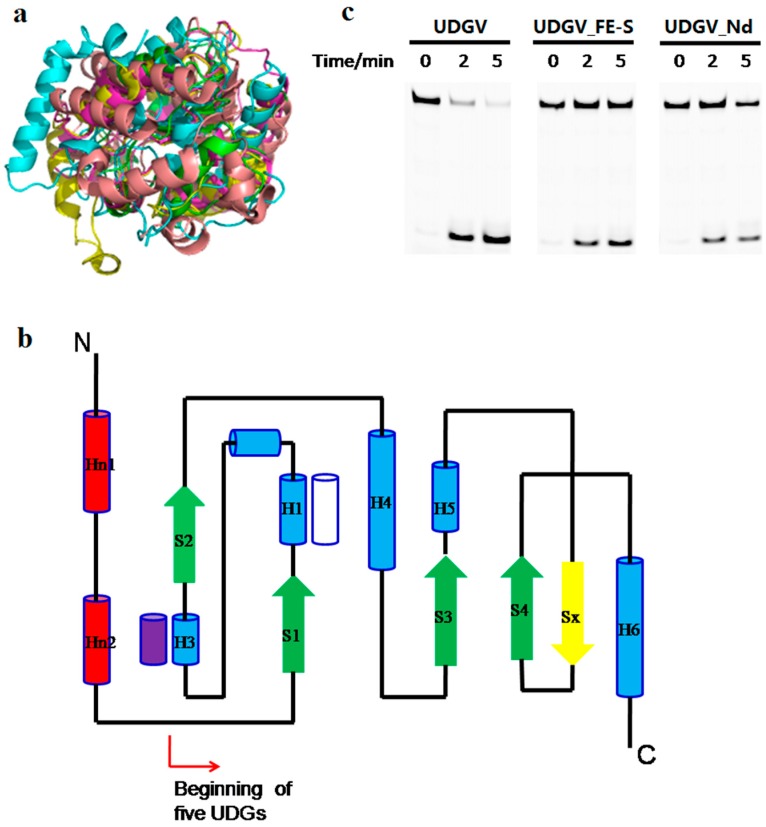
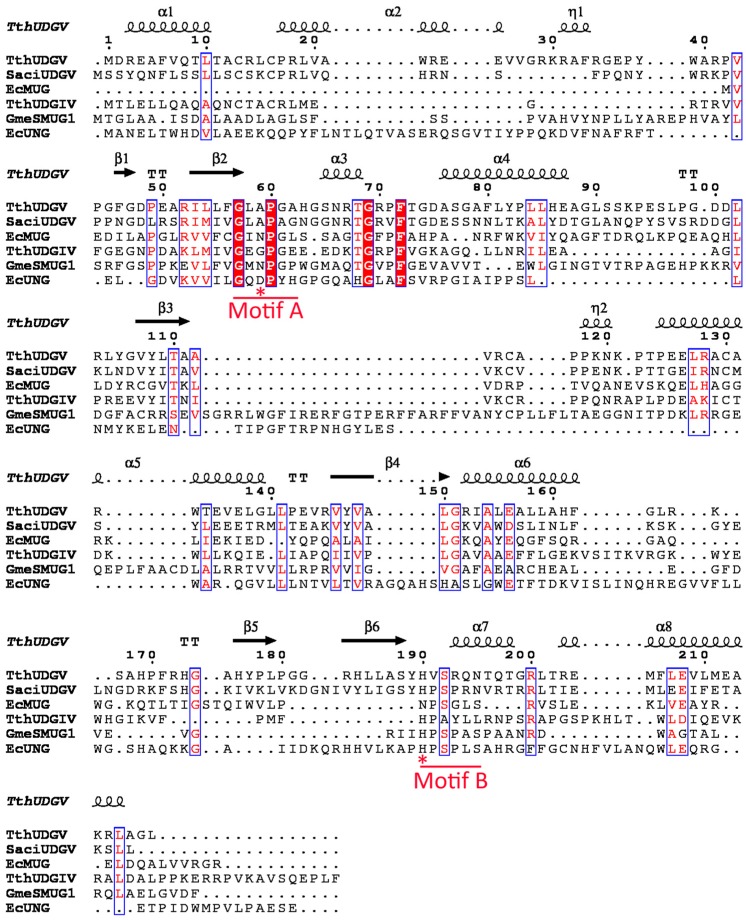
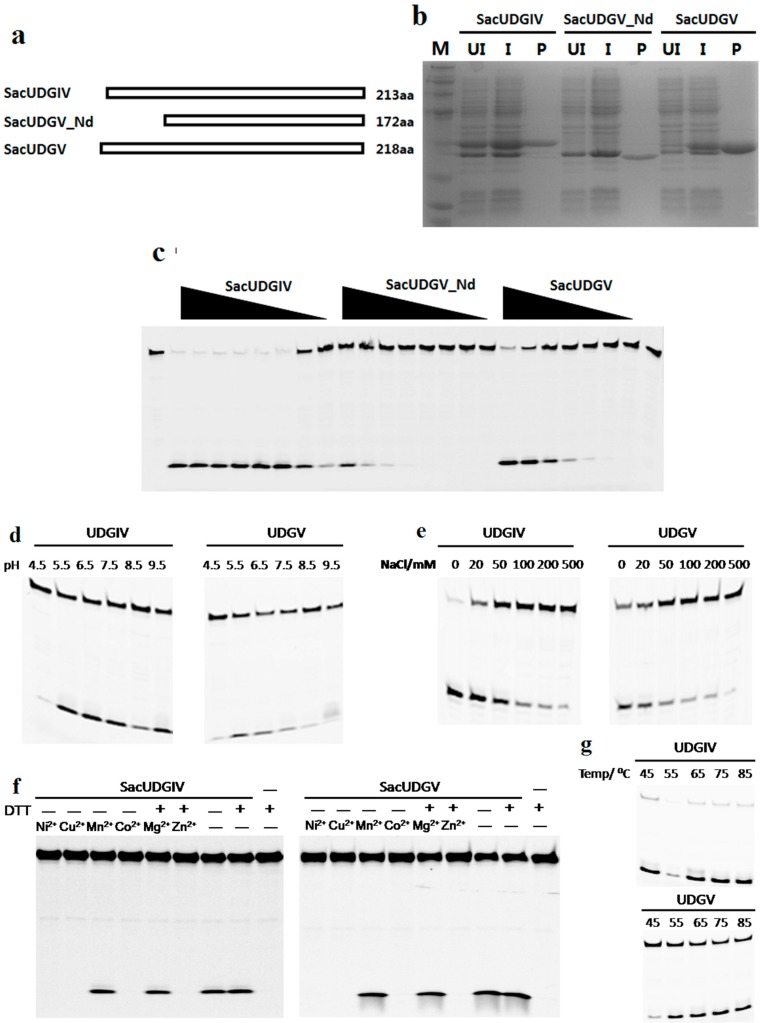
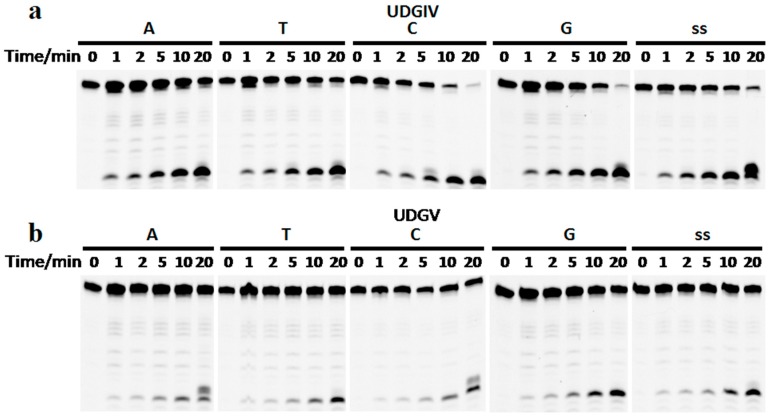
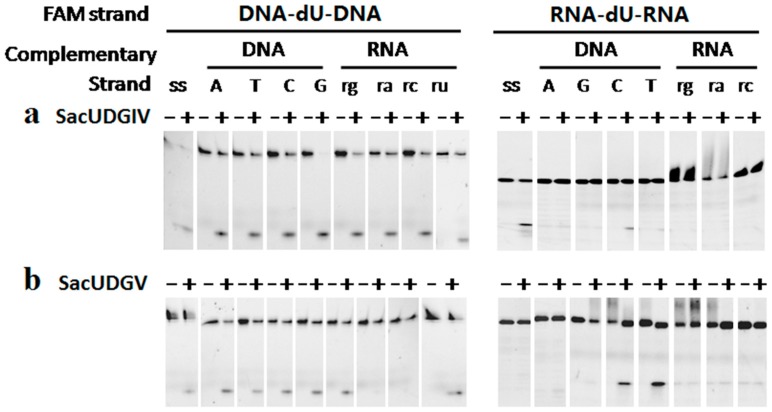
encodes family 4 and 5 uracil-DNA glycosylase (UDG). Two recombinant UDGs (SacUDG) were prepared and biochemically characterized using oligonucleotides carrying a deaminated base. Both SacUDGs can remove deoxyuracil (dU) base from both double-stranded DNA and single-stranded DNA. Interestingly, they can remove U linked with deoxyribose from single-stranded RNA backbone, suggesting that the riboses on the backbone have less effect on the recognition of dU and hydrolysis of the C-N glycosidic bond. However, the removal of rU from DNA backbone is inefficient, suggesting strong steric hindrance comes from the 2' hydroxyl of ribose linked to uracil. Both SacUDGs cannot remove 2,2'-anhydro uridine, hypoxanthine, and 7-deazaxanthine from single-stranded DNA and single-stranded DNA. Compared with the family 2 MUG, other family UDGs have an extra N-terminal structure consisting of about 50 residues. Removal of the 46 N-terminal residues of family 5 SacUDG resulted in only a 40% decrease in activity, indicating that the [4Fe-4S] cluster and truncated secondary structure are not the key elements in hydrolyzing the glycosidic bond. Combining our biochemical and structural results with those of other groups, we discussed the UDGs' catalytic mechanism and the possible repair reactions of deaminated bases in prokaryotes.
编码第4和第5家族尿嘧啶-DNA糖基化酶(UDG)。制备了两种重组UDG(SacUDG),并使用携带脱氨基碱基的寡核苷酸进行了生化特性分析。两种SacUDG都能从双链DNA和单链DNA中去除脱氧尿嘧啶(dU)碱基。有趣的是,它们能从单链RNA主链中去除与脱氧核糖相连的尿嘧啶,这表明主链上的核糖对dU的识别和C-N糖苷键的水解影响较小。然而,从DNA主链中去除rU效率较低,这表明空间位阻主要来自与尿嘧啶相连的核糖的2'羟基。两种SacUDG都不能从单链DNA和双链DNA中去除2,2'-脱水尿苷、次黄嘌呤和7-脱氮黄嘌呤。与第2家族的MUG相比,其他家族的UDG有一个由约50个残基组成的额外N端结构。去除第5家族SacUDG的46个N端残基后,活性仅降低40%,这表明[4Fe-4S]簇和截短的二级结构不是水解糖苷键的关键因素。结合我们的生化和结构结果以及其他研究小组的结果,我们讨论了UDG的催化机制以及原核生物中脱氨基碱基可能的修复反应。