Sutton Madeline Y, Gray Simone C, Elmore Kim, Gaul Zaneta
Division of HIV/AIDS Prevention, Centers for Disease Control and Prevention, Atlanta, GA, United States of America.
ICF, Atlanta, GA, United States of America.
PLoS One. 2017 Jan 20;12(1):e0170714. doi: 10.1371/journal.pone.0170714. eCollection 2017.
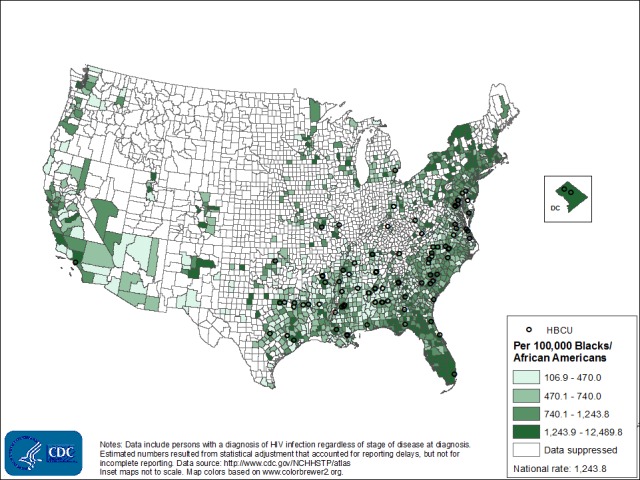
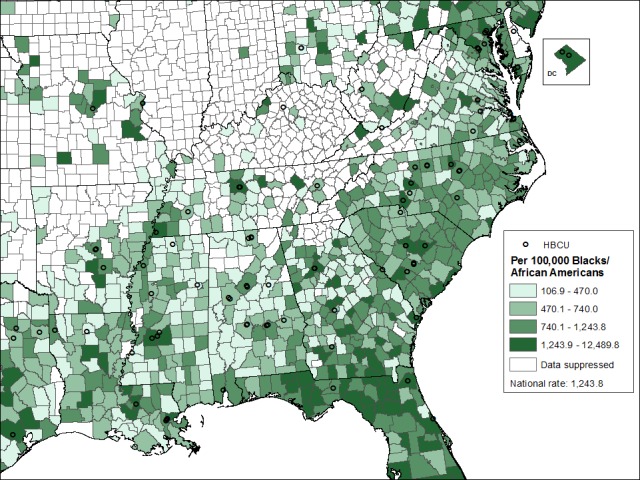
HIV infection disproportionately affects Blacks in the southern United States (U.S.), a region where legal policies that may unintentionally impede earlier HIV detection and treatment are prevalent. Historically Black Colleges and Universities (HBCUs) have historically facilitated social change in communities of color and have been underexplored as partners for HIV prevention. We describe geographic and social determinants of health (SDH) in the southern U.S. to inform potential HBCU-public health partnerships that might improve HIV health equity. We evaluated the relationship between county-level HIV prevalences (2013), HBCU geographic coordinates, and SDH variables in the southern counties with HBCUs. U.S. Census-derived SDH variables included race/ethnicity (i.e., Black, White, Hispanic), unemployment, female head of household, poverty, percent owner-occupied housing units, urbanicity, and primary care provider rates. Associations were assessed using bivariate and multivariable linear regression. Of 104 HBCUs in the contiguous U.S., 100 (96%) were located in 69 southern counties with average Black populations of 40% and an average HIV prevalence of 615. 5 per 100,000, over two times the national rate (295.1 per 100,000). In bivariable analyses, higher HIV rates in these counties were associated with higher percent Black population, unemployment, female head of household, poverty, fewer owner-occupied housing units, and greater urbanicity (p < 0.05). In multivariable analyses, counties with higher HIV rates had higher percentages of Blacks, greater urbanicity, fewer owner-occupied housing units, and more female heads of households (p < 0.05). The southern U.S. is disproportionately affected by HIV, and many HBCUs are located in affected southern counties. HBCUs may be important public health partners for helping to develop structural interventions that strengthen HIV policies in support of health equity in these southern, mostly urban counties.
在美国南部,艾滋病毒感染对黑人的影响尤为严重。在该地区,一些法律政策可能无意中阻碍了艾滋病毒的早期检测和治疗,此类政策颇为盛行。历史悠久的黑人学院和大学(HBCUs)历来推动了有色人种社区的社会变革,但作为艾滋病毒预防合作伙伴的作用尚未得到充分探索。我们描述了美国南部的健康地理和社会决定因素(SDH),以为可能改善艾滋病毒健康公平性的潜在HBCU-公共卫生伙伴关系提供参考。我们评估了县级艾滋病毒流行率(2013年)、HBCU地理坐标以及南部有HBCU的县的SDH变量之间的关系。源自美国人口普查的SDH变量包括种族/族裔(即黑人、白人、西班牙裔)、失业率、女性户主、贫困、自有住房单元百分比、城市化程度以及初级保健提供者比率。使用双变量和多变量线性回归评估关联。在美国本土的104所HBCUs中,100所(96%)位于69个南部县,这些县的黑人平均人口占40%,艾滋病毒平均流行率为每10万人615.5例,是全国比率(每10万人295.1例)的两倍多。在双变量分析中,这些县较高的艾滋病毒感染率与较高的黑人人口百分比、失业率、女性户主、贫困、自有住房单元较少以及城市化程度较高相关(p < 0.05)。在多变量分析中,艾滋病毒感染率较高的县黑人比例较高、城市化程度较高、自有住房单元较少且女性户主较多(p < 0.05)。美国南部受艾滋病毒影响尤为严重,许多HBCUs位于受影响的南部县。HBCUs可能是重要的公共卫生合作伙伴,有助于制定结构性干预措施,加强艾滋病毒政策,以支持这些南部主要城市县的健康公平。