Gagné Myriam E, Légaré France, Moisan Jocelyne, Boulet Louis-Philippe
Knowledge Translation, Education and Prevention Chair in Respiratory and Cardiovascular Health, Laval University, Quebec City, QC, Canada.
Quebec Heart and Lung Institute-Laval University, Quebec City, QC, Canada.
PLoS One. 2017 Jan 20;12(1):e0170055. doi: 10.1371/journal.pone.0170055. eCollection 2017.
Not providing adequate patient education interventions to asthma patients remains a major care gap. To help asthma patients and caregivers discuss inhaled controller medication use, our team has previously developed a decision aid (DA). We sought to assess whether adding this DA to education interventions improved knowledge, decisional conflict, and asthma control among adults with asthma.
A parallel clinical trial (NCT02516449). We recruited adults with asthma, aged 18 to 65 years, prescribed inhaled controller medication to optimize asthma control. Educators randomly allocated participants either to the education + DA or to the education group. At baseline and two-month follow-up, we measured asthma knowledge (primary outcome) with a validated self-administered questionnaire (score -37 to +37). Secondary outcomes included decisional conflict and asthma control. Blinded assessors collected data. Between the two time points, the within- and between-group changes were estimated by generalized linear mixed models.
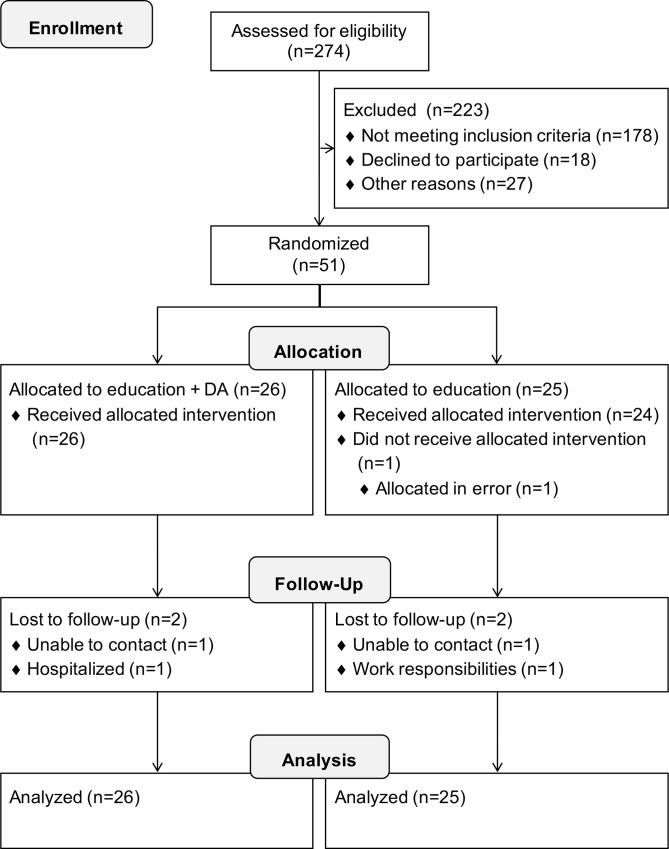
Fifty-one participants (response rate: 53%; age: 44 ± 13 years; women: n = 32) were randomized either to the education + DA group (n = 26) or to the education group (n = 25), and included in statistical analyses. Between baseline and follow-up, mean [95% CI] knowledge scores increased from 21.5 [19.9-23.2] to 25.1 [23.1-27.0] in the education + DA group (P = 0.0002) and from 24.0 [22.3-25.7] to 26.0 [24.0-28.0] in the education group (P = 0.0298). In both of the groups, decisional conflict and asthma control improved. There were no differences between groups.
Education improved knowledge, decisional conflict, and asthma control whether the DA was added or not.
未向哮喘患者提供充分的患者教育干预措施仍是一个主要的护理缺口。为帮助哮喘患者及其护理人员讨论吸入性控制药物的使用,我们的团队此前开发了一种决策辅助工具(DA)。我们试图评估在教育干预措施中加入这种DA是否能改善成年哮喘患者的知识水平、决策冲突和哮喘控制情况。
一项平行临床试验(NCT02516449)。我们招募了年龄在18至65岁之间、正在使用吸入性控制药物以优化哮喘控制的成年哮喘患者。教育工作者将参与者随机分配到教育+DA组或教育组。在基线和两个月的随访时,我们使用经过验证的自填问卷(得分-37至+37)测量哮喘知识(主要结局)。次要结局包括决策冲突和哮喘控制情况。盲法评估人员收集数据。在两个时间点之间,通过广义线性混合模型估计组内和组间的变化。
51名参与者(应答率:53%;年龄:44±13岁;女性:n = 32)被随机分配到教育+DA组(n = 26)或教育组(n = 25),并纳入统计分析。在基线和随访之间,教育+DA组的平均[95%CI]知识得分从21.5[19.9 - 23.2]提高到25.1[23.1 - 27.0](P = 0.0002),教育组从24.0[22.3 - 25.7]提高到26.0[24.0 - 28.0](P = 0.0298)。在两组中,决策冲突和哮喘控制情况均有所改善。两组之间无差异。
无论是否添加DA,教育都能改善知识水平、决策冲突和哮喘控制情况。