Center for Liver Cancer, National Cancer Center, Goyang, Korea.
Department of System Cancer Science, Graduate School of Cancer Science and Policy, National Cancer Center, Goyang, Korea.
Cancer Res Treat. 2017 Oct;49(4):1022-1032. doi: 10.4143/crt.2016.495. Epub 2017 Jan 19.
This study assessed the feasibility and compliance of induction chemotherapy with gemcitabine and cisplatin followed by simultaneous integrated boost-intensity modulated radiotherapy (SIB-IMRT) with concurrent gemcitabine in patients with locally advanced unresectable pancreatic cancer.
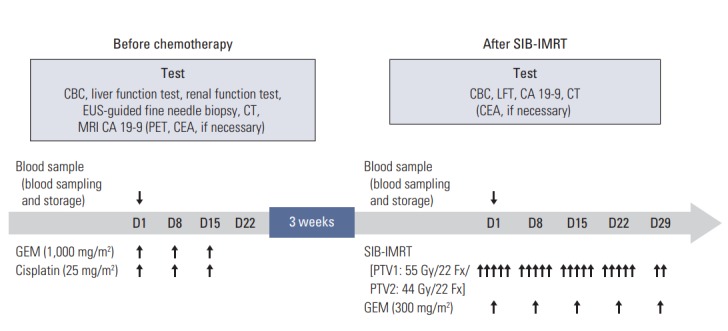
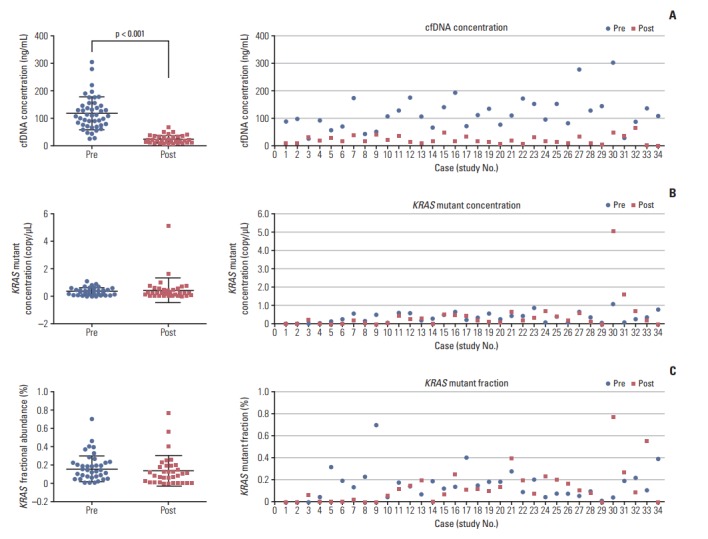
In this trial, patients received induction chemotherapy consisting of gemcitabine (1,000 mg/m2) and cisplatin (25 mg/m2) on days 1, 8, and 15 of each treatment cycle. Patients were subsequently treated with gemcitabine (300 mg/m2/wk) during SIB-IMRT. The patients received total doses of 55 and 44 Gy in 22 fractions to planning target volume 1 and 2, respectively. As an ancillary study, digital polymerase chain reaction was performed to screen for the seven most common mutations in codons 12 and 13 of the KRAS oncogene of circulating cell free DNA (cfDNA).
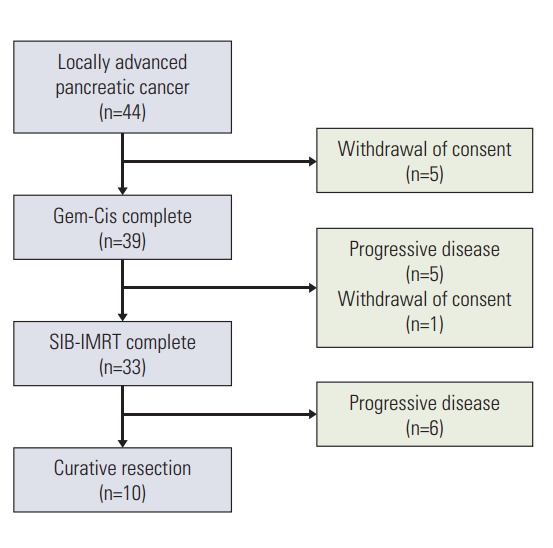
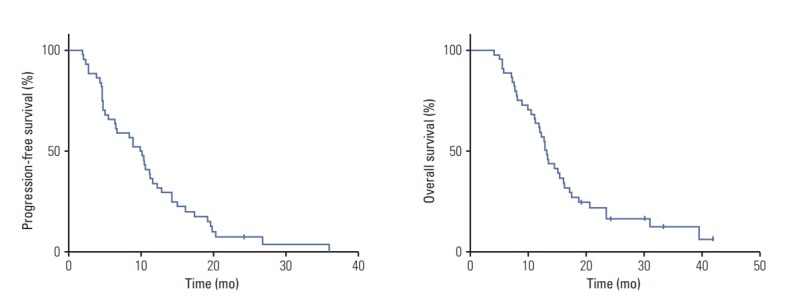
Forty-four patients were enrolled between 2012 and 2015. Of these, 33 (75%) completed the treatment. The most common toxicities during induction chemotherapy were grades 3 and 4 neutropenia (18.2%), grade 3 nausea (6.8%) and vomiting (6.8%). The most common toxicities during SIB-IMRT were grade 3 neutropenia (24.2%) and grade 3 anemia (12.1%). Ten patients (23%) underwent a curative resection after therapy. Median overall survival was significantly longer in patients who underwent curative resection (16.8 months vs. 11 months, p < 0.01). The median cfDNA concentration was significantly lower after treatment (108.5 ng/mL vs. 18.4 ng/mL, p < 0.001).
Induction chemotherapy with gemcitabine and cisplatin followed by concurrent SIB-IMRT was well tolerated and active.
本研究评估了吉西他滨和顺铂诱导化疗联合同时整合boost-强度调制放疗(SIB-IMRT)同步吉西他滨治疗局部晚期不可切除胰腺癌患者的可行性和依从性。
在该试验中,患者在每个治疗周期的第 1、8 和 15 天接受吉西他滨(1000mg/m2)和顺铂(25mg/m2)诱导化疗。随后,患者在 SIB-IMRT 期间接受吉西他滨(300mg/m2/周)治疗。计划靶区 1 和 2 分别接受 55 和 44Gy 的总剂量,共 22 个分次。作为辅助研究,对循环无细胞游离 DNA(cfDNA)中 KRAS 癌基因 12 和 13 密码子的七种最常见突变进行数字聚合酶链反应筛查。
2012 年至 2015 年间共纳入 44 例患者。其中,33 例(75%)完成治疗。诱导化疗期间最常见的毒性为 3 级和 4 级中性粒细胞减少症(18.2%)、3 级恶心(6.8%)和呕吐(6.8%)。SIB-IMRT 期间最常见的毒性为 3 级中性粒细胞减少症(24.2%)和 3 级贫血(12.1%)。10 例患者(23%)在治疗后行根治性切除术。根治性切除术后患者的中位总生存期明显延长(16.8 个月 vs. 11 个月,p < 0.01)。治疗后 cfDNA 浓度明显降低(108.5ng/mL vs. 18.4ng/mL,p < 0.001)。
吉西他滨和顺铂诱导化疗联合同步 SIB-IMRT 耐受性良好且有效。