Bordbari M H, Penedo M C T, Aleman M, Valberg S J, Mickelson J, Finno C J
Department of Population Health and Reproduction, School of Veterinary Medicine, University of California-Davis, Davis, CA, 95616, USA.
Veterinary Genetics Laboratory, School of Veterinary Medicine, University of California-Davis, Davis, CA, 95616, USA.
Anim Genet. 2017 Jun;48(3):287-294. doi: 10.1111/age.12531. Epub 2017 Jan 23.
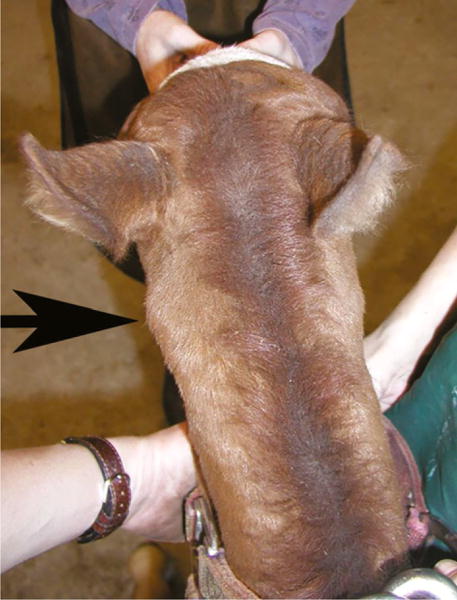
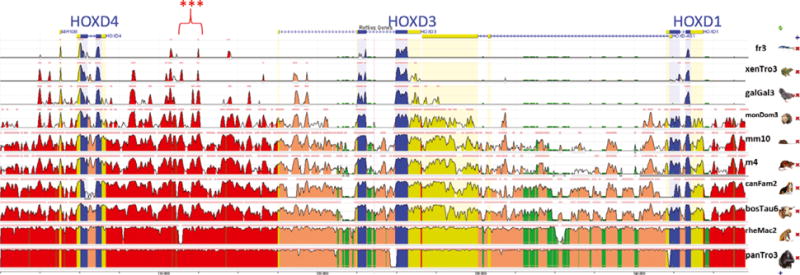
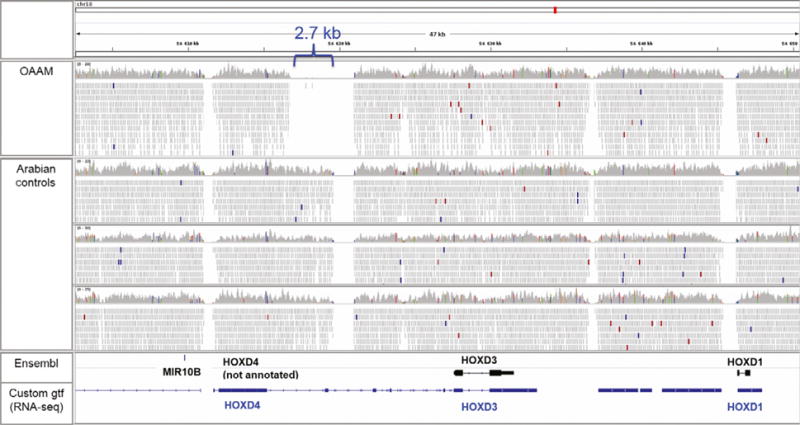
In the horse, the term occipitoatlantoaxial malformation (OAAM) is used to describe a developmental defect in which the first cervical vertebra (atlas) resembles the base of the skull (occiput) and the second cervical vertebra (axis) resembles the atlas. Affected individuals demonstrate an abnormal posture and varying degrees of ataxia. The homeobox (HOX) gene cluster is involved in the development of both the axial and appendicular skeleton. Hoxd3-null mice demonstrate a strikingly similar phenotype to Arabian foals with OAAM. Whole-genome sequencing was performed in an OAAM-affected horse (OAAM1) and seven unaffected Arabian horses. Visual inspection of the raw reads within the region of HOXD3 identified a 2.7-kb deletion located 4.4 kb downstream of the end of HOXD4 and 8.2 kb upstream of the start of HOXD3. A genotyping assay revealed that both parents of OAAM1 were heterozygous for the deletion. Additional genotyping identified two of 162 heterozygote Arabians, and the deletion was not present in 371 horses of other breeds. Comparative genomics studies have revealed that this region is highly conserved across species and that the entire genomic region between Hoxd4 and Hoxd3 is transcribed in mice. Two additional Arabian foals diagnosed with OAAM (OAAM 2 and 3) were genotyped and did not have the 2.7-kb deletion. Closer examination of the phenotype in these cases revealed notable variation. OAAM3 also had facial malformations and a patent ductus arteriosus, and the actual malformation at the craniocervical junction differed. Genetic heterogeneity may exist across the HOXD locus in Arabian foals with OAAM.
在马中,枕寰枢椎畸形(OAAM)一词用于描述一种发育缺陷,即第一颈椎(寰椎)类似颅骨底部(枕骨),而第二颈椎(枢椎)类似寰椎。受影响的个体表现出异常姿势和不同程度的共济失调。同源盒(HOX)基因簇参与了轴骨骼和附属骨骼的发育。Hoxd3基因敲除小鼠表现出与患有OAAM的阿拉伯马驹惊人相似的表型。对一匹受OAAM影响的马(OAAM1)和七匹未受影响的阿拉伯马进行了全基因组测序。对HOXD3区域内的原始读数进行目视检查,发现一个2.7kb的缺失,位于HOXD4末端下游4.4kb处,HOXD3起始上游8.2kb处。基因分型分析显示,OAAM1的双亲均为该缺失的杂合子。进一步的基因分型在162匹杂合子阿拉伯马中鉴定出两匹,在371匹其他品种的马中未发现该缺失。比较基因组学研究表明,该区域在物种间高度保守,并且Hoxd4和Hoxd3之间的整个基因组区域在小鼠中都有转录。另外两匹被诊断患有OAAM的阿拉伯马驹(OAAM 2和3)进行了基因分型,未发现2.7kb的缺失。对这些病例的表型进行更仔细的检查发现了明显的差异。OAAM3还存在面部畸形和动脉导管未闭,并且颅颈交界处的实际畸形也不同。患有OAAM的阿拉伯马驹的HOXD基因座可能存在遗传异质性。