Center for Marine Biodiversity and Conservation, Scripps Institution of Oceanography, UC San Diego, La Jolla, California 92093, USA.
Smithsonian Tropical Research Institute, Box 0843-03092 Balboa, Republic of Panama.
Nat Commun. 2017 Jan 23;8:14160. doi: 10.1038/ncomms14160.
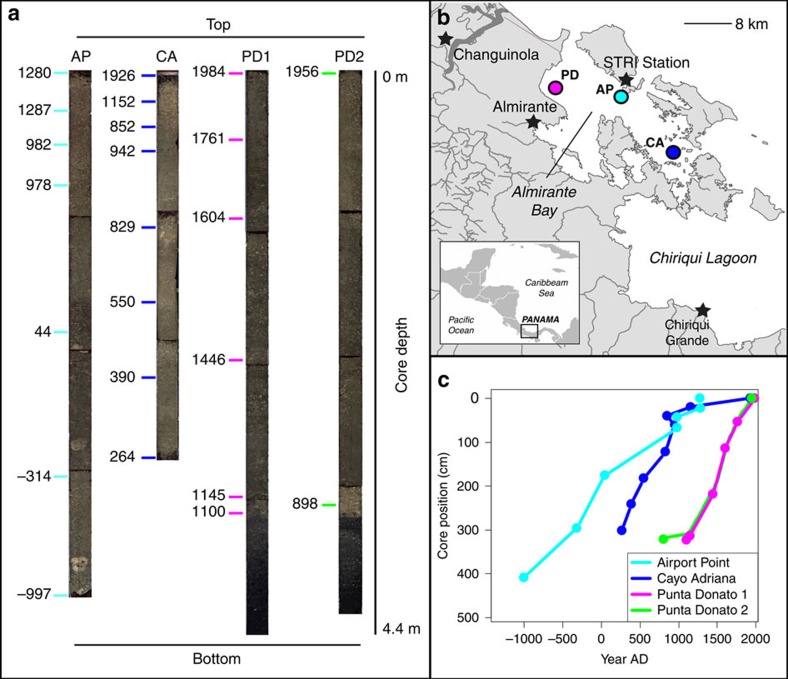
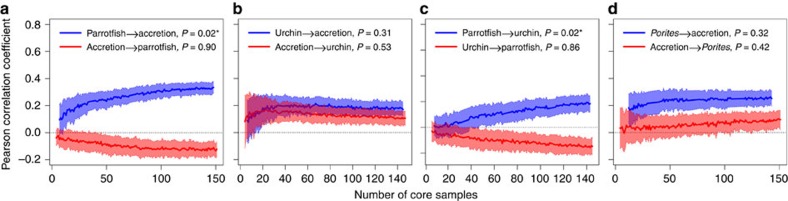
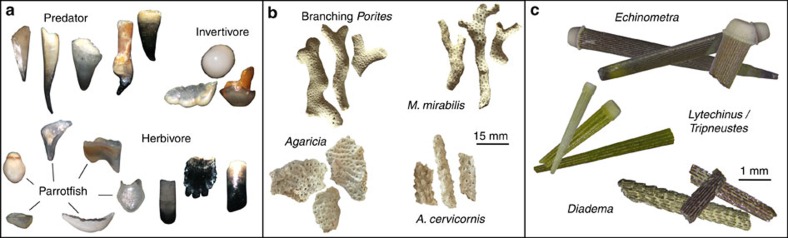
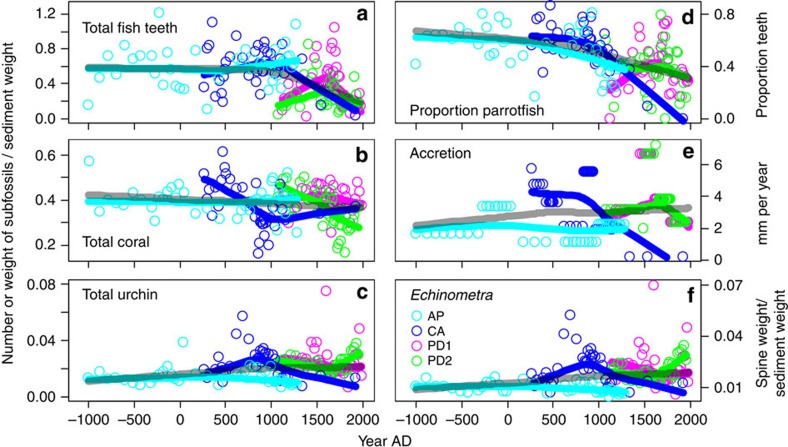
Caribbean coral reefs have transformed into algal-dominated habitats over recent decades, but the mechanisms of change are unresolved due to a lack of quantitative ecological data before large-scale human impacts. To understand the role of reduced herbivory in recent coral declines, we produce a high-resolution 3,000 year record of reef accretion rate and herbivore (parrotfish and urchin) abundance from the analysis of sediments and fish, coral and urchin subfossils within cores from Caribbean Panama. At each site, declines in accretion rates and parrotfish abundance were initiated in the prehistorical or historical period. Statistical tests of direct cause and effect relationships using convergent cross mapping reveal that accretion rates are driven by parrotfish abundance (but not vice versa) but are not affected by total urchin abundance. These results confirm the critical role of parrotfish in maintaining coral-dominated reef habitat and the urgent need for restoration of parrotfish populations to enable reef persistence.
几十年来,加勒比海的珊瑚礁已经转变为以藻类为主的生境,但由于在大规模人类影响之前缺乏定量生态数据,因此变化的机制仍未得到解决。为了了解减少食草动物在最近珊瑚衰退中的作用,我们从加勒比巴拿马的核心沉积物和鱼类、珊瑚和海胆亚化石分析中,生成了一个 3000 年高分辨率的珊瑚礁附生率和食草动物(鹦嘴鱼和海胆)丰度记录。在每个地点,附生率和鹦嘴鱼丰度的下降都是在史前或历史时期开始的。使用收敛交叉映射进行的直接因果关系的统计检验表明,附生率受鹦嘴鱼丰度的驱动(但反之则不然),而不受总海胆丰度的影响。这些结果证实了鹦嘴鱼在维持以珊瑚为主的珊瑚礁生境中的关键作用,以及迫切需要恢复鹦嘴鱼种群,以维持珊瑚礁的生存。