Warners M J, Vlieg-Boerstra B J, Verheij J, van Rhijn B D, Van Ampting M T J, Harthoorn L F, de Jonge W J, Smout A J P M, Bredenoord A J
Department of Gastroenterology & Hepatology, Academic Medical Centre, Amsterdam, the Netherlands.
Tytgat Institute for Liver and GI Research, Academic Medical Centre, Amsterdam, the Netherlands.
Aliment Pharmacol Ther. 2017 Mar;45(6):777-787. doi: 10.1111/apt.13953. Epub 2017 Jan 23.
Eosinophilic oesophagitis (EoE) is a chronic disease, driven by food allergens. Elemental diets are effective for the management of children with EoE, but studies on the effect of elemental diets in adults are scarce and poor palatability challenges dietary adherence.
To assess the effects of an elemental diet (Neocate, Nutricia, Utrecht, the Netherlands) on the inflammation, symptoms and endoscopic signs in adult EoE patients.
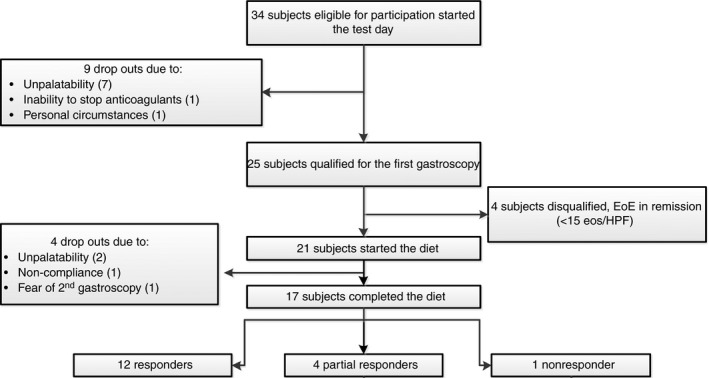
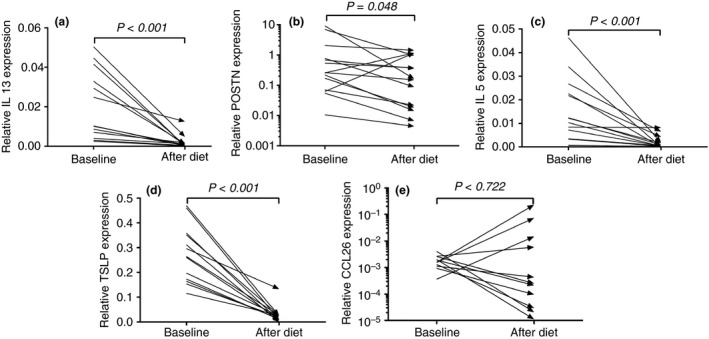
In this prospective study, 21 patients with active EoE, confirmed by biopsies showing ≥15 eosinophils per microscopic high power field (HPF) and symptoms of oesophageal dysfunction were included. Patients underwent endoscopy before and 4 weeks after diet. Histological disease activity (peak eosinophil count/HPF), and endoscopic signs were scored by physicians. Symptoms and adherence to the diet were evaluated by questionnaires. Serum total IgE levels and total eosinophil counts were determined and the expression of inflammatory cytokines was analysed by qPCR.
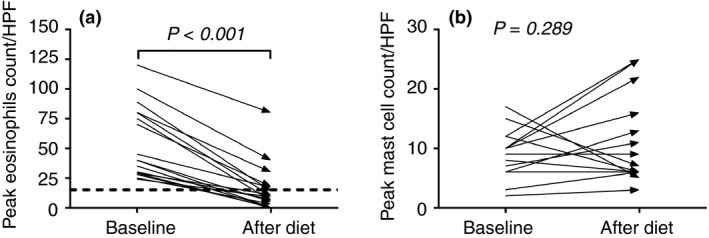
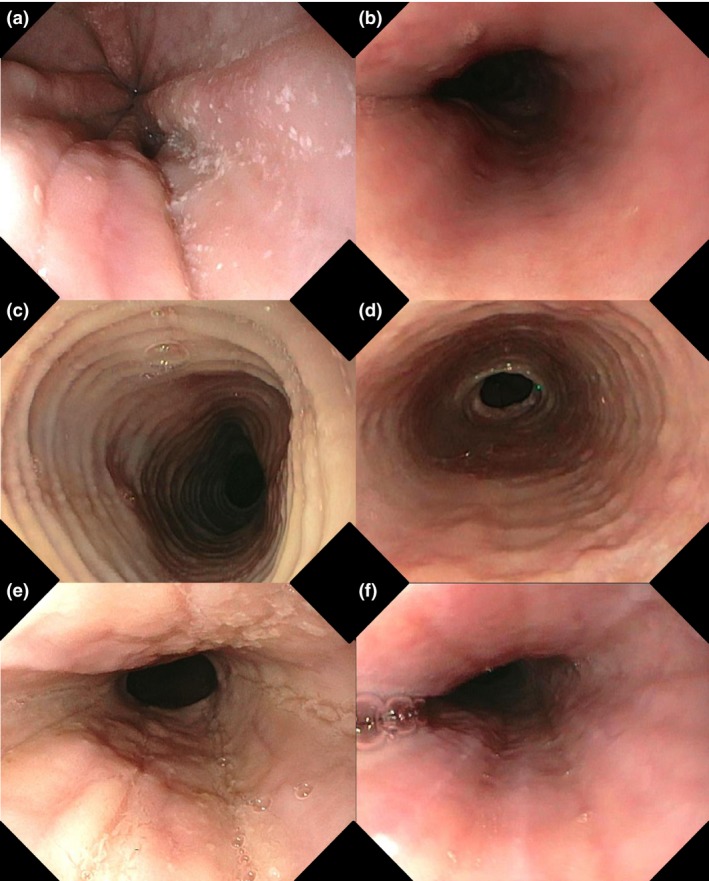
In total, 17 (81%) of the patients completed the diet, of whom 12 (71%) showed complete histological response (≤15 eosinophils/HPF) and 4 (24%) showed partial histological response (≥50% reduction of baseline eosinophil count). Peak eosinophil counts decreased significantly after the diet from 40 to 9 per HPF (P ≤ 0.001). A marked improvement in endoscopic signs was observed. Symptoms decreased significantly in all subjects, and 15 patients (88%) became completely asymptomatic (P ≤ 0.001). In 14 patients (82%), blood eosinophil count and serum IgE decreased (P ≤ 0.05).
Elemental diet reduces eosinophilic inflammation and induces clinical remission in adult patients with eosinophilic oesophagitis.
嗜酸性粒细胞性食管炎(EoE)是一种由食物过敏原引发的慢性疾病。要素饮食对EoE患儿的治疗有效,但关于要素饮食对成人影响的研究较少,且其适口性差影响饮食依从性。
评估要素饮食(纽迪希亚公司生产的Neocate,荷兰乌得勒支)对成年EoE患者炎症、症状及内镜表现的影响。
在这项前瞻性研究中,纳入了21例经活检证实每高倍视野(HPF)嗜酸性粒细胞≥15个且有食管功能障碍症状的活动性EoE患者。患者在饮食前及饮食4周后接受内镜检查。医生对组织学疾病活动度(嗜酸性粒细胞计数峰值/HPF)和内镜表现进行评分。通过问卷调查评估症状及饮食依从性。测定血清总IgE水平和嗜酸性粒细胞总数,并通过qPCR分析炎症细胞因子的表达。
共有17例(81%)患者完成了饮食治疗,其中12例(71%)显示组织学完全缓解(≤15个嗜酸性粒细胞/HPF),4例(24%)显示部分组织学缓解(嗜酸性粒细胞计数较基线减少≥50%)。饮食后嗜酸性粒细胞计数峰值从每HPF 40个显著降至9个(P≤0.001)。内镜表现有显著改善。所有受试者的症状均显著减轻,15例患者(88%)完全无症状(P≤0.001)。14例患者(82%)的血液嗜酸性粒细胞计数和血清IgE下降(P≤0.05)。
要素饮食可减轻成年嗜酸性粒细胞性食管炎患者的嗜酸性炎症并诱导临床缓解。