Lippi Giuseppe, Mattiuzzi Camilla, Cervellin Gianfranco
University of Verona, Verona, Italy.
Acta Biomed. 2016 Jan 16;87(3):323-328.
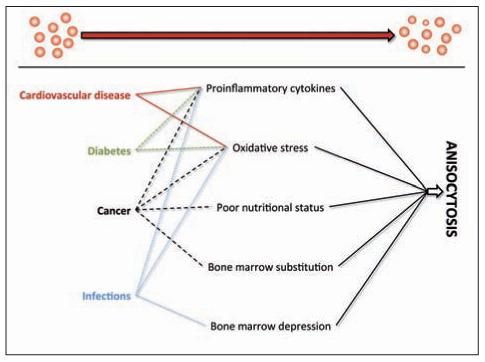
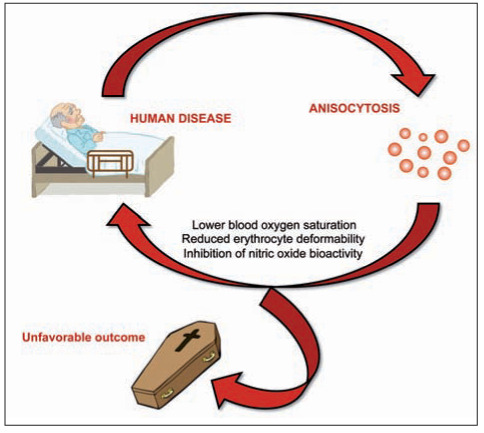
Due to increasing shortage of public healthcare resources in many countries around the globe, the use of simple, rapid and inexpensive laboratory parameters may be seen as a valuable aid for preliminary and cost-effective risk stratification of patients. Anisocytosis, conventionally measured by hematologic analyzers as the red blood cell distribution width (RDW), is an index of the heterogeneity of erythrocytes volumes. Several lines of evidence now attest that increased RDW values are commonplace in patients with many disorders, especially in those with the most prevalent conditions such as cardiovascular disease, diabetes, cancer and infections. Although the nature of this association remains to be definitely disclosed, what is strongly emerging from the recent scientific research is that the RDW should now be regarded as a "non" innocent bystander, wherein anisocytosis may be an active player in the pathogenesis of many pathologies. Therefore, major attention should be placed on this inexpensive but clinically meaningful parameter. The recent finding that dynamic changes of RDW are strongly predictors of mortality also suggests that continuous monitoring of anisocytosis may be an ancillary useful tool for establishing the effectiveness of managed care, as well as for deciding whether or not the overall clinical status is improving.
由于全球许多国家公共医疗资源短缺日益严重,使用简单、快速且廉价的实验室参数可能被视为对患者进行初步且具有成本效益的风险分层的宝贵辅助手段。红细胞大小不均一性,传统上通过血液分析仪测量为红细胞分布宽度(RDW),是红细胞体积异质性的一个指标。目前有几条证据表明,RDW值升高在许多疾病患者中很常见,尤其是在患有心血管疾病、糖尿病、癌症和感染等最常见疾病的患者中。尽管这种关联的本质仍有待明确揭示,但最近的科学研究强烈表明,RDW现在应被视为一个“并非”无辜的旁观者,其中红细胞大小不均一性可能在许多疾病的发病机制中发挥积极作用。因此,应高度关注这个廉价但具有临床意义的参数。最近发现RDW的动态变化是死亡率的强预测指标,这也表明持续监测红细胞大小不均一性可能是确定管理式医疗有效性以及判断整体临床状况是否改善的有用辅助工具。