Nakasuji Takashi, Ogonuki Narumi, Chiba Tomoki, Kato Tomomi, Shiozawa Kumiko, Yamatoya Kenji, Tanaka Hiromitsu, Kondo Tadashi, Miyado Kenji, Miyasaka Naoyuki, Kubota Toshiro, Ogura Atsuo, Asahara Hiroshi
Comprehensive Reproductive Medicine, Regulation of Internal Environment and Reproduction, Systemic Organ Regulation, Graduate School, Tokyo Medical and Dental University (TMDU), Bunkyo, Tokyo, Japan.
Department of Systems BioMedicine, Tokyo Medical and Dental University (TMDU), Bunkyo, Tokyo, Japan.
PLoS Genet. 2017 Jan 23;13(1):e1006578. doi: 10.1371/journal.pgen.1006578. eCollection 2017 Jan.
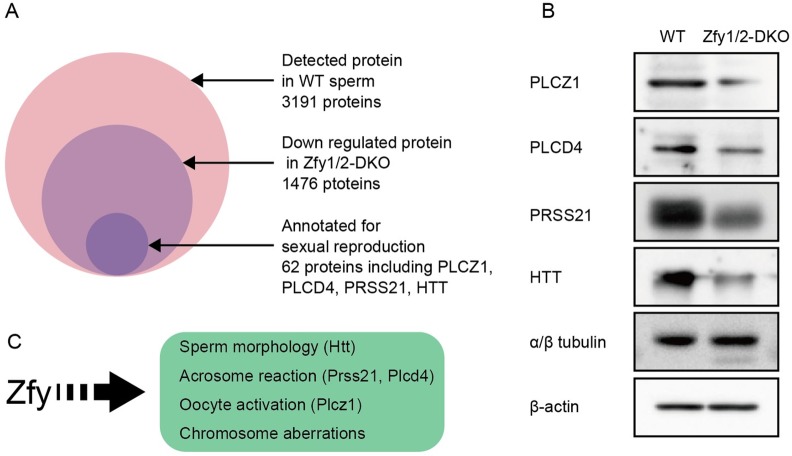
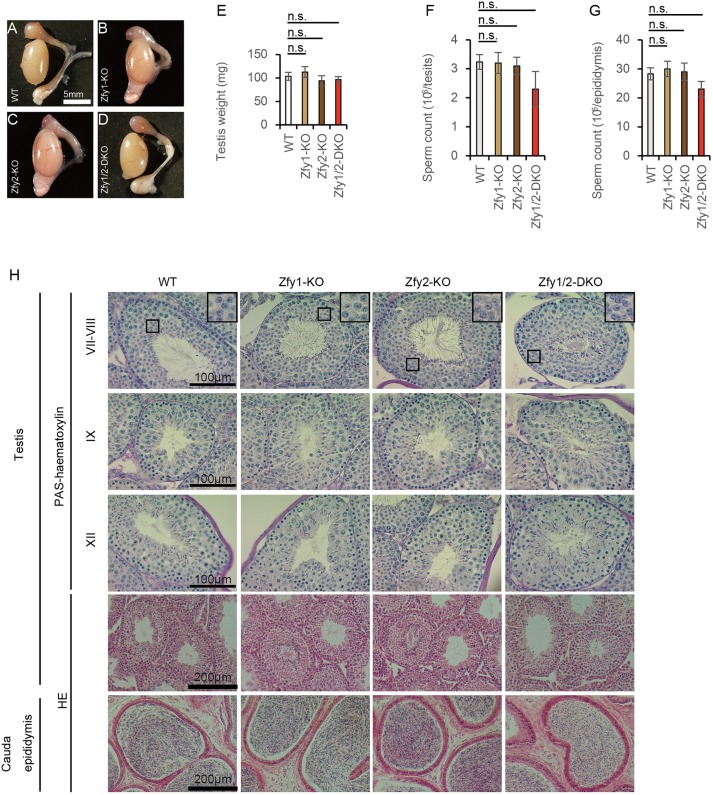
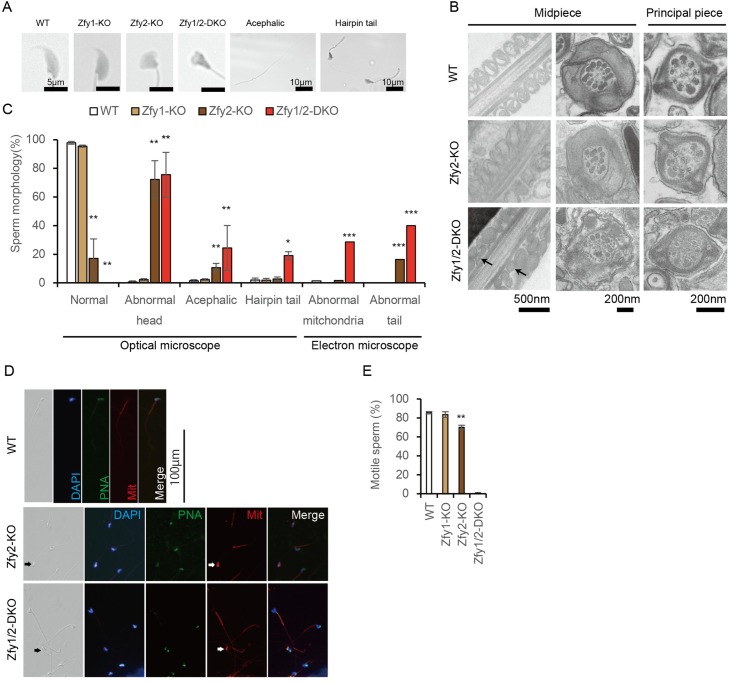
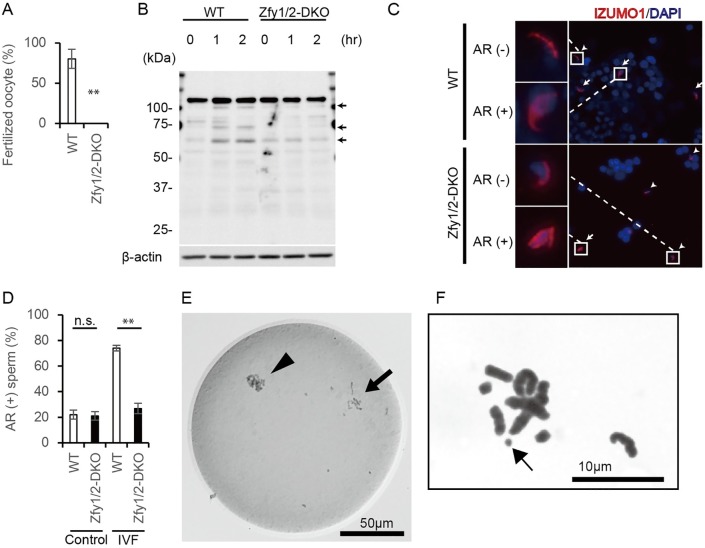
The mammalian Y chromosome plays a critical role in spermatogenesis. However, the exact functions of each gene in the Y chromosome have not been completely elucidated, partly owing to difficulties in gene targeting analysis of the Y chromosome. Zfy was first proposed to be a sex determination factor, but its function in spermatogenesis has been recently elucidated. Nevertheless, Zfy gene targeting analysis has not been performed thus far. Here, we adopted the highly efficient CRISPR/Cas9 system to generate individual Zfy1 or Zfy2 knockout (KO) mice and Zfy1 and Zfy2 double knockout (Zfy1/2-DKO) mice. While individual Zfy1 or Zfy2-KO mice did not show any significant phenotypic alterations in fertility, Zfy1/2-DKO mice were infertile and displayed abnormal sperm morphology, fertilization failure, and early embryonic development failure. Mass spectrometric screening, followed by confirmation with western blot analysis, showed that PLCZ1, PLCD4, PRSS21, and HTT protein expression were significantly deceased in spermatozoa of Zfy1/2-DKO mice compared with those of wild-type mice. These results are consistent with the phenotypic changes seen in the double-mutant mice. Collectively, our strategy and findings revealed that Zfy1 and Zfy2 have redundant functions in spermatogenesis, facilitating a better understanding of fertilization failure and early embryonic development failure.
哺乳动物的Y染色体在精子发生过程中起着关键作用。然而,Y染色体上每个基因的确切功能尚未完全阐明,部分原因是Y染色体基因靶向分析存在困难。Zfy最初被认为是性别决定因子,但它在精子发生中的功能最近才得以阐明。尽管如此,迄今为止尚未进行Zfy基因靶向分析。在此,我们采用高效的CRISPR/Cas9系统来生成单独的Zfy1或Zfy2基因敲除(KO)小鼠以及Zfy1和Zfy2双基因敲除(Zfy1/2-DKO)小鼠。虽然单独的Zfy1或Zfy2-KO小鼠在生育能力方面未表现出任何显著的表型改变,但Zfy1/2-DKO小鼠不育,并表现出异常的精子形态、受精失败和早期胚胎发育失败。质谱筛选,随后通过蛋白质印迹分析进行确认,结果显示与野生型小鼠相比,Zfy1/2-DKO小鼠精子中PLCZ1、PLCD4、PRSS21和HTT蛋白表达显著降低。这些结果与双突变小鼠中观察到的表型变化一致。总体而言,我们的策略和发现揭示了Zfy1和Zfy2在精子发生中具有冗余功能,有助于更好地理解受精失败和早期胚胎发育失败。