Townsend Leah B, Smith Spencer L
Neuroscience Curriculum, University of North Carolina at Chapel Hill, Chapel Hill, NC USA.
Department of Cell Biology and Physiology, University of North Carolina at Chapel Hill, Chapel Hill, NC USA.
J Neurodev Disord. 2017 Jan 19;9:2. doi: 10.1186/s11689-016-9182-5. eCollection 2017.
Autism spectrum disorder (ASD) is a heritable, heterogeneous neurodevelopmental disorder that is four times more likely to affect males than females. Despite this overt sex bias, it is unclear how genetic mutations associated with ASD alter cortical circuitry to produce the behavioral phenotypes by which ASD is diagnosed. Contactin-associated protein-like 2 () is an ASD-associated gene, and while knockout (KO) mice recapitulate many of the features of ASD, the effect on cortical circuitry is poorly understood. Moreover, although heterozygous (Het) mice are the more relevant genotype for ASD-linked mutations in humans, to our knowledge, no effects in Het mice have been previously reported.
Intrinsic signal optical imaging was used to measure functional visual responses in primary and higher visual cortical areas in male and female KO, Het, and wild-type (WT) mice. Main effect of genotype was assessed with one-way ANOVA. Visual responses were also measured in P17-18 and P30-32 KO and WT mice. Main effects of age and genotype were assessed using two-way ANOVA.
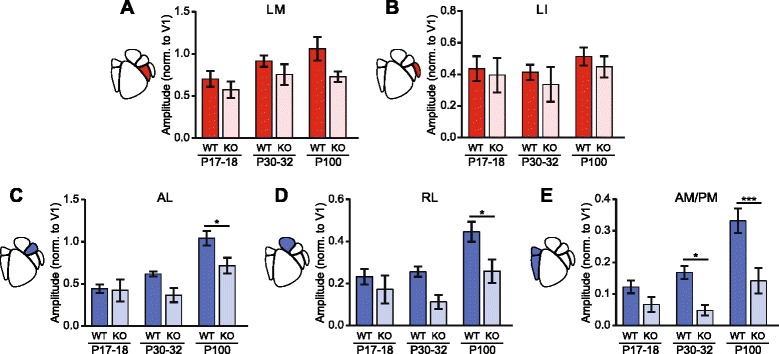
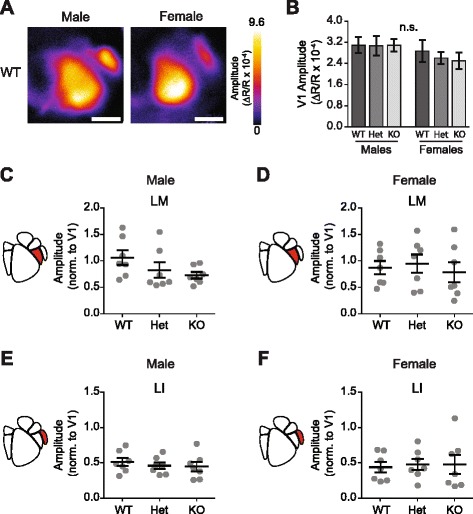
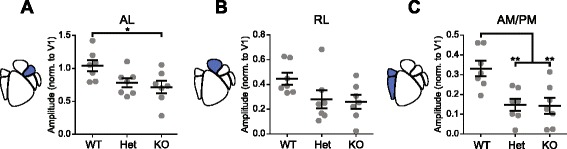
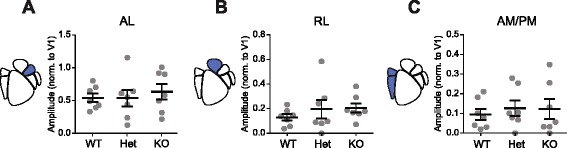
Visually evoked activity in dorsal stream associated higher visual areas in both KO and Het adult males was decreased relative to WT adult males. This decrease was not observed in adult females. Additionally, no significant difference was observed between WT and KO males at P17-18 with differences beginning to emerge at P30-32.
The functional responses of cortical circuitry in male mice are more strongly affected by mutations than females, an effect present even in Hets. The observed differences in males emerge with development beginning at P30-32. These results reveal genotype- and sex-dependent effects of altered expression and can shed light on the sex-dependent incidence of ASD.
自闭症谱系障碍(ASD)是一种遗传性、异质性神经发育障碍,男性受其影响的可能性是女性的四倍。尽管存在这种明显的性别偏见,但尚不清楚与ASD相关的基因突变如何改变皮质回路,从而产生用于诊断ASD的行为表型。接触蛋白相关蛋白样2()是一个与ASD相关的基因,虽然敲除(KO)小鼠重现了ASD的许多特征,但对皮质回路的影响却知之甚少。此外,尽管杂合(Het)小鼠是人类中与ASD相关突变更相关的基因型,但据我们所知,此前尚未报道过Het小鼠有任何影响。
使用内在信号光学成像来测量雄性和雌性KO、Het和野生型(WT)小鼠初级和高级视觉皮质区域的功能性视觉反应。用单因素方差分析评估基因型的主要效应。还在P17 - 18和P30 - 32的KO和WT小鼠中测量视觉反应。使用双因素方差分析评估年龄和基因型的主要效应。
与WT成年雄性小鼠相比,KO和Het成年雄性小鼠背侧流相关高级视觉区域的视觉诱发活动均降低。成年雌性小鼠未观察到这种降低。此外,在P17 - 18时,WT和KO雄性小鼠之间未观察到显著差异,差异在P30 - 32时开始出现。
与雌性小鼠相比,雄性小鼠皮质回路的功能反应受突变的影响更大,即使在Het小鼠中也存在这种效应。在雄性小鼠中观察到的差异从P30 - 32开始随着发育出现。这些结果揭示了表达改变的基因型和性别依赖性效应,并有助于阐明ASD的性别依赖性发病率。