Neuroscience Graduate Group, University of Pennsylvania, Philadelphia, PA 19104, United States.
Department of Biology, University of Pennsylvania, Philadelphia, PA 19104, United States; Department of Biology, Saint Joseph's University, Philadelphia, PA 19131, United States.
Neurobiol Learn Mem. 2019 Nov;165:107000. doi: 10.1016/j.nlm.2019.02.010. Epub 2019 Feb 20.
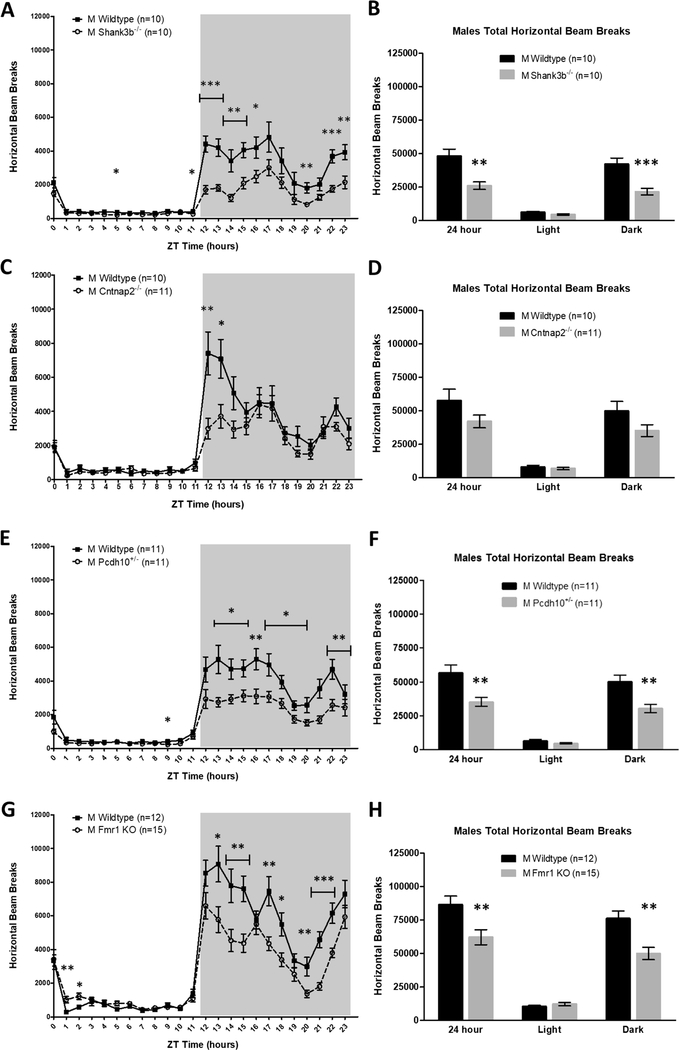
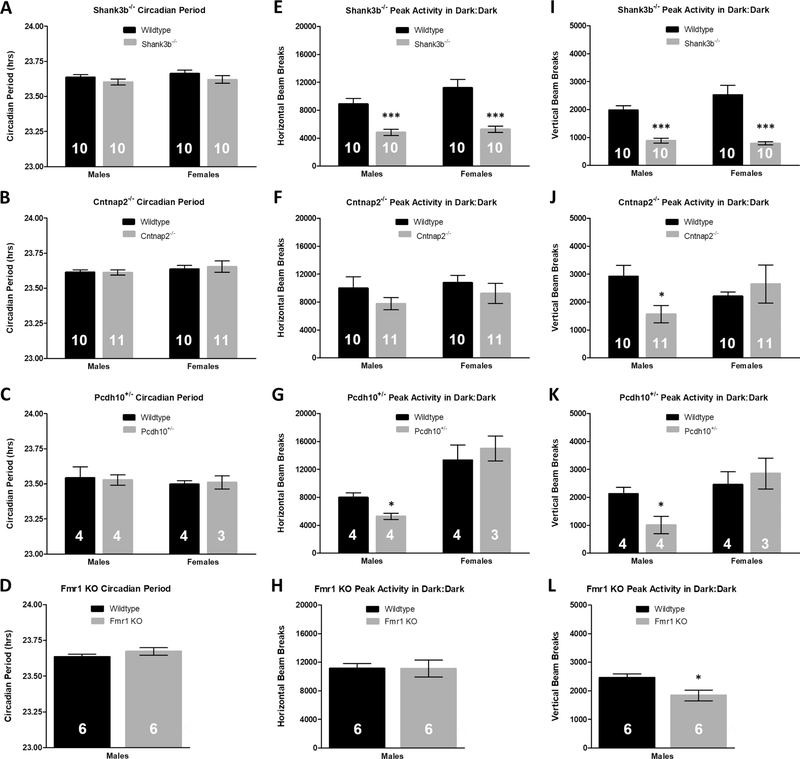
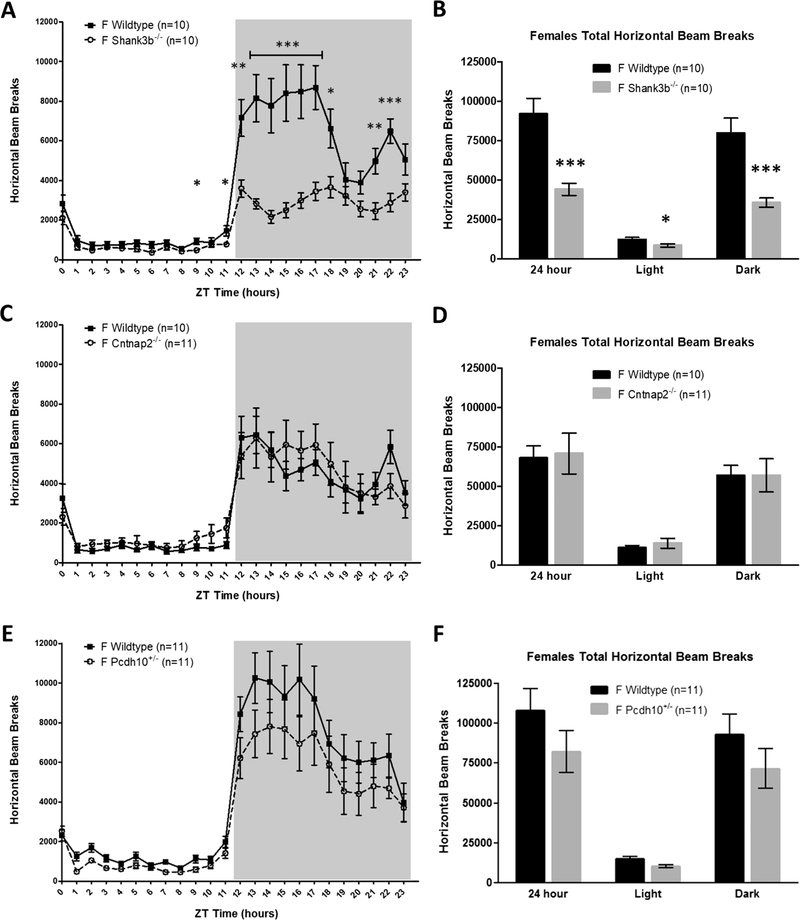
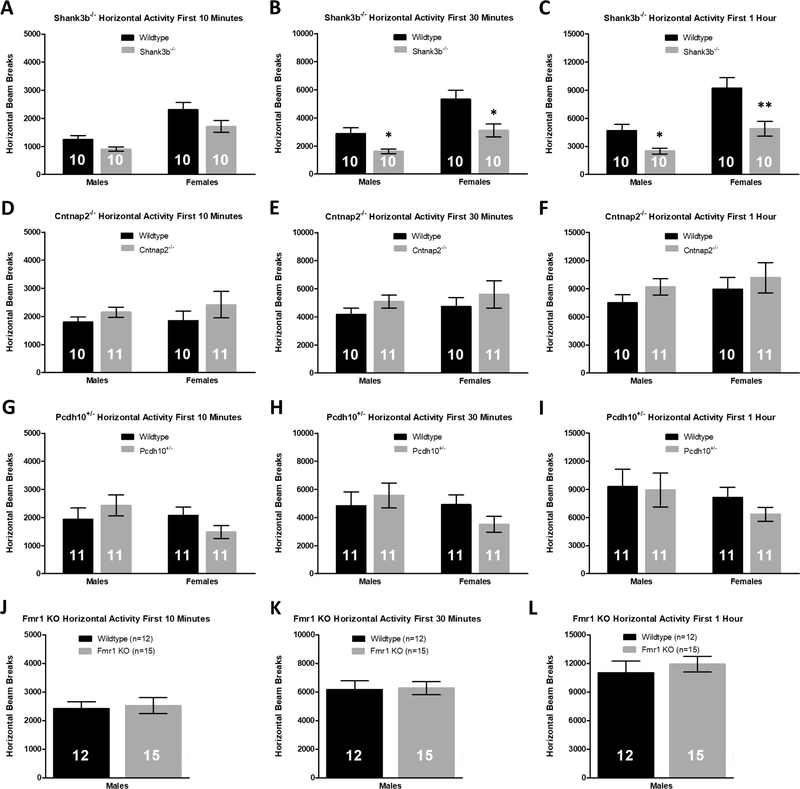
Genome-wide association and whole exome sequencing studies from Autism Spectrum Disorder (ASD) patient populations have implicated numerous risk factor genes whose mutation or deletion results in significantly increased incidence of ASD. Behavioral studies of monogenic mutant mouse models of ASD-associated genes have been useful for identifying aberrant neural circuitry. However, behavioral results often differ from lab to lab, and studies incorporating both males and females are often not performed despite the significant sex-bias of ASD. In this study, we sought to investigate the simple, passive behavior of home-cage activity monitoring across multiple 24-h days in four different monogenic mouse models of ASD: Shank3b, Cntnap2, Pcdh10, and Fmr1 knockout mice. Relative to sex-matched wildtype (WT) littermates, we discovered significant home-cage hypoactivity, particularly in the dark (active) phase of the light/dark cycle, in male mice of all four ASD-associated transgenic models. For Cntnap2 and Pcdh10 mice, these activity alterations were sex-specific, as female mice did not exhibit home-cage activity differences relative to sex-matched WT controls. These home-cage hypoactivity alterations differ from activity findings previously reported using short-term activity measurements in a novel open field. Despite circadian problems reported in human ASD patients, none of the mouse models studied had alterations in free-running circadian period. Together, these findings highlight a shared phenotype across several monogenic mouse models of ASD, outline the importance of methodology on behavioral interpretation, and in some genetic lines parallel the male-enhanced phenotypic presentation observed in human ASDs.
全基因组关联和全外显子组测序研究表明,自闭症谱系障碍 (ASD) 患者群体中的许多风险因素基因发生突变或缺失会导致 ASD 的发病率显著增加。对与 ASD 相关基因的单基因突变小鼠模型的行为研究有助于识别异常的神经回路。然而,行为研究结果往往因实验室而异,并且通常不进行同时包含雄性和雌性的研究,尽管 ASD 存在明显的性别偏倚。在这项研究中,我们试图研究四个不同的 ASD 单基因小鼠模型:Shank3b、Cntnap2、Pcdh10 和 Fmr1 敲除小鼠在多个 24 小时日常活动中的简单、被动行为,即通过家庭笼活动监测。与性别匹配的野生型(WT)同窝仔相比,我们发现所有四个与 ASD 相关的转基因模型的雄性小鼠在家庭笼中表现出明显的活动减少,尤其是在光/暗周期的暗(活动)期。对于 Cntnap2 和 Pcdh10 小鼠,这些活动改变是性别特异性的,因为雌性小鼠相对于性别匹配的 WT 对照没有表现出家庭笼活动差异。这些家庭笼活动减少的改变与之前使用新异开放场进行的短期活动测量报告的活动发现不同。尽管人类 ASD 患者报告存在昼夜节律问题,但所研究的小鼠模型中没有自发活动周期的改变。这些发现共同强调了几个单基因 ASD 小鼠模型的共同表型,强调了方法学对行为解释的重要性,并且在某些遗传系中与人类 ASD 中观察到的男性增强表型表现平行。