Department of Geosciences, University of Arizona, 1040 East Fourth Street, Tucson, AZ 85721, USA.
Department of Meteorology, Stockholm University, Stockholm, Sweden.
Sci Adv. 2017 Jan 18;3(1):e1601503. doi: 10.1126/sciadv.1601503. eCollection 2017 Jan.
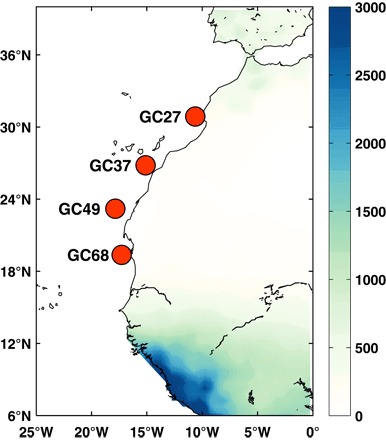
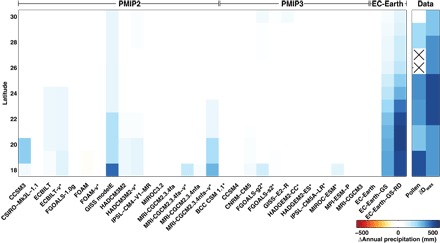
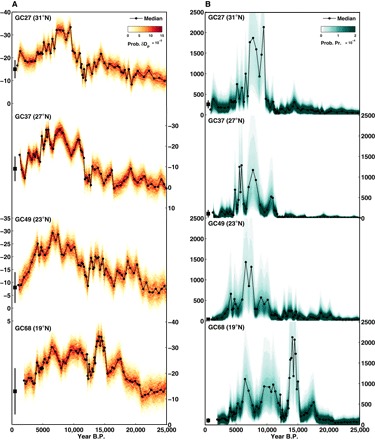
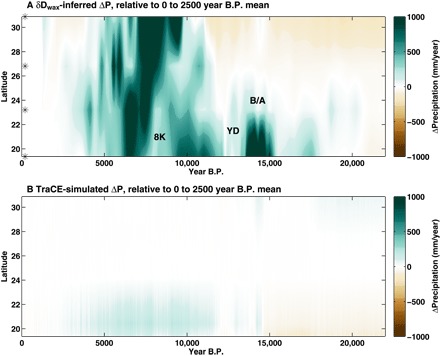
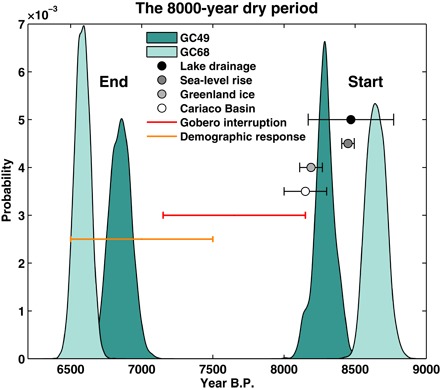
During the "Green Sahara" period (11,000 to 5000 years before the present), the Sahara desert received high amounts of rainfall, supporting diverse vegetation, permanent lakes, and human populations. Our knowledge of rainfall rates and the spatiotemporal extent of wet conditions has suffered from a lack of continuous sedimentary records. We present a quantitative reconstruction of western Saharan precipitation derived from leaf wax isotopes in marine sediments. Our data indicate that the Green Sahara extended to 31°N and likely ended abruptly. We find evidence for a prolonged "pause" in Green Sahara conditions 8000 years ago, coincident with a temporary abandonment of occupational sites by Neolithic humans. The rainfall rates inferred from our data are best explained by strong vegetation and dust feedbacks; without these mechanisms, climate models systematically fail to reproduce the Green Sahara. This study suggests that accurate simulations of future climate change in the Sahara and Sahel will require improvements in our ability to simulate vegetation and dust feedbacks.
在“绿撒哈拉”时期(距今 11000 年至 5000 年),撒哈拉沙漠降雨量很大,支持着多样的植被、永久性湖泊和人类居住。我们对降雨量和湿润条件的时空范围的了解因缺乏连续的沉积记录而受到限制。我们根据海洋沉积物中的叶蜡同位素定量重建了来自西部撒哈拉的降水。我们的数据表明,绿撒哈拉延伸到 31°N 并可能突然结束。我们发现,在 8000 年前,绿撒哈拉条件出现了一个长时间的“暂停”,与新石器时代人类暂时放弃作业地点的情况相吻合。我们的数据推断出的降雨量最好用强烈的植被和尘埃反馈来解释;如果没有这些机制,气候模型系统地无法再现绿撒哈拉。本研究表明,要准确模拟撒哈拉和萨赫勒未来的气候变化,就需要提高我们模拟植被和尘埃反馈的能力。