Abegaz Tadesse Melaku, Shehab Abdulla, Gebreyohannes Eyob Alemayehu, Bhagavathula Akshaya Srikanth, Elnour Asim Ahmed
Department of Clinical Pharmacy, College of Medicine and Health Sciences, School of Pharmacy, University of Gondar, Gondar, Ethiopia Department of Internal Medicine, College of Medicine and Health Sciences, UAE University Department of Clinical Pharmacy, Faculty of Pharmacy, Fathima College of Health Sciences, Al Ain, UAE.
Medicine (Baltimore). 2017 Jan;96(4):e5641. doi: 10.1097/MD.0000000000005641.
Hypertension drives the global burden of cardiovascular disease and its prevalence is estimated to increase by 30% by the year 2025. Nonadherence to chronic medication regimens is common; approximately 43% to 65.5% of patients who fail to adhere to prescribed regimens are hypertensive patients. Nonadherence to medications is a potential contributing factor to the occurrence of concomitant diseases.
This systematic review applied a meta-analytic procedure to investigate the medication nonadherence in adult hypertensive patients.
Original research studies, conducted on adult hypertensive patients, using the 8-item Morisky medication adherence scale (MMAS-8) to assess the medication adherence between January 2009 and March 2016 were included. Comprehensive search strategies of 3 databases and MeSH keywords were used to locate eligible literature. Study characteristics, participant demographics, and medication adherence outcomes were recorded. Effect sizes for outcomes were calculated as standardized mean differences using random-effect model to estimate overall mean effects.
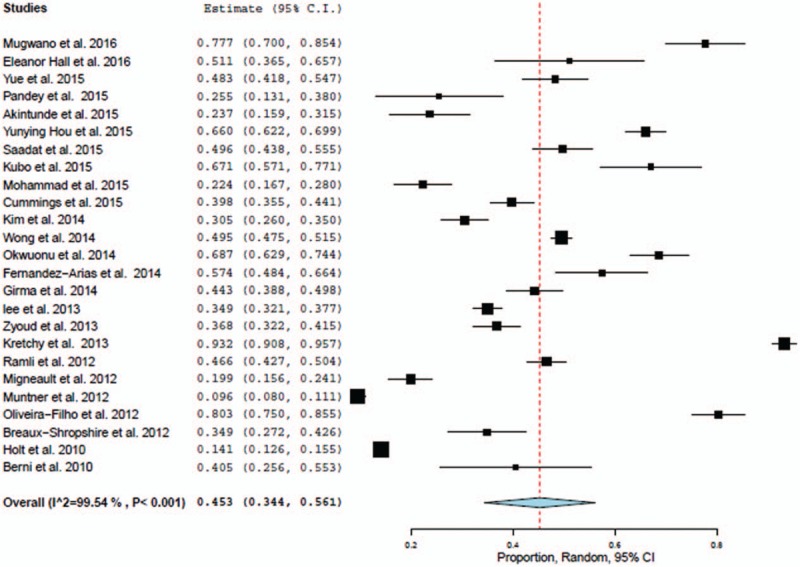
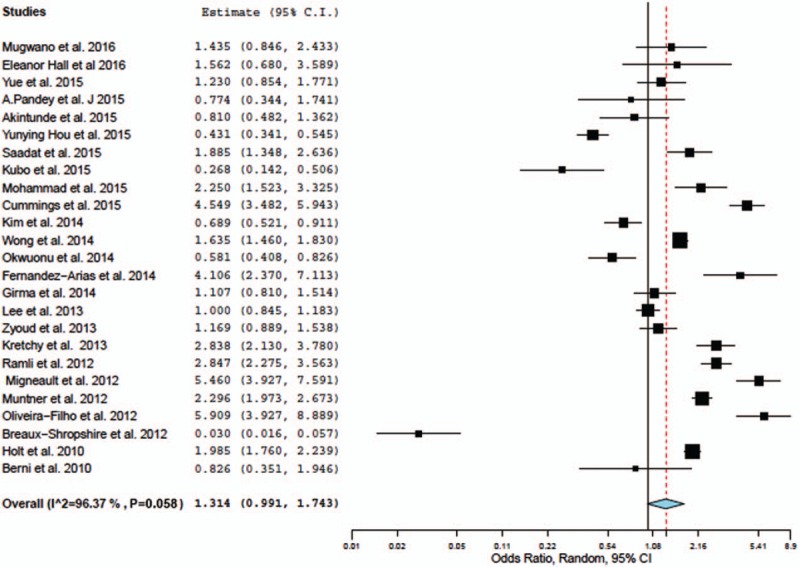
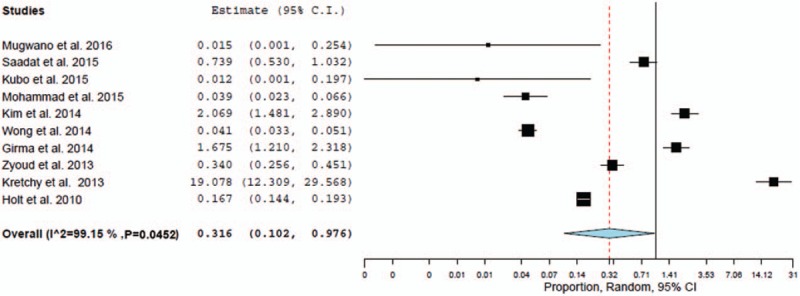
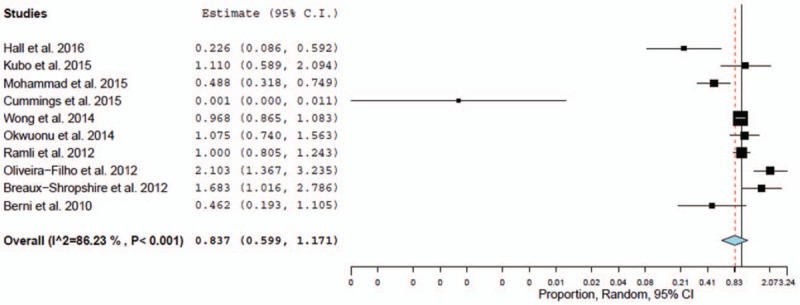
A total of 28 studies from 15 countries were identified, in total comprising of 13,688 hypertensive patients, were reviewed. Of 25 studies included in the meta-analysis involving 12,603 subjects, a significant number (45.2%) of the hypertensive patients and one-third (31.2%) of the hypertensive patients with comorbidities were nonadherent to medications. However, a higher proportion (83.7%) of medication nonadherence was noticed in uncontrolled blood pressure (BP) patients. Although a higher percentage (54%) of nonadherence to antihypertensive medications was noticed in females (P < 0.001), the risk of nonadherence was 1.3 times higher in males, with a relative risk of 0.883. Overall, nearly two-thirds (62.5%) of the medication nonadherence was noticed in Africans and Asians (43.5%).
Nonadherence to antihypertensive medications was noticed in 45% of the subjects studied and a higher proportion of uncontrolled BP (83.7%) was nonadherent to medication. Intervention models aiming to improve adherence should be emphasized.
高血压导致了全球心血管疾病负担,据估计到2025年其患病率将增加30%。不坚持慢性药物治疗方案的情况很常见;在未坚持规定治疗方案的患者中,约43%至65.5%为高血压患者。不坚持用药是并发疾病发生的一个潜在促成因素。
本系统评价采用荟萃分析程序,调查成年高血压患者的用药依从性。
纳入2009年1月至2016年3月期间对成年高血压患者进行的、使用8项Morisky药物依从性量表(MMAS-8)评估用药依从性的原始研究。采用3个数据库的综合检索策略和医学主题词(MeSH)关键词来查找符合条件的文献。记录研究特征、参与者人口统计学信息和用药依从性结果。使用随机效应模型将结果的效应量计算为标准化均数差,以估计总体平均效应。
共检索到来自15个国家的28项研究,总共包括13688名高血压患者,并进行了综述。在纳入荟萃分析的25项研究中,涉及12603名受试者,相当数量(45.2%)的高血压患者以及三分之一(31.2%)患有合并症的高血压患者不坚持用药。然而,血压未得到控制的患者中,用药不依从的比例更高(83.7%)。尽管女性中不坚持服用降压药的比例更高(54%)(P<0.001),但男性不依从的风险高出1.3倍,相对风险为0.883。总体而言,近三分之二(62.5%)的用药不依从情况出现在非洲人和亚洲人(43.5%)中。
在所研究的受试者中,45%的人不坚持服用降压药,血压未得到控制的患者中不坚持用药的比例更高(83.7%)。应强调旨在提高依从性的干预模式。