Liu Huiliang, Abudureheman Buhailiqiemu, Zhang Lingwei, Baskin Jerry M, Baskin Carol C, Zhang Daoyuan
Key Laboratory of Biogeography and Bioresource in Arid Land, Xinjiang Institute of Ecology and Geography, Chinese Academy of Sciences, Urümqi 830011, China.
Turpan Eremophytes Botanical Garden, Chinese Academy of Sciences, Turpan 838008,China.
AoB Plants. 2017 Jan 24;9(1). doi: 10.1093/aobpla/plx003.
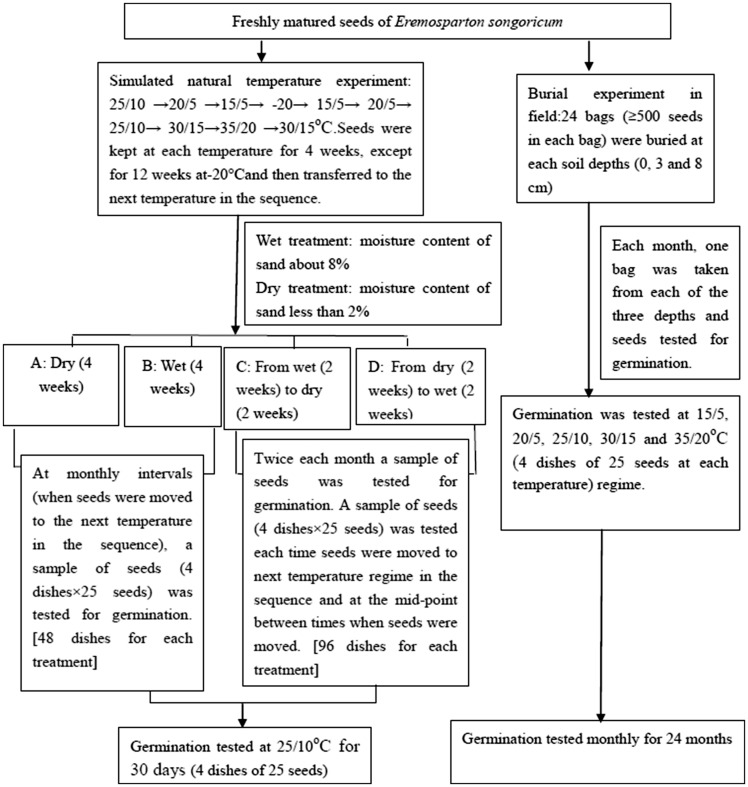
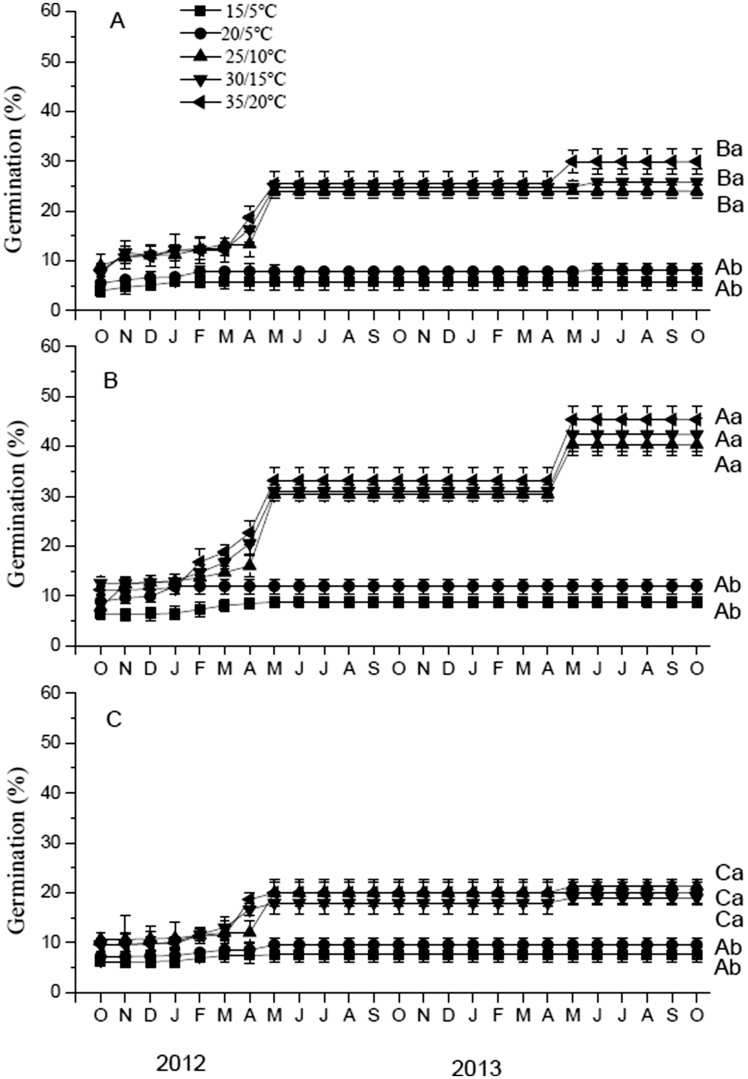
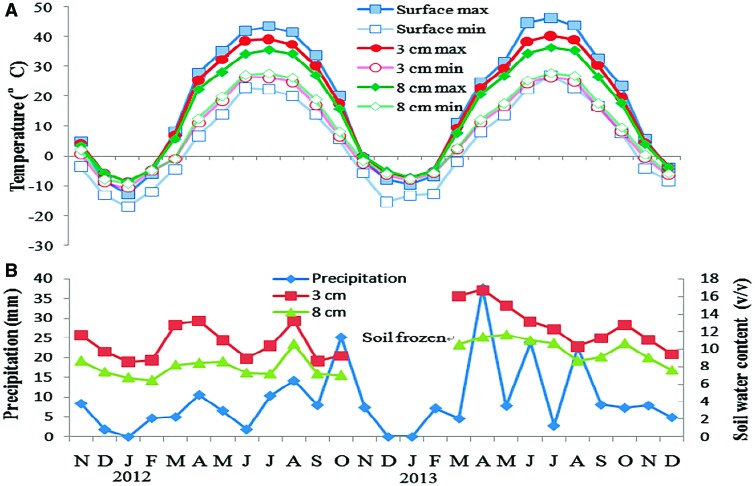
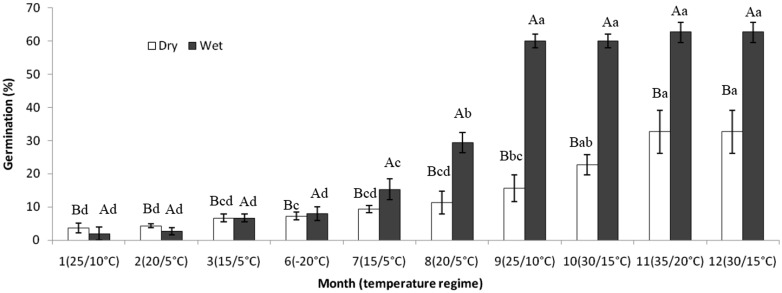
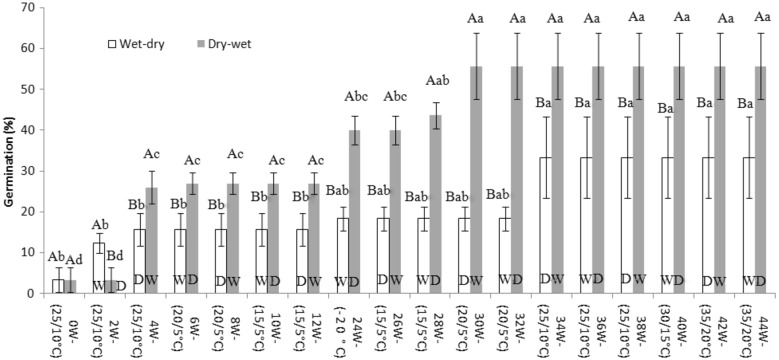
Seasonal periodicity of seed germination and its relationship to seasonal changes in temperature and soil moisture have been well studied in seeds of species with physiological dormancy. However, relatively little information is available on the role of these environmental factors in controlling germination of seeds with physical dormancy (PY). Our primary aim was to determine if seeds of the cold desert sand dune semi-shrub Eremosparton songoricum exhibits seasonal periodicity of seed germination and the relationship between seed dormancy break and soil temperature and moisture. In the laboratory, seeds incubated on dry, wet, wet-dry and dry-wet sand were exposed to a 1-year sequence of temperature regimes simulating those in the field. In the field, seeds were buried at different depths on a sand dune, and germination of periodically exhumed seeds was tested at five temperature regimes during a 2-year period. In the one-year sequence of simulated natural temperature regimes, breaking of PY was more effective under constantly wet than under constantly dry conditions, and germination percentage was significantly higher under dry-wet than under wet-dry conditions. Seeds buried in the field exhibited a distinct peak of germination in spring and little or no germination in other seasons. The final (two-year) monthly cumulative germination percentage differed among burial depths and temperature, and it was highest (47%) in seeds buried at 3 cm and tested at 25/10 °C. A seed cohort of E. songoricum likely exhibits a long-term annual periodicity of spring germination in the field, and dormancy break appears to be driven by low (winter) temperatures and relatively high sand moisture content. To our knowledge this is the first study to document seasonal periodicity in seed germination in a cold desert species with PY and to identify the mechanism (at the whole-seed level) of its occurrence.
对于具有生理休眠的物种种子,种子萌发的季节性周期及其与温度和土壤湿度季节性变化的关系已得到充分研究。然而,关于这些环境因素在控制具有物理休眠(PY)种子萌发中的作用,相关信息相对较少。我们的主要目的是确定冷沙漠沙丘半灌木准噶尔无叶豆的种子是否表现出种子萌发的季节性周期,以及种子休眠解除与土壤温度和湿度之间的关系。在实验室中,将种子置于干沙、湿沙、湿 - 干交替沙和干 - 湿交替沙上进行培养,并使其经历模拟田间情况的为期1年的温度序列。在田间,将种子埋于沙丘的不同深度,在两年期间,于五种温度条件下对定期挖出的种子进行萌发测试。在为期一年的模拟自然温度序列中,持续湿润条件下PY的解除比持续干燥条件下更有效,干 - 湿交替条件下的萌发率显著高于湿 - 干交替条件。田间掩埋的种子在春季呈现明显的萌发高峰,其他季节萌发很少或不萌发。最终(两年)的月度累积萌发率因掩埋深度和温度而异,在埋于3厘米深处并在25/10°C下测试的种子中最高(47%)。准噶尔无叶豆的种子群体在田间可能表现出长期的春季年度萌发周期,休眠解除似乎是由低温(冬季)和相对较高的沙湿度驱动的。据我们所知,这是第一项记录具有PY的冷沙漠物种种子萌发季节性周期并确定其发生机制(在全种子水平)的研究。