Wong Joseph K-H, Todd Matthew H, Rutledge Peter J
School of Chemistry, The University of Sydney, Sydney, New South Wales 2006, Australia.
Molecules. 2017 Jan 25;22(2):200. doi: 10.3390/molecules22020200.
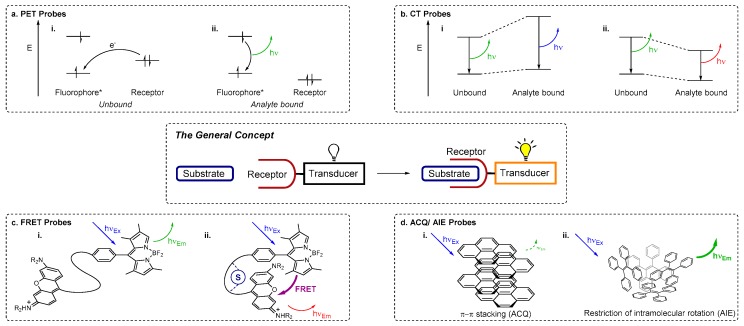
Small-molecule fluorescent probes play a myriad of important roles in chemical sensing. Many such systems incorporating a receptor component designed to recognise and bind a specific analyte, and a reporter or transducer component which signals the binding event with a change in fluorescence output have been developed. Fluorescent probes use a variety of mechanisms to transmit the binding event to the reporter unit, including photoinduced electron transfer (PET), charge transfer (CT), Förster resonance energy transfer (FRET), excimer formation, and aggregation induced emission (AIE) or aggregation caused quenching (ACQ). These systems respond to a wide array of potential analytes including protons, metal cations, anions, carbohydrates, and other biomolecules. This review surveys important new fluorescence-based probes for these and other analytes that have been reported over the past five years, focusing on the most widely exploited macrocyclic recognition components, those based on cyclam, calixarenes, cyclodextrins and crown ethers; other macrocyclic and non-macrocyclic receptors are also discussed.
小分子荧光探针在化学传感中发挥着众多重要作用。许多这样的系统都包含一个设计用于识别和结合特定分析物的受体组件,以及一个通过荧光输出变化来指示结合事件的报告器或换能器组件。荧光探针利用多种机制将结合事件传递给报告单元,包括光诱导电子转移(PET)、电荷转移(CT)、Förster共振能量转移(FRET)、激基缔合物形成以及聚集诱导发光(AIE)或聚集导致猝灭(ACQ)。这些系统可对多种潜在分析物做出响应,包括质子、金属阳离子、阴离子、碳水化合物和其他生物分子。本综述概述了过去五年中报道的针对这些及其他分析物的重要新型荧光探针,重点关注应用最广泛的大环识别组件,即基于环胺、杯芳烃、环糊精和冠醚的组件;同时也讨论了其他大环和非大环受体。