Heo Won Il, Park Kui Young, Jin Taewon, Lee Mi-Kyung, Kim MinJeong, Choi Eung Ho, Kim Hae-Suk, Bae Jung Min, Moon Nam Ju, Seo Seong Jun
Department of Dermatology, Chung-Ang University Hospital, Heukseok-Ro 102, Dongjak-Gu, Seoul, South Korea.
Department of Laboratory Medicine, Chung-Ang University Hospital, Seoul, South Korea.
BMC Med Genet. 2017 Jan 26;18(1):8. doi: 10.1186/s12881-017-0368-9.
The prevalence of atopic dermatitis has increased over the last 10 years. Atopic dermatitis tends to run in families and commonly begins to manifest in childhood. The prevalence of atopic dermatitis is as high as 20% in children. Thus, early diagnosis and treatment of atopic dermatitis are important. Understanding its genetic basis is also needed to facilitate early detection.
To identify family-specific candidate genetic variants associated with early-onset atopic dermatitis in Koreans, we carried out whole-exome sequencing of three separate families with this condition. Additional validation was performed in 112 AD patients and 61 controls using Sanger sequencing.
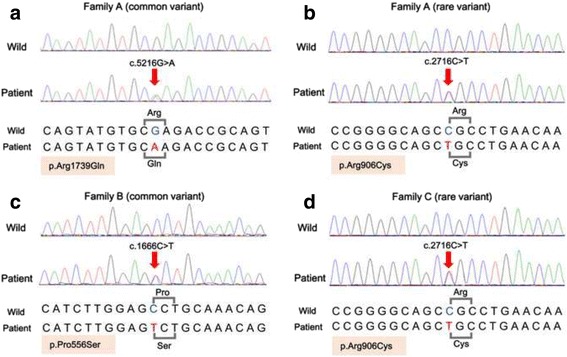
We focused on both common functional variants with a minor allele frequency higher than 1% and rare variants with a minor allele frequency less than 1%. The relevance of the respective variants was supported by a program that could predict whether the mutations resulted in damaged protein function. Fourteen overlapping genes were identified during exome sequencing. Three variants of the COL6A6 gene appeared in all three families and were in close proximity to atopic dermatitis-related loci on chromosome 3q21. The homozygous frequency for the rs16830494 minor allele (AA) and the rs59021909 (TT) allele and the rs200963433 heterozygous (CT) frequency were all higher in AD cases compared to controls in a population-based case-control study.
Identifying family-specific COL6A6 polymorphisms and genetic variants of other candidate genes associated with AD using WES is a novel approach. Our study suggests that COL6A6 variants may be risk factors for atopic dermatitis. This study provides a genetic basis for early-onset AD diagnosis in Korean patients and the development of new therapies.
Trial registration number: IRB NO. C2008030 (133); Name of registry: The collection research of clinical data and patient blood to identify genetic and protein biomarker of atopic dermatitis; Date of registration: 09-July-2008.
IRB NO. C2015258 (1716); Name of registry: The collection study of patient blood and clinical data for the development of the prognosis prediction and early diagnosis of atopic dermatitis; Date of registration: 15-jan-2016.
在过去10年中,特应性皮炎的患病率有所上升。特应性皮炎往往具有家族聚集性,通常在儿童期开始显现。儿童特应性皮炎的患病率高达20%。因此,特应性皮炎的早期诊断和治疗很重要。为便于早期检测,还需要了解其遗传基础。
为了鉴定与韩国人早发性特应性皮炎相关的家族特异性候选基因变异,我们对三个患有此病的不同家庭进行了全外显子组测序。使用桑格测序法在112例特应性皮炎患者和61名对照中进行了额外验证。
我们关注次要等位基因频率高于1%的常见功能性变异以及次要等位基因频率低于1%的罕见变异。一个能够预测突变是否导致蛋白质功能受损的程序支持了各个变异的相关性。在外显子组测序过程中鉴定出14个重叠基因。COL6A6基因的三个变异出现在所有三个家庭中,并且与3号染色体q21上的特应性皮炎相关基因座紧密相邻。在一项基于人群的病例对照研究中,与对照组相比,特应性皮炎病例中rs16830494次要等位基因(AA)、rs59021909(TT)等位基因的纯合频率以及rs200963433杂合(CT)频率均更高。
使用全外显子组测序鉴定与特应性皮炎相关的家族特异性COL6A6多态性和其他候选基因的遗传变异是一种新方法。我们的研究表明,COL6A6变异可能是特应性皮炎的危险因素。本研究为韩国患者早发性特应性皮炎的诊断及新疗法的开发提供了遗传基础。
试验注册号:IRB NO. C2008030 (133);注册名称:用于鉴定特应性皮炎遗传和蛋白质生物标志物的临床数据及患者血液收集研究;注册日期:2008年7月9日。
IRB NO. C2015258 (1716);注册名称:用于特应性皮炎预后预测和早期诊断的患者血液及临床数据收集研究;注册日期:2016年1月15日。