Gubili Chrysoula, Mariani Stefano, Weckworth Byron V, Galpern Paul, McDevitt Allan D, Hebblewhite Mark, Nickel Barry, Musiani Marco
School of Environment and Life Sciences University of Salford Salford UK; Faculties of Environmental Design and Veterinary Medicine University of Calgary Calgary AB Canada.
School of Environment and Life Sciences University of Salford Salford UK.
Evol Appl. 2016 Dec 20;10(2):199-211. doi: 10.1111/eva.12443. eCollection 2017 Feb.
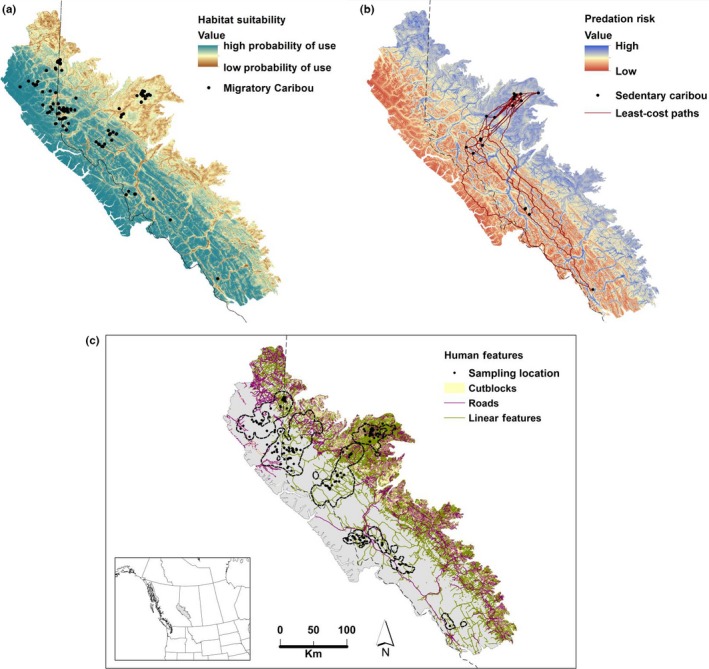
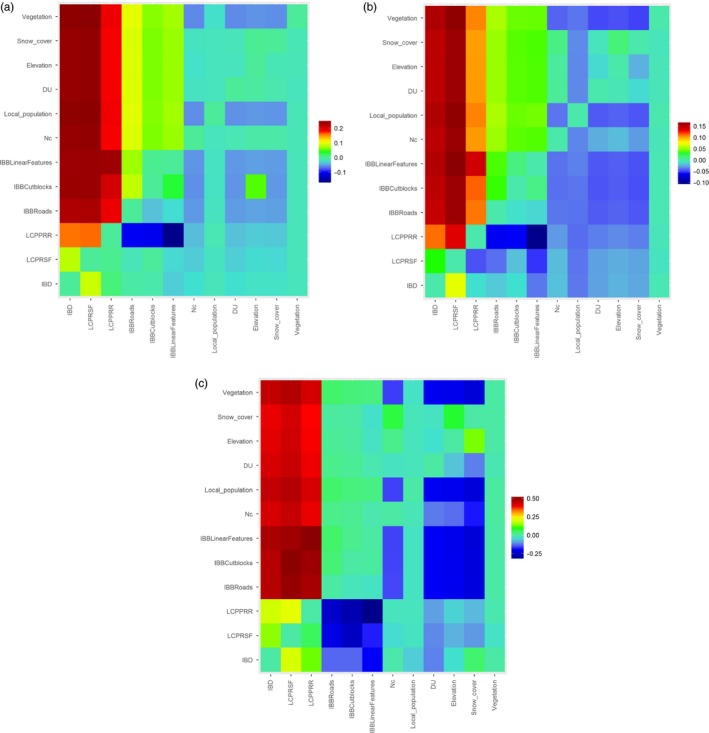
Ecosystem fragmentation and habitat loss have been the focus of landscape management due to restrictions on contemporary connectivity and dispersal of populations. Here, we used an individual approach to determine the drivers of genetic differentiation in caribou of the Canadian Rockies. We modelled the effects of isolation by distance, landscape resistance and predation risk and evaluated the consequences of individual migratory behaviour (seasonally migratory vs. sedentary) on gene flow in this threatened species. We applied distance-based and reciprocal causal modelling approaches, testing alternative hypotheses on the effects of geographic, topographic, environmental and local population-specific variables on genetic differentiation and relatedness among individuals. Overall, gene flow was restricted to neighbouring local populations, with spatial coordinates, local population size, groups and elevation explaining connectivity among individuals. Landscape resistance, geographic distances and predation risk were correlated with genetic distances, with correlations threefold higher for sedentary than for migratory caribou. As local caribou populations are increasingly isolated, our results indicate the need to address genetic connectivity, especially for populations with individuals displaying different migratory behaviours, whilst maintaining quality habitat both within and across the ranges of threatened populations.
由于当代种群连通性和扩散受到限制,生态系统破碎化和栖息地丧失一直是景观管理的重点。在此,我们采用个体方法来确定加拿大落基山脉驯鹿遗传分化的驱动因素。我们模拟了距离隔离、景观抗性和捕食风险的影响,并评估了个体迁徙行为(季节性迁徙与定居)对这种濒危物种基因流动的影响。我们应用基于距离和相互因果关系的建模方法,检验关于地理、地形、环境和当地种群特定变量对个体间遗传分化和亲缘关系影响的替代假设。总体而言,基因流动局限于相邻的当地种群,空间坐标、当地种群大小、群体和海拔解释了个体间的连通性。景观抗性、地理距离和捕食风险与遗传距离相关,定居驯鹿的相关性比迁徙驯鹿高三倍。随着当地驯鹿种群日益隔离,我们的结果表明需要解决遗传连通性问题,特别是对于具有不同迁徙行为个体的种群,同时在濒危种群的范围内外维持优质栖息地。