Tossici-Bolt Livia, Dickson John C, Sera Terez, Booij Jan, Asenbaun-Nan Susanne, Bagnara Maria C, Borght Thierry Vander, Jonsson Cathrine, de Nijs Robin, Hesse Swen, Koulibaly Pierre M, Akdemir Umit O, Koole Michel, Tatsch Klaus, Varrone Andrea
Department of Medical Physics, University Hospital Southampton NHS Foundation Trust, Southampton, UK.
Institute of Nuclear Medicine, University College London Hospital NHS Foundation Trust, London, UK.
EJNMMI Phys. 2017 Dec;4(1):8. doi: 10.1186/s40658-017-0175-6. Epub 2017 Jan 28.
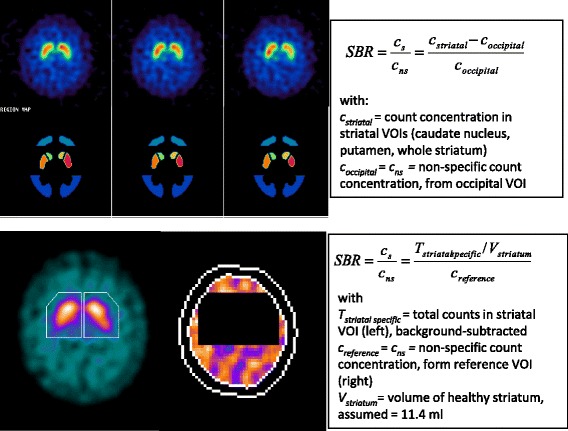
[I]FP-CIT is a well-established radiotracer for the diagnosis of dopaminergic degenerative disorders. The European Normal Control Database of DaTSCAN (ENC-DAT) of healthy controls has provided age and gender-specific reference values for the [I]FP-CIT specific binding ratio (SBR) under optimised protocols for image acquisition and processing. Simpler reconstruction methods, however, are in use in many hospitals, often without implementation of attenuation and scatter corrections. This study investigates the impact on the reference values of simpler approaches using two quantifications methods, BRASS and Southampton, and explores the performance of the striatal phantom calibration in their harmonisation.
BRASS and Southampton databases comprising 123 ENC-DAT subjects, from gamma cameras with parallel collimators, were reconstructed using filtered back projection (FBP) and iterative reconstruction OSEM without corrections (IRNC) and compared against the recommended OSEM with corrections for attenuation and scatter and septal penetration (ACSC), before and after applying phantom calibration. Differences between databases were quantified using the percentage difference of their SBR in the dopamine transporter-rich striatum, with their significance determined by the paired t test with Bonferroni correction. Attenuation and scatter losses, measured from the percentage difference between IRNC and ACSC databases, were of the order of 47% for both BRASS and Southampton quantifications. Phantom corrections were able to recover most of these losses, but the SBRs remained significantly lower than the "true" values (p < 0.001). Calibration provided, in fact, "first order" camera-dependent corrections, but could not include "second order" subject-dependent effects, such as septal penetration from extra-cranial activity. As for the ACSC databases, phantom calibration was instrumental in compensating for partial volume losses in BRASS (~67%, p < 0.001), while for the Southampton method, inherently free from them, it brought no significant changes and solely corrected for residual inter-camera variability (-0.2%, p = 0.44).
The ENC-DAT reference values are significantly dependent on the reconstruction and quantification methods and phantom calibration, while reducing the major part of their differences, is unable to fully harmonize them. Clinical use of any normal database, therefore, requires consistency with the processing methodology. Caution must be exercised when comparing data from different centres, recognising that the SBR may represent an "index" rather than a "true" value.
[I]FP - CIT是一种用于诊断多巴胺能退行性疾病的成熟放射性示踪剂。DaTSCAN的欧洲健康对照正常数据库(ENC - DAT)为图像采集和处理的优化方案下的[I]FP - CIT特异性结合率(SBR)提供了年龄和性别特异性参考值。然而,许多医院使用的是更简单的重建方法,通常未实施衰减和散射校正。本研究使用BRASS和南安普敦两种定量方法,研究更简单方法对参考值的影响,并探讨纹状体体模校准在其标准化中的性能。
包含123名ENC - DAT受试者的BRASS和南安普敦数据库,来自带有平行准直器的伽马相机,使用滤波反投影(FBP)和无校正的迭代重建OSEM(IRNC)进行重建,并与推荐的带有衰减、散射和间隔穿透校正的OSEM(ACSC)在应用体模校准前后进行比较。使用富含多巴胺转运体的纹状体中SBR的百分比差异对数据库之间的差异进行量化,其显著性通过配对t检验和Bonferroni校正确定。从IRNC和ACSC数据库之间的百分比差异测量的衰减和散射损失,对于BRASS和南安普敦定量均约为47%。体模校正能够恢复大部分这些损失,但SBR仍显著低于“真实”值(p < 0.001)。实际上,校准提供了“一阶”相机相关校正,但不能包括“二阶”受试者相关效应,如来自颅外活动的间隔穿透。至于ACSC数据库,体模校准有助于补偿BRASS中的部分容积损失(约67%,p < 0.001),而对于南安普敦方法,其本身不存在部分容积损失,它没有带来显著变化,仅校正了相机间的残余变异性(-0.2%,p = 0.44)。
ENC - DAT参考值显著依赖于重建和定量方法以及体模校准,虽然减少了它们差异的主要部分,但无法完全使其标准化。因此,任何正常数据库的临床应用都需要与处理方法保持一致。在比较不同中心的数据时必须谨慎,认识到SBR可能代表一个“指标”而非“真实”值。