Solmaz Volkan, Köse Özlece Hatice, Eroglu Hüseyin Avni, Aktuğ Hüseyin, Erbaş Oytun, Taşkıran Dilek
Department of Neurology, Trakya University Faculty of Medicine, Edirne, Turkey.
Department of Physiology, Kafkas University Faculty of Medicine, Kars, Turkey.
Neurol Res Int. 2017;2017:5952149. doi: 10.1155/2017/5952149. Epub 2017 Jan 4.
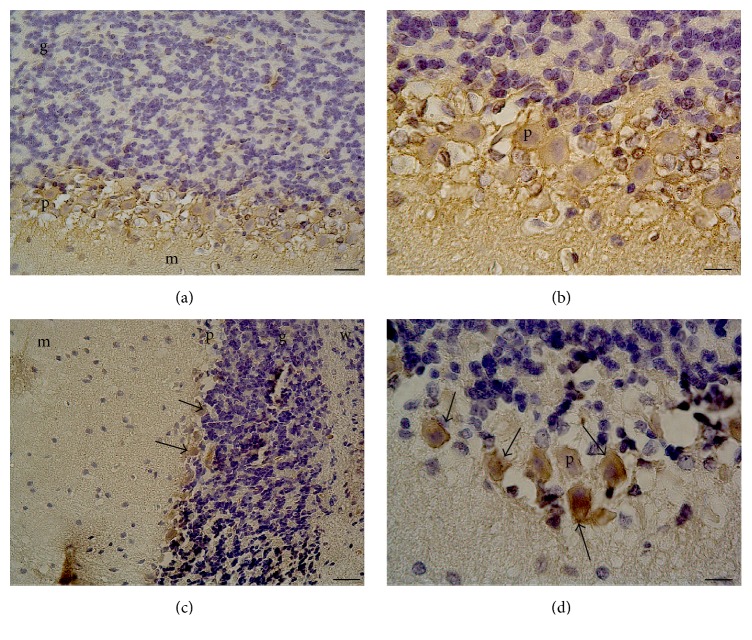
The present study was conducted to evaluate the relationship between plasma oxidative stress markers such as malondialdehyde (MDA) and glutathione (GSH), inflammatory marker pentraxin-3 (PTX3), and cerebellar accumulation of -synuclein in streptozotocin- (STZ-) induced diabetes model in rats. Twelve rats were included in the study. Diabetes ( = 6) was induced with a single intraperitoneal injection of streptozotocin (STZ, 60 mg/kg). Diabetes was verified after 48 h by measuring blood glucose levels. Six rats served as controls. Following 8 weeks, rats were sacrificed for biochemical and immunohistochemical evaluation. Plasma MDA levels were significantly higher in diabetic rats when compared with the control rats ( < 0.01), while plasma GSH levels were lower in the diabetic group than in the control group ( < 0.01). Also, plasma pentraxin-3 levels were statistically higher in diabetic rats than in the control rats ( < 0.01). The analysis of cerebellar -synuclein immunohistochemistry showed a significant increase in -synuclein immunoexpression in the diabetic group compared to the control group ( < 0.01). Due to increased inflammation and oxidative stress in the chronic period of hyperglycemia linked to diabetes, there may be -synuclein accumulation in the cerebellum and the plasma PTX3 levels may be assessed as an important biomarker of this situation.
本研究旨在评估链脲佐菌素(STZ)诱导的大鼠糖尿病模型中,血浆氧化应激标志物如丙二醛(MDA)和谷胱甘肽(GSH)、炎症标志物五聚体3(PTX3)与小脑α-突触核蛋白蓄积之间的关系。本研究纳入了12只大鼠。通过单次腹腔注射链脲佐菌素(STZ,60 mg/kg)诱导6只大鼠患糖尿病。48小时后通过测量血糖水平来验证糖尿病。6只大鼠作为对照。8周后,处死大鼠进行生化和免疫组织化学评估。与对照大鼠相比,糖尿病大鼠的血浆MDA水平显著更高(P<0.01),而糖尿病组的血浆GSH水平低于对照组(P<0.01)。此外,糖尿病大鼠的血浆五聚体3水平在统计学上高于对照大鼠(P<0.01)。小脑α-突触核蛋白免疫组织化学分析显示,与对照组相比,糖尿病组的α-突触核蛋白免疫表达显著增加(P<0.01)。由于与糖尿病相关的高血糖慢性期炎症和氧化应激增加,小脑可能存在α-突触核蛋白蓄积,血浆PTX3水平可被评估为这种情况的重要生物标志物。