Department of Hematology-Oncology, Kaohsiung Chang Gung Memorial Hospital and Chang Gung University College of Medicine, Kaohsiung, Taiwan.
Graduate Institute of Clinical Medical Sciences, Chang Gung University College of Medicine, Taiwan.
Sci Rep. 2017 Jan 30;7:41785. doi: 10.1038/srep41785.
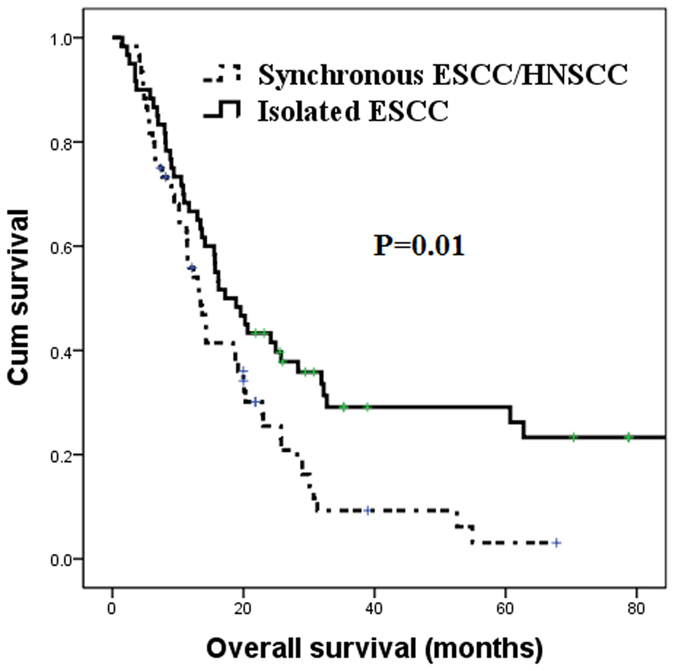
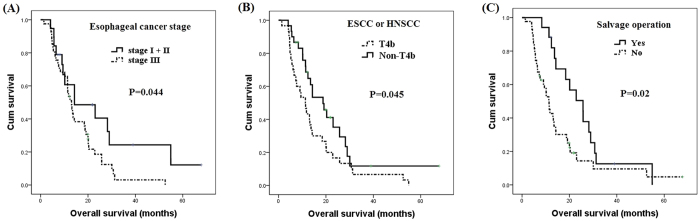
The present study investigated clinical outcomes and prognostic factors of patients with locally advanced synchronous esophageal squamous cell carcinoma (ESCC) and head/neck squamous cell carcinoma (HNSCC) receiving curative concurrent chemoradiotherapy (CCRT), and determined whether synchronous ESCC/HNSCC patients had worse prognosis compared to isolated ESCC patients. Using propensity score matching method, we compared 60 locally advanced synchronous ESCC/HNSCC patients with 60 matched isolated ESCC patients. Compared to 60 matched isolated ESCC patients, synchronous ESCC/HNSCC patients had significantly worse prognosis (13.5 months versus 17.2 months, P = 0.01), more grade 3-4 CCRT toxicity, and higher percentage of CCRT interruption. For synchronous ESCC/HNSCC group, the 1-year and 2-year survival rates were 52% and 13%, respectively. Univariate analysis showed that early ESCC stage, non-T4b disease, and salvage operations were significantly associated with superior survival. In multivariate analysis, ESCC stage represented an independent prognosticator. For chemotherapy regimen during CCRT, cisplatin/5-fluorouracil had significantly more grade 3-4 mucositis/esophagitis and neutropenia than weekly cisplatin. In conclusion, synchronous ESCC/HNSCC patients receiving curative CCRT have worse prognosis and poorer compliance of CCRT compared to isolated ESCC patients. For these patients, ESCC stage and T4b disease were significantly associated with clinical outcomes, and salvage operation may improve overall survival.
本研究调查了接受根治性同期放化疗(CCRT)的局部晚期食管鳞状细胞癌(ESCC)和头颈部鳞状细胞癌(HNSCC)患者的临床结局和预后因素,并确定同步 ESCC/HNSCC 患者的预后是否比孤立性 ESCC 患者更差。我们使用倾向评分匹配方法比较了 60 例局部晚期同步 ESCC/HNSCC 患者和 60 例匹配的孤立性 ESCC 患者。与 60 例匹配的孤立性 ESCC 患者相比,同步 ESCC/HNSCC 患者的预后明显较差(13.5 个月比 17.2 个月,P=0.01),CCRT 毒性更高,且 CCRT 中断率更高。同步 ESCC/HNSCC 组的 1 年和 2 年生存率分别为 52%和 13%。单因素分析显示,ESCC 早期分期、非 T4b 疾病和挽救性手术与生存改善显著相关。多因素分析显示,ESCC 分期是独立的预后因素。在 CCRT 期间,顺铂/5-氟尿嘧啶化疗方案的 3-4 级粘膜炎/食管炎和中性粒细胞减少症发生率明显高于每周顺铂方案。结论:接受根治性 CCRT 的同步 ESCC/HNSCC 患者的预后较孤立性 ESCC 患者差,且 CCRT 依从性较差。对于这些患者,ESCC 分期和 T4b 疾病与临床结局显著相关,挽救性手术可能提高总体生存率。