Kavurma Mary M, Rayner Katey J, Karunakaran Denuja
aHeart Research Institute, Sydney, New South Wales, Australia bCardiometabolic microRNA Laboratory, University of Ottawa Heart Institute, Ottawa, Ontario, Canada.
Curr Opin Lipidol. 2017 Apr;28(2):91-98. doi: 10.1097/MOL.0000000000000394.
To highlight recent studies that describe novel inflammatory and signaling mechanisms that regulate macrophage death in atherosclerosis.
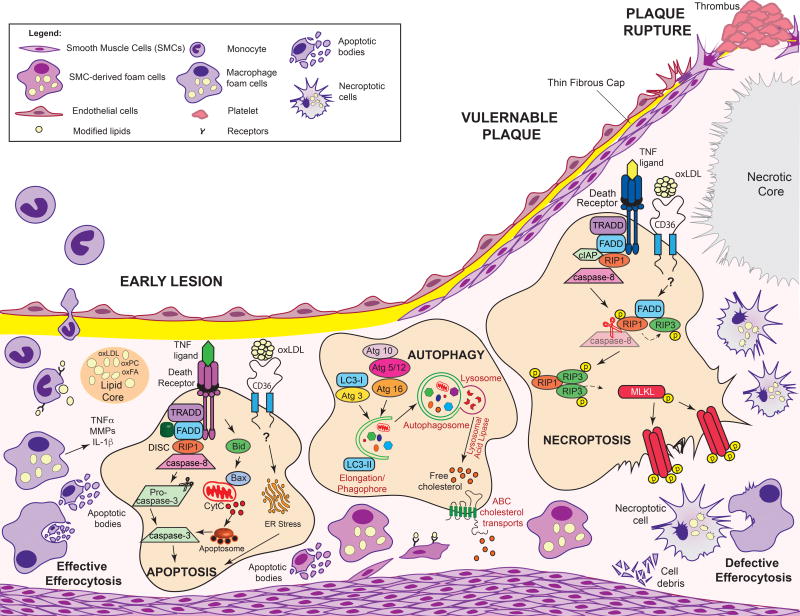
Macrophages contribute to all stages of atherosclerosis. The traditional dogma states that in homeostatic conditions, macrophages undergo apoptosis and are efficiently phagocytosed to be cleared by a process called efferocytosis. In advanced atherosclerosis, however, defective efferocytosis results in secondary necrosis of these uncleared apoptotic cells, which ultimately contributes to the formation of the characteristic necrotic core and the vulnerable plaque. Here, we outline the different types of lesional macrophage death: apoptosis, autophagic and the newly defined necroptosis (i.e. a type of programmed necrosis). Recent discoveries demonstrate that macrophage necroptosis directly contributes to necrotic core formation and plaque instability. Further, promoting the resolution of inflammation using preresolving mediators has been shown to enhance efferocytosis and decrease plaque vulnerability. Finally, the canonical 'don't eat me' signal CD47 has recently been described as playing an important role in atherosclerotic lesion progression by impairing efficient efferocytosis. Although we have made significant strides in improving our understanding of cell death and clearance mechanisms in atherosclerosis, there still remains unanswered questions as to how these pathways can be harnessed using therapeutics to promote lesion regression and disease stability.
Improving our understanding of the mechanisms that regulate macrophage death in atherosclerosis, in particular apoptosis, necroptosis and efferocytosis, will provide novel therapeutic opportunities to resolve atherosclerosis and promote plaque stability.
重点介绍近期描述调节动脉粥样硬化中巨噬细胞死亡的新型炎症和信号传导机制的研究。
巨噬细胞参与动脉粥样硬化的各个阶段。传统观点认为,在稳态条件下,巨噬细胞会发生凋亡,并通过一种称为胞葬作用的过程被有效吞噬清除。然而,在晚期动脉粥样硬化中,胞葬作用缺陷会导致这些未清除的凋亡细胞发生继发性坏死,最终导致特征性坏死核心的形成和易损斑块的出现。在此,我们概述了病变巨噬细胞死亡的不同类型:凋亡、自噬和新定义的坏死性凋亡(即一种程序性坏死)。最近的发现表明,巨噬细胞坏死性凋亡直接导致坏死核心形成和斑块不稳定。此外,使用促消退介质促进炎症消退已被证明可增强胞葬作用并降低斑块易损性。最后,经典的“别吃我”信号CD47最近被描述为通过损害有效的胞葬作用在动脉粥样硬化病变进展中发挥重要作用。尽管我们在增进对动脉粥样硬化中细胞死亡和清除机制的理解方面取得了重大进展,但关于如何利用这些途径通过治疗促进病变消退和疾病稳定性仍存在未解决的问题。
增进我们对调节动脉粥样硬化中巨噬细胞死亡机制的理解,特别是凋亡、坏死性凋亡和胞葬作用,将为解决动脉粥样硬化和促进斑块稳定性提供新的治疗机会。