Alwahsh Salamah M, Dwyer Benjamin J, Forbes Shareen, Thiel David H van, Lewis Philip J Starkey, Ramadori Giuliano
Clinic for Gastroenterology and Endocrinology, University Medical Center, Georg-August-University Goettingen, Goettingen D-37075, Germany.
MRC Centre for Regenerative Medicine, University of Edinburgh, Edinburgh EH16 4UU, UK.
Int J Mol Sci. 2017 Jan 28;18(2):285. doi: 10.3390/ijms18020285.
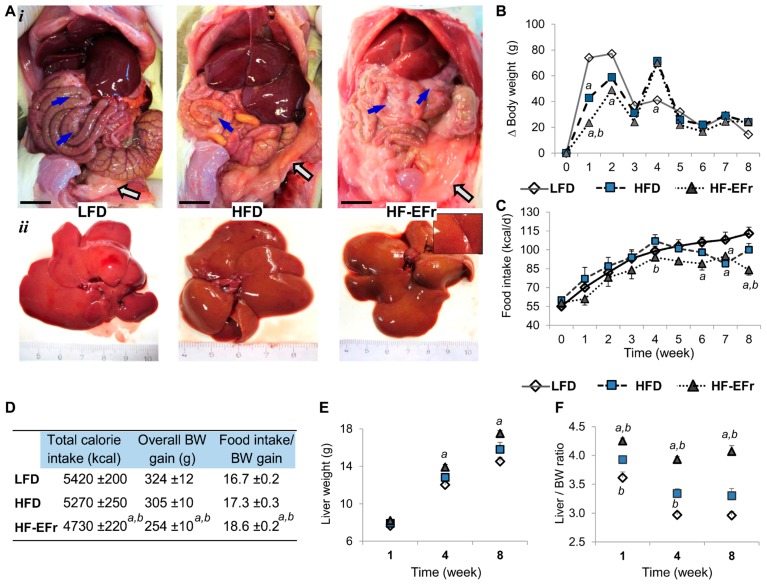
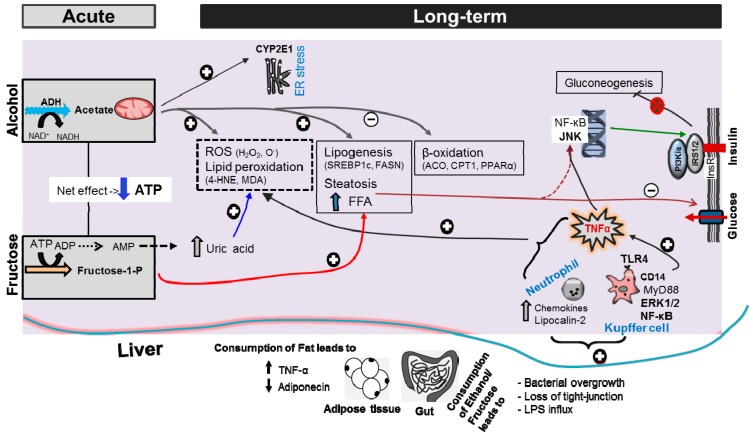
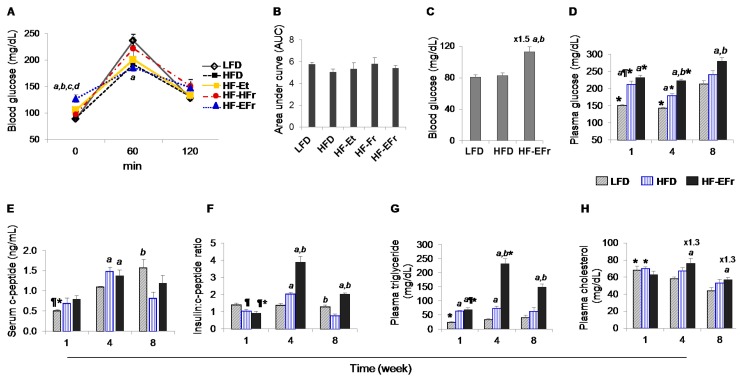
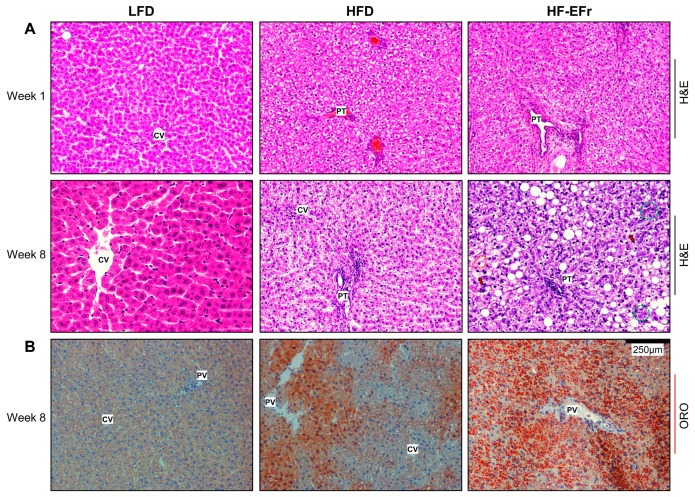
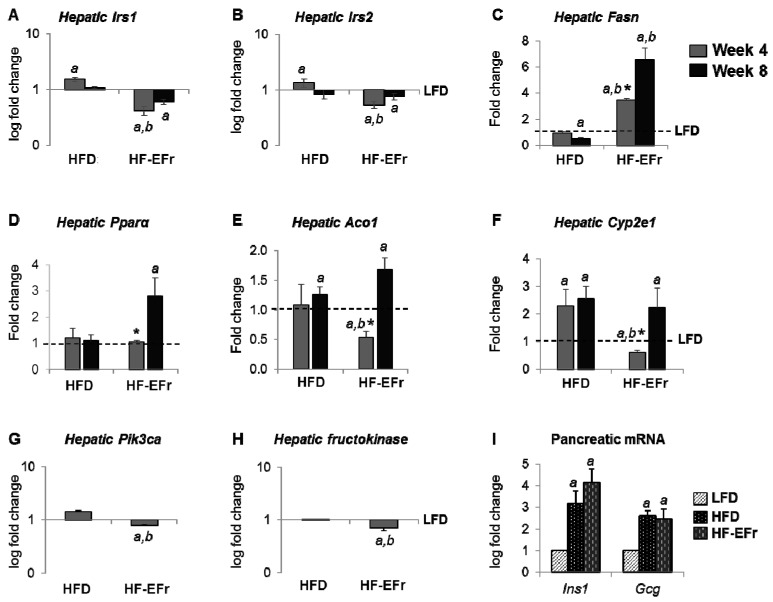
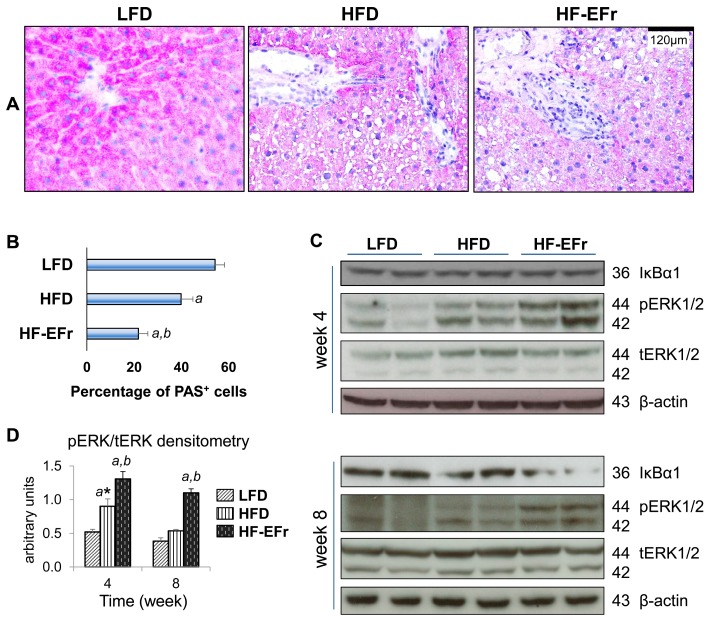
The role of the liver and the endocrine pancreas in development of hyperinsulinemia in different types of obesity remains unclear. Sedentary rats (160 g) were fed a low-fat-diet (LFD, chow 13% kcal fat), high-fat-diet (HFD, 35% fat), or HFD+ 30% ethanol+ 30% fructose (HF-EFr, 22% fat). Overnight-fasted rats were culled after one, four or eight weeks. Pancreatic and hepatic mRNAs were isolated for subsequent RT-PCR analysis. After eight weeks, body weights increased three-fold in the LFD group, 2.8-fold in the HFD group, and 2.4-fold in the HF-EFr ( < 0.01). HF-EFr-fed rats had the greatest liver weights and consumed less food during Weeks 4-8 ( < 0.05). Hepatic-triglyceride content increased progressively in all groups. At Week 8, HOMA-IR values, fasting serum glucose, C-peptide, and triglycerides levels were significantly increased in LFD-fed rats compared to that at earlier time points. The greatest plasma levels of glucose, triglycerides and leptin were observed in the HF-EFr at Week 8. Gene expression of pancreatic-insulin was significantly greater in the HFD and HF-EFr groups versus the LFD. Nevertheless, insulin: C-peptide ratios and HOMA-IR values were substantially higher in HF-EFr. Hepatic gene-expression of insulin-receptor-substrate was downregulated in the HF-EFr. The expression of phospho-ERK-1/2 and inflammatory-mediators were greatest in the HF-EFr-fed rats. Chronic intake of both LFD and HFD induced obesity, MetS, and intrahepatic-fat accumulation. The hyperinsulinemia is the strongest in rats with the lowest body weights, but having the highest liver weights. This accompanies the strongest increase of pancreatic insulin production and the maximal decrease of hepatic insulin signaling, which is possibly secondary to hepatic fat deposition, inflammation and other factors.
肝脏和内分泌胰腺在不同类型肥胖症中高胰岛素血症发展过程中的作用仍不明确。将久坐不动的大鼠(160克)分为三组,分别喂食低脂饮食(LFD,食物中脂肪含量为13%千卡)、高脂饮食(HFD,35%脂肪)或HFD + 30%乙醇 + 30%果糖(HF-EFr,22%脂肪)。过夜禁食的大鼠在1周、4周或8周后被处死。分离胰腺和肝脏的mRNA用于后续的RT-PCR分析。8周后,LFD组体重增加了两倍,HFD组增加了2.8倍,HF-EFr组增加了2.4倍(P<0.01)。喂食HF-EFr的大鼠肝脏重量最大,且在第4至8周期间食物摄入量减少(P<0.05)。所有组的肝脏甘油三酯含量均逐渐增加。在第8周时,与早期时间点相比,喂食LFD的大鼠的HOMA-IR值、空腹血清葡萄糖、C肽和甘油三酯水平显著升高。在第8周时,HF-EFr组的血糖、甘油三酯和瘦素血浆水平最高。与LFD组相比,HFD组和HF-EFr组胰腺胰岛素的基因表达显著更高。然而,HF-EFr组的胰岛素:C肽比值和HOMA-IR值显著更高。HF-EFr组肝脏胰岛素受体底物的基因表达下调。喂食HF-EFr的大鼠中磷酸化ERK-1/2和炎症介质的表达最高。长期摄入LFD和HFD均会导致肥胖、代谢综合征和肝内脂肪堆积。高胰岛素血症在体重最低但肝脏重量最高的大鼠中最为严重。这伴随着胰腺胰岛素分泌的最强增加和肝脏胰岛素信号传导的最大降低,这可能继发于肝脏脂肪沉积、炎症和其他因素。